In Vedic and later Indic literature Svāhā is presented both as the ritual formula pronounced with each ladle of an oblation and as a personified goddess connected to Agni. Upanishadic summaries and the Brahmavaivarta Purāṇa characterize her as an aspect of Prakṛti or the śakti that Agni cannot burn; Purāṇic and epic variants (summarized across traditions) make her a consort of Agni and attribute differing parentages (e.g., daughter of Daksha or of Bṛhaspati in various accounts). Some Purāṇic narratives link her to the origin of certain divine offspring (for example, accounts associating her with the miraculous birth of Skanda/Kārtikeya via sacrificial processes), while other texts emphasize her identity as the embodied power of mantra and oblation rather than a single fixed genealogical origin.
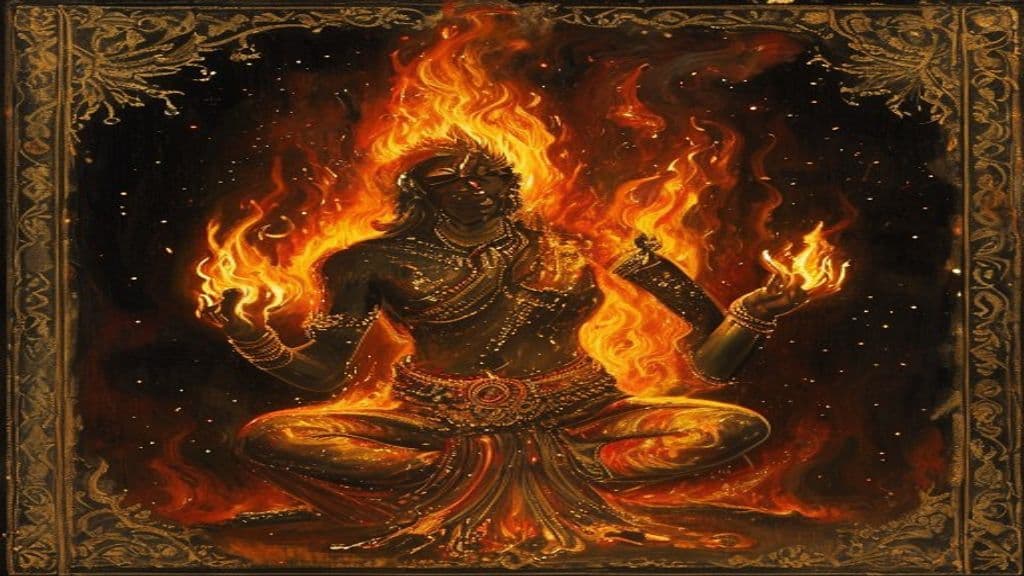
Sources do not provide a consistent anthropomorphic iconography but offer symbolic descriptions. Purāṇic and Upanishadic summaries describe Svāhā cosmologically: her body is said to consist of the four Vedas and her six limbs are considered to be the six aṅgas of the Vedas, language that presents her as a ritual-cosmological principle rather than a detailed physical portrait. Narrative episodes (e.g., Mahābhārata-related accounts summarized in the sources) depict her assuming the forms of others (such as the wives of the Saptarṣi) to approach Agni, indicating a capacity for assuming other appearances in mythic contexts.
As a ritual formula Svāhā functions as the consummatory utterance during offerings into the sacred fire — "with each ladle of the offering, the priest would say svāhā" — and is commonly appended to mantras and dhāraṇīs to confer efficacy. As a personified goddess she is described in Upanishadic and Purāṇic passages as the śakti or power that cannot be consumed by Agni and as a bestower of ritual success: the Devi Bhagavata Purāṇa meditation passage explicitly describes Svāhā as ‘‘embodied of the Mantras’’ and states that when worshipped with the given mūla-mantra she gives success and the fruits of actions to men. In Mahāyāna Buddhism the phonetic formula svāhā appears at the ends of dhāraṇīs (e.g., in the Lotus Sūtra and the Golden Light Sūtra) where it serves as an invocatory/mantric closing rather than as a distinct personal deity.
Community Record
- [1]Svaha - Wikipedia. Wikipedia entry 'Svaha' (accessed as provided in research notes).wiki
- [2]Wikidata: Svaha. Wikidata item Q2614321 for Svaha (referenced in research notes).other
- [3]Vākyasudhāṭīkā (archive). Archive item 'Vākyasudhāṭīkā' referenced in research notes.other
- [4]Kuru Kuru Svaha Manoshar Shyam Joshi (archive). Archive item 'Kuru Kuru Svaha Manoshar Shyam Joshi' referenced in research notes.other
- [5]AYR220 Ayurvedic Consultation 003 (archive). Archive item referenced in research notes.other