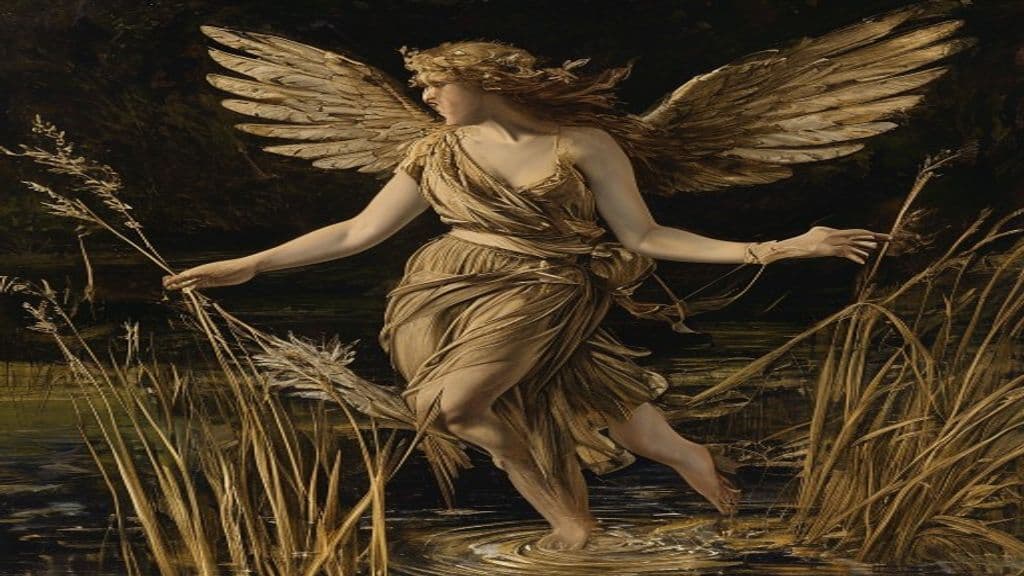
In classical Greek myth Syrinx (Ancient Greek: Σῦριγξ, Súrinx, literally 'pipe') is an Arcadian wood-nymph and follower of Artemis who had vowed chastity. While fleeing the advances of Pan (and by general cultural context other satyrs), Syrinx fled to the banks of the river Ladon. In Ovid's account she appealed to river-nymphs and was transformed into hollow reeds to escape violation; Pan later cut those reeds to fashion the first set of panpipes, which were thereafter called a syrinx. A variant reported in later literature (Longus) has Syrinx vanish among reeds in a marsh without an explicit intervening agent; Pan still makes pipes from the reeds.
Classical sources characterise Syrinx simply as a beautiful Arcadian wood-nymph and a follower of Artemis; specific physical detail beyond 'beautiful' and her being a female nymph is not recorded in the supplied texts. Later visual art (Victorian paintings, 19th–20th century sculpture, and a cited image of Pan with a syrinx beside him) depicts her according to later artistic conventions as a classical female figure and depicts the syrinx instrument (sets of reeds/pipes) associated with her.
Syrinx's recorded actions in the myths are flight from sexual pursuit and (in some versions) the ability to obtain transformation as refuge: in Ovid she appeals to river-nymphs and is changed into reeds; in another variant she disappears among marsh-reeds. She does not display offensive or expansive supernatural powers in the supplied sources; her primary supernatural dimension is metamorphosis (whether granted by allied nymphs or effected by the environment). After transformation the hollow reeds produce a haunting sound when Pan blew across them, and Pan fashioned them into the first panpipes.
Weaknesses
- otherno hostile agency — none attested
Wards
- othernone attested in sources
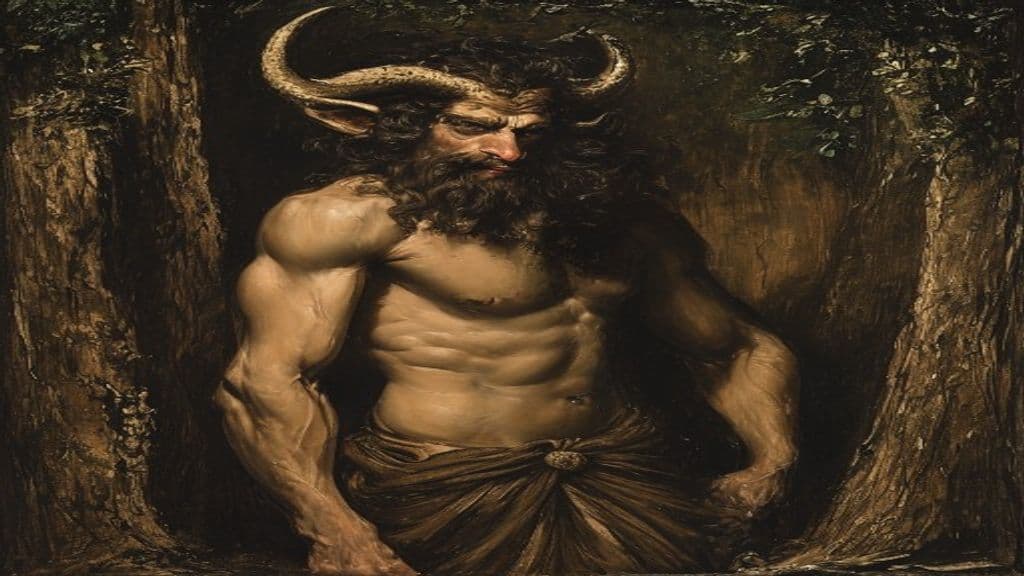
Satyr
In ancient Greek tradition a satyr (σάτυρος, sátyros) is a male nature spirit of woodlands, mountains, and pastures who accompanies Dionysus (and is later identified with Pan/fauns). Satyrs embody ribaldry, music, dance, and unrestrained sexuality and appear collectively (as a chorus) in the satyr play as well as individually in mythic episodes (e.g., Marsyas, Silenus).

Artemis
Artemis is an ancient Greek goddess of hunting, the wilderness and wild animals, transitions (especially childbirth and puberty), vegetation, and chastity. Twin sister of Apollo and daughter of Zeus and Leto, she functions as a protector of young children and maidens while also capable of inflicting disease or punishment for transgressions against her sacred laws.
Agreus
Agreus (also spelled Argeus) is attested in modern compilations as one of the Pans — a class of rustic, pan-like rural deities in classical Greek mythology. In modern database records he is additionally listed as a son of Apollo; beyond classificatory notes, surviving citations provide no detailed cultic or narrative material for him.
Alkyonides
In classical Greek mythology the Alkyonides (Alcyonides) are the seven daughters of the giant Alcyoneus. Classical summaries record that, in grief at their father's death, the daughters threw themselves into the sea; the mythic name survives in modern Greek toponymy as the Alkyonides Gulf.
Alseid
An Alseid (Ancient Greek: Ἀλσηΐδες, Alsēïdes) is a class of nymph in classical Greek mythology specifically associated with groves and glens. The term functions as a locality-category within the broader Greek taxonomy of nymphs; later modern sources reuse the label for varied fantasy and game creations.
Amphinome
Amphinome is an ancient Greek proper name attested for multiple distinct female figures in myth — chiefly a Nereid (sea-nymph) and several mortal women (including a wife of Aeson and one of the Peliades). The name is also reused in modern taxonomic and creative contexts (annelid genus, butterfly species, and contemporary fantasy), but these are later reuses rather than continuations of a single mythic being.
Androgeos
Androgeos (Greek Ἀνδρόγεως, Latin Androgeus) is a personal name borne by mortal figures in classical Greek and Roman literary tradition, most notably a son of Minos and Pasiphaë whose death in mythic narratives precipitates Athenian tribute to Crete. A separate, less-detailed bearer of the name is listed as a Greek soldier present at the sack of Troy in some sources.
Arge
Arge (Ancient Greek: Ἄργη, Árgē) is a name applied to several distinct female personages in Greek mythic traditions — a boastful huntress transformed by a god, one of the Hyperborean maidens honored at Delos, and a Cretan nymph attested in a rare variant of Dionysus’ birth. The name functions as an individuated personal name across local narratives rather than as a coherent supernatural taxon.
Butes
Boutes (Ancient Greek: Βούτης, Boútēs, literally 'herdsman') is a personal name applied to several distinct figures in Greek mythology — mortal princes, Argonauts, warriors, and local cult-heroes — rather than a single supernatural species. Bearers of the name appear across multiple heroic cycles and locales, notably an Athenian priest-hero, an Argonaut rescued by Aphrodite, and a Thracian punished by Dionysus.
Cilix
Cilix is a figure from Greek myth presented as a Phoenician prince and eponymous founder whose settlement in Asia Minor explains the place-name Cilicia. In modern usage the name is also applied to a genus of insects and to an impact structure on Jupiter's moon Europa, but those are scientific reuses of the name.
Cleite (Clite / Κλείτη)
Cleite (Ancient Greek: Κλείτη) is a personal name borne by several mortal women in Greek myth rather than a single supernatural class. Figures called Cleite appear in different epic cycles—Argonautica, the Danaid traditions, the Trojan cycle, and Nonnus' Dionysiaca—typically as wives, mourners, maenads, or mothers whose narrative fates include grief, filial ties, and in one tradition metamorphosis into a spring.
Eileithyia
Eileithyia is a Greek divine figure principally associated with childbirth and midwifery. Invoked to ease labour pains and ensure successful delivery, she appears in classical poetry, mythic episodes, and in long-lived local cults (notably cave-sanctuaries in Crete and sanctuaries in Aigion and other locales).
Lacedaemon
Lacedaemon (Lakedaimon, Lacaedemon) is a mythic eponymous king in classical Greek tradition: the legendary founder whose name is given to the region and polis of Lacedaemon/Sparta. He is presented genealogically as a son of Zeus and the Pleiad Taygete and as husband of Sparta, serving an etiological function linking the city to divine ancestry.
Manto (daughter of Teiresias)
Manto is a named figure in classical mythological lists identified in the supplied sources as a daughter of the seer Teiresias. The provided materials record her genealogical identity but do not supply narratives, descriptions, or ritual material concerning her.
Community Record
- [1]Syrinx (Wikipedia). Wikipedia, 'Syrinx' entry (summary of classical sources and later uses)wiki
- [2]Wikidata: Syrinx. Wikidata entry for 'Syrinx' (lexical and identifier information)other
- [3]Archive image: Pan consoles Psyche (syrinx depicted). Archive image caption noting 'A syrinx lies next to Pan' (visual depiction referenced in notes)other