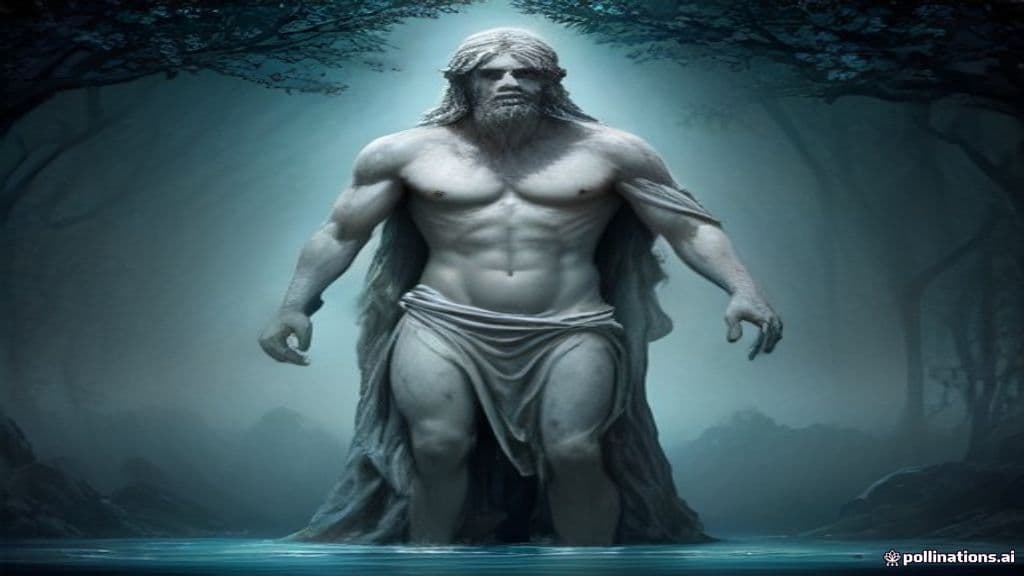
Tantalus is presented in Greek sources as a mortal king whose crimes against the divine order—variants include revealing divine secrets, stealing ambrosia/nectar, and serving his son as a meal to the gods—led to an arranged, eternal punishment in the underworld. Different traditions emphasize different offending acts; literary reports place his fate in Hades/Tartarus and link him genealogically to children such as Pelops, Niobe, and Broteas, making him ancestor of the cursed House of Atreus.
In Homer (Odyssey) and later poetic summaries Tantalus in the underworld is depicted standing in a pool of water up to his chin beneath a low‑branched fruit tree; when he tries to drink the water recedes and when he reaches for fruit the branches withdraw. Earlier Greek lyric fragments and some authors instead emphasize an alternative motif: a large rock suspended perpetually above his head threatening to fall. Ancient visual accounts and Pausanias report both motifs in paintings and local representations, indicating variant iconic traditions rather than a single fixed depiction.
No supernatural powers are attributed to Tantalus in the supplied sources; he is portrayed as a punished mortal and an exemplum of divine retribution rather than an active agent. His role in literature is pedagogical and proverbial—Odysseus sees him in the Nekyia as a sighted example—and he is not described as attacking or roaming among the living in the cited materials.
Abderus
Abderus (Ancient Greek: Ἄβδηρος, romanized Ábdēros) is a mortal heroic figure in Greek myth closely associated with Heracles, remembered as the youth left in charge of the Mares of Diomedes who was killed by them. He functions as an eponymous local/divine-hero ancestor for the city of Abdera and received funerary commemoration and athletic agones at his tomb.
Acamas
Acamas (Ancient Greek: Ἀκάμας) is a personal name recurrent in ancient Greek narrative traditions applied to multiple human characters (warriors, princes, suitors), once to a Cyclops, and once as a hound's name. Rather than a single supernatural entity, bearers of the name appear episodically across the Trojan War, Theseid, and Theban cycles as mortal actors whose deeds intersect with gods and fate.
Acarnan
Acarnan (Ancient Greek: Ἀκαρνάν) is an anthroponym attested in Greek mythic and epic tradition as the name of at least two distinct mortal figures: a son of Alcmaeon and Callirrhoe, and a human suitor of Penelope from Dulichium. The lexical form also appears adjectivally/ethnically (Acarnanian), linking the word to the region Acarnania; etymologically the name is reported as derived from a Greek fish-name (akarnan).
Acastus
Acastus is a mortal heroic figure of ancient Greek tradition: son of Pelias who became king of Iolcus, an Argonaut who sailed with Jason, and an actor in the post-Argonautic cycle involving Medea, Peleus, and the aftermath of Pelias’s death. He is attested as performing civic and ritual actions (burying Pelias, instituting funeral games, purifying Peleus) and as a participant in vendetta episodes that end in violent reprisals.
Acmon
Acmon (Ancient Greek: Ἄκμων, 'anvil') is a polyvalent personal name in Greek myth borne by several distinct minor figures — a Dactyl (artisan), a Phrygian eponymous king, a mischievous woodland creature, companions in epic cycles (one companion of Diomedes transformed into a bird; an Aenead), and in some brief traditions an alleged father of Uranus. The name therefore functions across artisanal, topographical, trickster, and metamorphosis motifs rather than denoting a single unified supernatural species.
Acrisius
Acrisius (Ancient Greek: Ἀκρίσιος, Akrisios) is a mythic-historical king of Argos in Greek tradition whose narrative is defined by an oracular prophecy foretelling his death by his daughter's son. He is portrayed as a mortal ruler entangled with dynastic rivalry, oracular authority, and the eventual accidental fulfillment of fate.
Aeacidae
The Aeacidae are a dynastic lineage in Greek myth and historiography descended from the hero Aeacus, son of Zeus and the nymph Aegina. The name functions as a patronymic designation for those 'of Aeacus' and is used to claim genealogical legitimacy and political prestige in regions such as Aegina and Molossian Epirus.
Aegipan
Aegipan (Αἰγίπαν / Αἰγίπανος) is an ancient Greek mythological figure associated with goat attributes and with the sea‑goat imagery of the constellation Capricornus. He appears in classical myth as a semi‑divine helper (notably in the Typhon episode) and, in later natural‑history and medieval bestiary reception, the name is applied to satyr‑like or ape‑like wild men in distant lands.
Aegisthus
Aegisthus (Greek Αἴγισθος, Aigisthos) is a mortal member of the House of Atreus in Greek myth who, born of incestuous circumstances and raised by shepherds and a goat, participates in dynastic murder and usurpation — notably the slaying of Atreus in some accounts and the conspiracy (with Clytemnestra) that results in Agamemnon's death — and is later killed by Orestes, an episode that figures in narratives about inherited guilt, vengeance, and the transition from private retribution to public justice.
Aepytus
Aepytus (Ancient Greek: Αἴπυτος, Aíputos/Aípytos, lit. 'steep, high, lofty') is a personal name in Greek myth borne by several legendary kings tied to Arcadian and Heraclid genealogies. The figures named Aepytus function as ancestral/dynastic nodes in literary genealogies and later literary receptions rather than as supernatural beings.
Aeson
Aeson (Ancient Greek: Αἴσων) is a legendary mortal king of Iolcus in Thessaly in Greek myth, best known as the father of the hero Jason. His fate—imprisonment by his half-brother Pelias and either suicide or a miraculous restoration performed by Medea—provides the dynastic and moral background for the Argonautic cycle.
Aethalides
Aethalides is a personal name borne by two distinct figures in ancient Greek myth: one listed among the Argonauts as a son of Hermes and Eupolemeia, and another named among the Tyrrhenian sailors who attempted to deceive Dionysus and was transformed into a dolphin. The sources treat Aethalides as named human mythic personages appearing in separate narrative contexts rather than as a class of supernatural being.
Community Record
- [1]Tantalus — Wikipedia. Wikipedia: Tantaluswiki
- [2]Wikidata entry for Tantalus. Wikidata: Tantalusother
- [3]LP0061 Thebes Mythical History (archive). Archive holdings referencing classical myth materialother
- [4]Hong Kong Daily Press 1930-03-27 (archive). Archive: historical uses of the Tantalus proverbother
- [5]CIA Reading Room document referencing Tantalus usage. Archive: modern references to the Tantalus tropeother
- [6]To‑Hawaii.com — Tantalus, Oahu. Place‑name uses derived from the mythother
- [7]To‑Hawaii.com — Round Top Drive, Oahu (Tantalus). Toponymic use of the nameother
- [8]Fanlore — Tantalus. Modern cultural adaptations and name usagesother
- [9]Marvunapp — Tantalus (fictional usages). Modern fiction drawing on the nameother
- [10]KeenWiki — Tantalus ray. Contemporary media use of the nameother
- [11]Black Library — Tantalus (eBook). Modern fiction titled after the mythic nameother