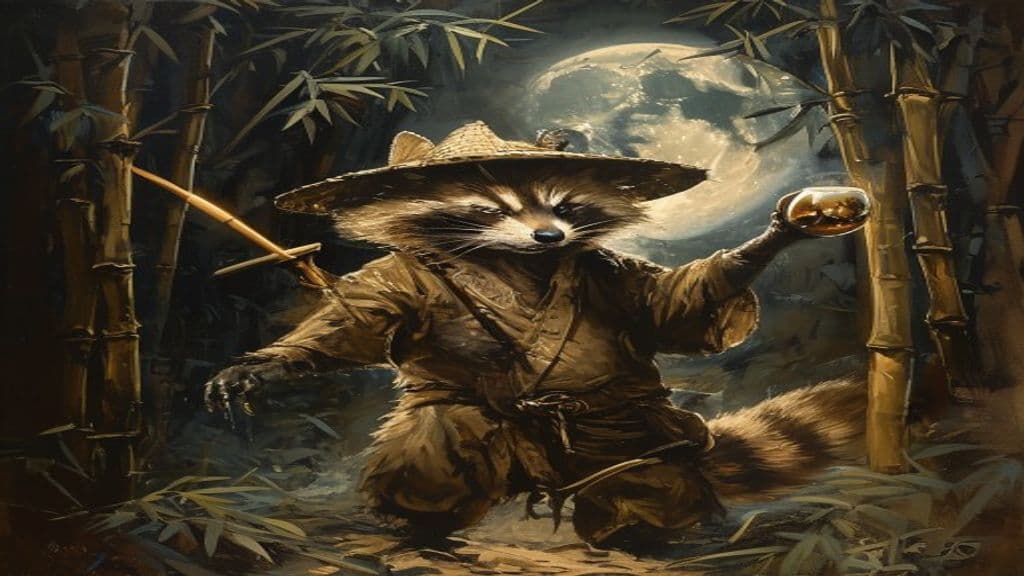
The real tanuki (Japanese raccoon dog) has been associated with supernatural powers since at least the Nara period (8th century). Folk tradition holds that an old tanuki acquires magic powers and can become a major yokai.
Unlike the kitsune's refined cunning, the tanuki's magic tends toward broad comedy — transforming leaves into gold (which reverts at dawn), disguising itself as a monk to beg food, inflating its belly to terrible size for drum-like rhythms (tanuki-bayashi).
In natural form, a stout raccoon-dog with characteristic markings. In folk art and statuary, a standing anthropomorphic tanuki with a straw hat, sake jug, and comically oversized scrotum — a prosperity symbol. In human disguise, often an eccentric monk or merchant.
Shape-shifting into humans, objects, and landscapes. Transforms leaves into coins (which revert to leaves at dawn). Illusion-casting at small scale. Drums on its distended belly to produce the eerie music heard in mountain woods.
Weaknesses
- substanceDogs can see through their illusions
- conditionCannot maintain large transformations past dawn
Wards
- ritualDo not accept gifts from strangers met in the forest at night
Ajisukitakahikone
Ajisukitakahikone is a kami in Japanese mythic literature (Kojiki/Nihon Shoki). He appears in the transfer-of-rule cycle between heaven and earth, is described as a son of Ōkuninushi, associated with the Kamo cult (called Kamo no ōmikami in some modern museum/catalog entries), and features in narratives that explain landscape formation and meteorological genealogy.
Amaterasu Ōmikami
Amaterasu Ōmikami is the sun deity and a principal kami in Shinto tradition, presented in classical Japanese sources as ruler of Takamagahara (the High Celestial Plain) and the mythic ancestress of the Imperial House through her grandson Ninigi. She is central to shrine cult at Ise and to ritual nomenclature and practice within institutional Shinto.
Amatsumara
Amatsumara (天津麻羅), also called Amenomahitotsu, is a Shinto kami presented in sources as the divine smith of Takamagahara who is said to have aided in making the mirror used in the Amaterasu cave episode and who serves as a patron of earthly blacksmiths.
Ame-no-Koyane-no-mikoto
Ame-no-Koyane-no-mikoto is a male Amatsukami (heavenly kami) in classical Shinto myth, presented as the ritual-official ancestor of the Nakatomi clan and linked genealogically to the Fujiwara. He functions as a divine ritual specialist—performing divination and liturgical speech in foundational myths (notably the Ama-no-Iwato episode) and as guardian of the sacred mirror—and is venerated at major shrines such as Kasuga Taisha and Hiraoka Shrine.
Ame-no-Minakanushi
Ame-no-Minakanushi (天之御中主) is a primordial kami named in Japan's classical creation texts as one of the very first deities to come into being in Takamanohara (High Heaven). Presented in the Kojiki and Nihon Shoki as a solitary, hidden first god, he functions primarily as a mythic point of cosmic origin rather than an actively intervening deity in surviving narratives.
Ame-no-Tajikarao
Ame-no-Tajikarao is a kami in Japanese Shinto myth notable for exceptional physical strength. He appears in the Ama-no-Iwato narrative as the deity who pulls Amaterasu from the heavenly rock cave, and he is venerated at numerous shrines across Japan with associations to physical power and local lineage claims.
Ame-no-Tokotachi
Ame-no-Tokotachi is a primordial kami in classical Shinto cosmology attested in summaries of the Kojiki and Nihon Shoki tradition. Sources identify a very early solitary or among-the-first deity who manifests at the creation of heaven and earth; supplied materials also reference a closely related name, Ame-no-Minakanushi, in English summaries of those chronicles.
Ame-no-Uzume-no-Mikoto
Ame-no-Uzume-no-Mikoto is a Shinto kami of dawn, mirth, revelry and the performing arts whose comic and erotic dance at the entrance of Amano‑Iwato lures the sun goddess Amaterasu from hiding, restoring light; her action is cited as the mythic origin of kagura and of certain ritual/performance lineages.
Ame-no-hohi
Ame-no-hohi (also rendered Ame no Fuhi) is a male kami in Japanese mythology identified in sources as the second son of the sun goddess Amaterasu. He is principally attested as an ancestral figure: historical rulers of Izumo and the modern heads of Izumo Taisha and Izumo-taishakyo claim descent from him.
Ame-no-wakahiko
Ame-no-wakahiko is presented in the provided sources as a kami in Japanese mythology, described specifically as a god of grains and counted among the Amatsukami (heavenly deities). The sources identify him as a son of Amatsukunitama and note a medieval prose narrative, the Ame no Wakahiko Monogatari, exists about him.
Amenohoakari
Amenohoakari (天火明) is a Japanese kami associated with sunlight, heat, and the ripening of grain; he functions as an agricultural deity and a divine ancestor claimed by multiple clans and hereditary priestly lineages. Textual sources place him within heavenly genealogy (tensonzoku) while other records give alternate parentage, producing divergent traditions about his origins and relationships to other kami.
An (案)
An (案) is a small table, desk, or platform used in Shinto ceremonies to bear offerings. It is a liturgical furnishing and material mediator in shrine rites rather than a sentient supernatural being.
Community Record
- [1]The Book of Yokai. Foster, Michael Dylan. 2015. The Book of Yokai. University of California Press.academic
- [2]Pom Poko and Japanese Folk Tradition. Casal, U.A. 1959. The Goblin Fox and Badger and Other Witch Animals of Japan. Folklore Studies 18.academic