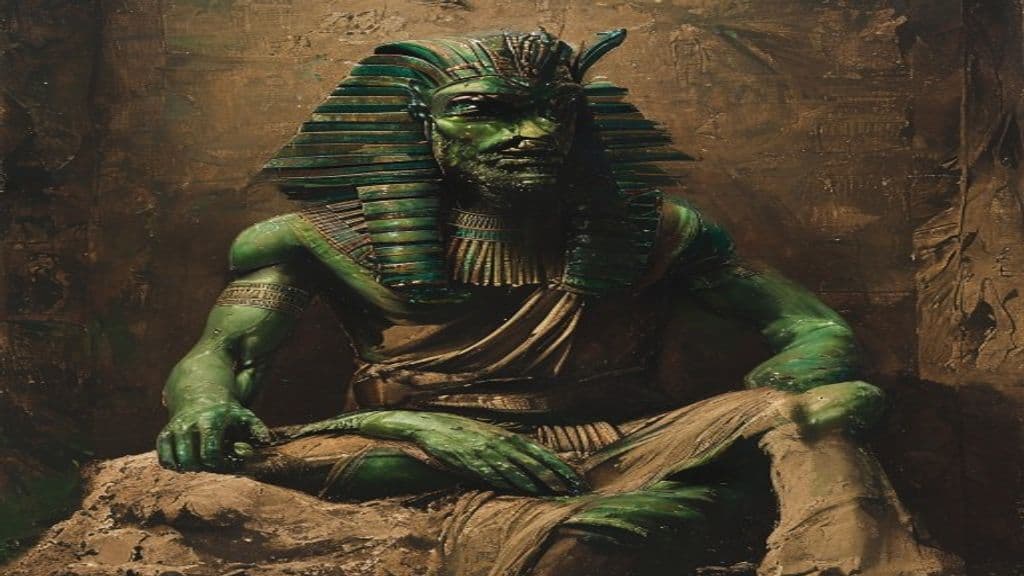
Tatenen embodies the primordial moment and substance of cosmogony in Memphite tradition: the risen land or primordial mound that emerges from the chaotic waters. His name literally signifies the 'risen land' or 'exalted earth' and refers both to the toponymic/elemental silt of the Nile and the ontological event of emergence that yields terrestrial life. In hymnographic and theological texts he is presented as a creator figure—at times called creator, mother and father who gives birth to the gods—and in later Memphite formulations he is syncretized with Ptah (forming Ptah‑Tatenen) and identified with Khnum or aspects of Geb.
Tatenen is typically depicted in anthropomorphic form, often shown as a youthful, handsome and slightly androgynous man. Some portrayals render his face and arms green to signal fertility and plant life. He is often depicted seated and is sometimes shown with a pharaonic beard. Headgear varies in surviving descriptions: an Atef‑style crown in some fused forms or a pair of ram's horns surmounted by a solar disk and two tall feathers; earlier chthonic attestations (Tanenu/Tanuu) note representations with two snakes on his head. Iconographic accoutrements in the tradition include a staff and a magical mace associated with earth‑creator functions.
Across Memphite and later sources Tatenen functions as the personified source of plants, minerals, food and other resources, and as a primeval creator whose being is the risen earth itself. Hymnic texts and summaries attribute to him creator‑parent titles (creator, mother, father) and in some hymns he is identified with or credited with creative acts similar to Khnum's formation of beings. Mythically he repels the chaotic serpent Apep using a staff and is described in sources as assisting the dead in their journey to the afterlife. Over time he is merged with Ptah (Ptah‑Tatenen) and in some formulations linked genealogically to the Ogdoad, situating him within broader cosmogonic networks rather than as an isolated force.
Weaknesses
- othernone attested in sources
Wards
- symbolstaff (mythic implement by which Tatenen repelled Apep)
- othermagical mace ('The Great White of the Earth Creator') — attested as an implement associated with his protective/mythic action
- otherDjed‑pillar association (occasionally credited with bringing stability in some interpretations; attribution contested)
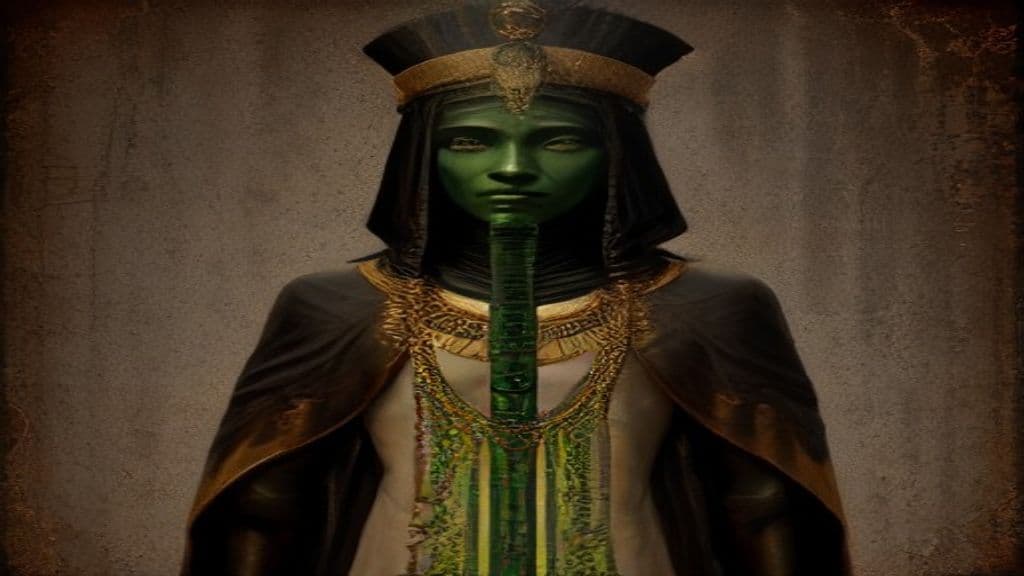
Ptah
Ptah is the principal Memphite deity of ancient Egypt, venerated as a creator god and patron of craftsmen and architects. He conceives the world 'in the design of his heart' and realizes it by speech, serves as master of ceremonies and justice in state cult, and is central to funerary and royal ritual in Memphis.

Geb
Geb (Egyptian gbb/Gebeb) is the ancient Egyptian personification of the Earth and a member of the Heliopolitan Ennead. He functions as the fertile, chthonic ground that produces crops and snakes, an early divine king who later judges in the divine tribunal, and the husband of the sky goddess Nut.

Apep
Apep (also Apophis or Aphoph) is the ancient Egyptian serpent-like embodiment of chaos and darkness who recurrently assaults the solar barque of Ra, representing the ongoing threat to cosmic order (Maat). Ritual texts in the Egyptian corpus contain spells framed to smite or repel Apep and protect the sun's passage.
Tarqiup Inua
Tarqiup Inua (also Tatqim Iñua) is the lunar spirit or 'Master of the Moon' in Inuit thought, described as a man — a mighty hunter — who dwells in the skies and is associated with fertility, moral authority, and (for Alaskan Inuit) the animals.
Tartalo
A one-eyed giant from Basque mythology, known for enormous strength and hunting habits. (Note: - Power tier: Primordial (due to similarity with a Greek mythological figure, suggesting a more cosmic or archetypal power level) - Abilities: Expand on eating habits, specifically mentioning the cons)
Tartaruchi
Tartaruchi (singular tartaruchus) are a class of custodial agents in early Christian apocryphal visionary literature who are set over Tartarus (the place of torment) and charged with receiving, restraining, escorting, and torturing condemned souls. A named figure among them, Temeluchus, appears in the Apocalypse/Vision of Paul and related apocryphal texts.
Tasenetnofret
Tasenetnofret is attested in the supplied materials only as an Egyptian goddess (Wikidata Q7327040). The provided sources give no further information about her functions, iconography, cult, or myths.
Tash
Tash is the principal deity of Calormen in C. S. Lewis's The Chronicles of Narnia. Portrayed as an active, monstrous divine presence in The Last Battle, Tash is summoned into Narnia by conspiratorial actions and is depicted as a devouring antagonist contrasted with Aslan.
Tata Duende
A caring spirit that protects animals and the jungle in Maya tradition. (Note: 1. The power tier should be adjusted to "Minor Spirit" based on the description of Tata Duende being a powerful regional entity does not align with its local and caring nature. 2. The sensory cues sec)
Tatewari
Tatewari is the Huichol (Wixárika) 'grandfather fire' — an ancestral fire deity and the patron/shamanic master who brings, manages, and personifies fire in ritual life, agriculture, hunting, and healing.
Tatzelwurm
A Germanic/Alpine legendary mountain and tunnel 'worm' — a lizard- or serpent-like dragon reported in Austrian, Bavarian, Swiss, French and Italian Alpine folklore. Accounts vary, but folklore attributes a cat-like head in some regions, variable limb counts, a shrieking or hissing cry, and (in some traditions) poisonous breath; it is embedded in local anecdotes and place-names rather than a single canonical myth.
Tauira
A great ocean-going canoe used by Māori ancestors for migration and settlement in New Zealand. (Note: - Power tier should be Primordial, as it's a great ocean-going canoe used for migration and settlement on a cosmic scale (i.e., settling an entire island). - Origin story is missing; include the sourc)
Taweret
Taweret is an ancient Egyptian household protectress associated primarily with childbirth, fertility, and domestic protection. Depicted in composite hippopotamus-derived form, she appears on amulets, birth wands, and funerary objects and is invoked as a pacificatory maternal figure aiding both living birth and symbolic rebirth.
Taygete
Taygete is a Pleiad nymph in Classical Greek myth, a companion of Artemis and an eponymous figure of Mount Taygetos in Laconia. She is represented in narrative cycles as a woman, a sacred doe with golden horns, and as one of the seven stars of the Pleiades, and figures in genealogical/foundation myths connected to Sparta.
Tayt
Tayt (also Tait, Tayet, Taytet) is an ancient Egyptian goddess who functions as the divine patron of textiles and weaving and, by extension, of the linen used in mummification and funerary rites. She appears in Pyramid Texts and the Book of Caverns as a protective, motherly figure who provides ritual linen, wraps bandages on dead kings, and greets deities in underworld narratives.
Community Record
- [1]Tatenen - Wikipedia. Wikipedia contributors, 'Tatenen', Wikipedia, The Free Encyclopediawiki
- [2]Tatenen, Tenen, Tatjenen (Nemo.nu). Nemo.nu, 'Egyptian gods: Tatenen, Tenen, Tatjenen'other
- [3]Tatenen | Henadology. Henadology blog, 'Tatenen'other
- [4]Tatenen – Ancient World (Little‑Egypt). Little‑Egypt, 'Tatenen'other
- [5]Tatenen - Crystalinks. Crystalinks, 'Tatenen'other
- [6]The REAL STORY of PTAH and THOTH... 2025 (Archive.org) — speculative etymology. Archive.org item proposing a speculative re‑reading of TaTe elements (marked uncertain in sources)other
- [7]Tatenen - Ramesses inscriptions context (Pharaoh.se / Wikidata references). Wikidata entry Q1145531, 'Tatenen'other