Theseus is narrated as the son of Aethra and Aegeus (with some accounts adding Poseidon as a divine father), conceived in the mythic past and raised in Troezen. As a youth he recovered his father's tokens (sword and sandals) concealed under a heavy rock, proving his lineage and embarking on the overland journey to Athens. His mixed mortal/divine parentage is given in classical summaries as the motif explaining his exceptional status among Greek heroes.
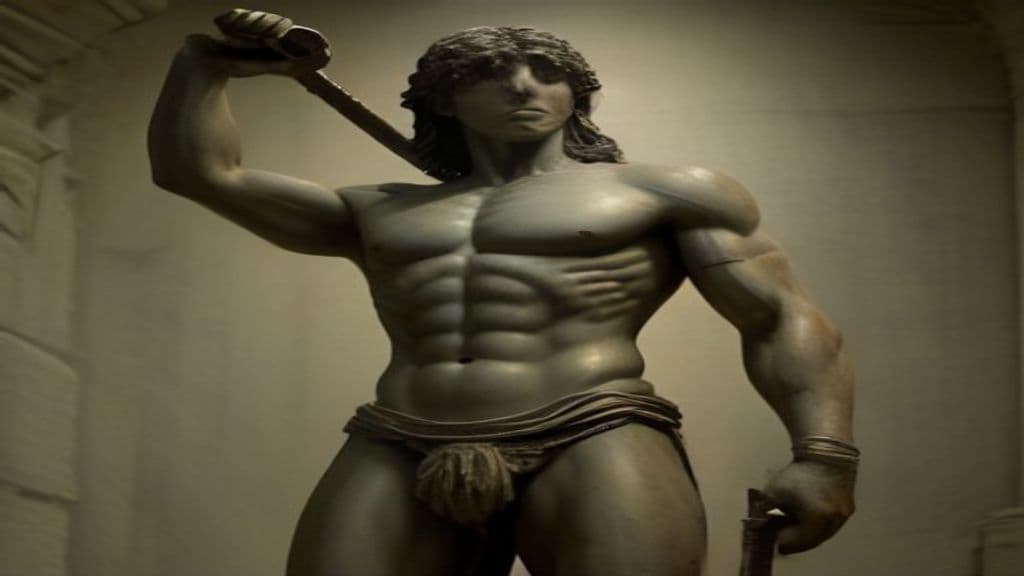
Classical texts and later iconography represent Theseus as a robust, physically powerful young man rather than as a non-human apparition. Narrative attributes function as identifying markers in art and story: the stout staff or club associated with his defeat of Periphetes, the sword and sandals retrieved from beneath the rock, and scenes of wrestling or single combat. Later prints and paintings continue to portray him in heroic human form (e.g., scenes with Aegeus or Aethra).
Theseus is depicted with exceptional physical strength, martial skill, and cunning; he performs a series of six road-labours (Periphetes the Club Bearer, Sinis/Pityokamptes, the Crommyonian Sow, Sciron, Cercyon, Procrustes) clearing chthonic dangers at liminal sites, and he later sails to Crete and slays the Minotaur. His supposed divine paternity (Poseidon in some accounts) and mortal descent (Aegeus) are given as the mythic explanation for his extraordinary capacities. As king-founder he also undertakes civic acts: synoikismos (political consolidation of Attica), building a palace on the Acropolis (reported in summaries), and establishing cult practice (notably an Aphrodite cult on the Acropolis' southern slope ascribed by Pausanias in later reports cited in summaries).
Weaknesses
- otherhuman fallibility (narrative errors and moral failings)
- othervulnerabilities in story: family tragedy (forgetting to change sails leading to Aegeus' death) and susceptibility to betrayal or domestic plots (Ariadne's abandonment, Medea's plotting in sources)
Wards
None recorded.

Community Record
- [1]Theseus - Wikipedia (excerpted). Wikipedia: 'Theseus … was a divine hero in Greek mythology, famous for slaying the Minotaur.'; 'The mix gave Theseus a combination of divine as well as mortal characteristics…'; 'Pausanias reports that after synoikismos, Theseus established a cult of Aphrodite ("Aphrodite of all the People") on the southern slope of the Acropolis.'wiki
- [2]Wikidata entry Q110738703. Wikidata: Theseus listed as a male given name / entity entry referenced in supplied materials.other
- [3]Archive: Theseus and Aegeus (print). Archive listing indicating later artistic depiction titled 'Theseus and Aegeus' referenced in supplied materials.other
- [4]Archive: Theseus and his Mother Aethra | Laurent de la Hyre (print). Archive listing indicating later artistic depiction 'Theseus and his Mother Aethra' referenced in supplied materials.other
- [5]Archive: related cultural item referencing 'Ship of Theseus' thought experiment. Archive listing noted among supplied materials indicating later cultural uses of the Theseus figure (Ship of Theseus reference).other