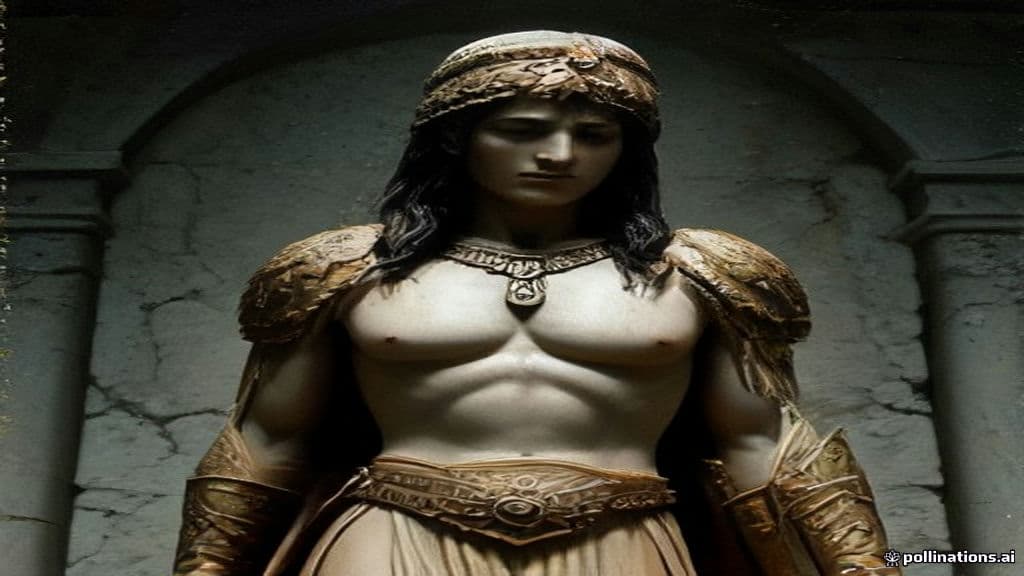
Two complementary registers exist in the sources. In Greek mythic tradition Thrace is integrated into Hellenic genealogy: Thrax, named as a quintessential Thracian, is counted among the sons of Ares, and Ares is presented as a patron deity of Thrace (his gilded shield was said to be kept at Bistonia). In scholarly prehistory the Thracian cultural complex is described as emerging in the Bronze Age from mixtures of Proto‑Indo‑European speaking migrants and indigenous farmers, with regional development over millennia leading to tribal formations and, later, political groupings such as the Odrysian kingdom in the early 5th century BCE.
Classical authors provide evaluative characterizations rather than uniform ethnographic description. Thracians are repeatedly called 'warlike' or 'barbarians' by Greek and Roman writers, labels reflecting outsider perspectives. A specific cultural physical marker attested in sources is tattooing, noted as practiced by both men and women. Beyond such cultural markers, the sources emphasize diversity across many tribes rather than a single, homogeneous physical type.
Descriptions in the sources frame Thracian capacities as social and cultural strengths rather than supernatural powers: they were widely valued as formidable mercenary soldiers, renowned in antiquity for martial skill; they produced notable music and poetry; they practiced polytheistic religion with local cults and at least one attested oracular sanctuary dedicated to a Thracian form of Dionysus in the Rhodope Mountains; and they were capable of political consolidation at times, as in the Odrysian kingdom, while otherwise remaining politically fragmented and organized in tribes.
Weaknesses
- conditionpolitical fragmentation and lack of long-term centralization
- conditionvulnerability to external conquest (eventual incorporation into the Roman province of Thrace in the 1st century CE)
Wards
None recorded.
Community Record
- [1]Thracians (Wikipedia). Wikipedia contributors. 'Thracians.' Wikipedia, The Free Encyclopedia.wiki
- [2]Thracian religion (Wikipedia). Wikipedia contributors. 'Thracian religion.' Wikipedia, The Free Encyclopedia.wiki
- [3]Thracians - Alchetron. Alchetron. 'Thracians.'other
- [4]Thracians, Getians, Paionians, and others: Herodotos (mid-fifth century BCE). Harland, Philip. 'Thracians, Getians, Paionians, and others: Herodotos.' Blog post discussing Herodotus.other
- [5]Thrace - in ancient sources (Attalus). Attalus.org. 'Thrace - in ancient sources.'other