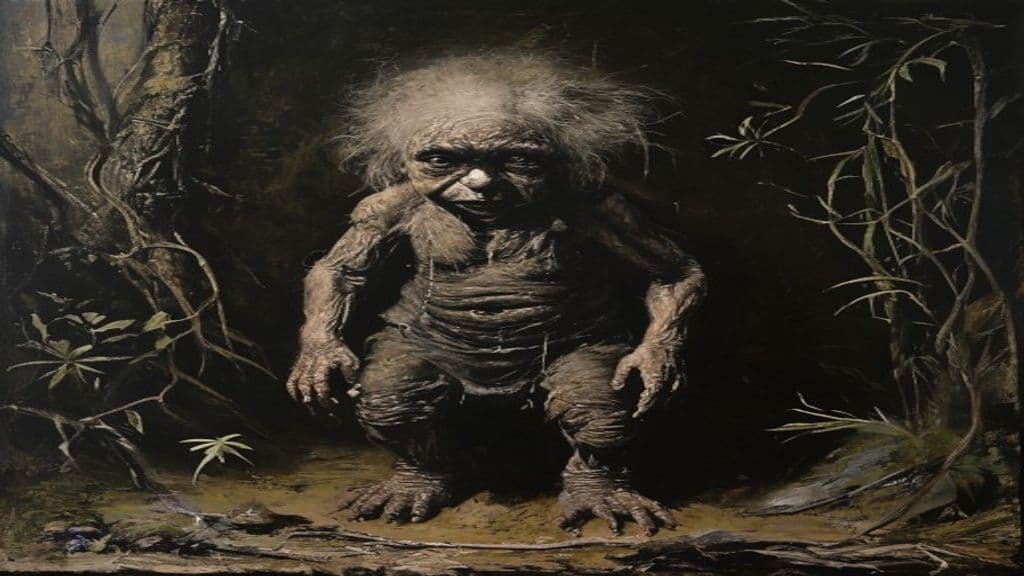
The supplied sources do not provide a single narrative origin myth for the tikoloshe. Within the Nguni cosmological framework as reported, the tikoloshe occupies the unseen, watery dimension of the spirit world and forms part of a universe in which humans, spirits and ritual specialists interact. Its role is principally functional rather than cosmogonic: it operates at the intersection of social conflict and misfortune, serving as an explanation for sudden illness or death and as a supernatural instrument deployed by people with malevolent intent. The being thus figures in social and ritual practices where sangomas, and in more syncretic contexts certain Christian pastors, are recognised as the counter‑agents able to diagnose, prevent or remove its influence.
Across the supplied materials the tikoloshe is consistently described as dwarf‑like and non‑human—small in stature and envisaged as a creature that could reach or disturb people close to the ground. Sources emphasise its diminutive, often childlike size rather than providing fixed, detailed physical markers such as colour, clothing or facial features. The variety of regional spellings and names in Nguni languages suggests local variation in emphasis and portrayal, but the persistent descriptor in the sources is that of a small, ground‑level spirit associated with water.
Reported capabilities centre on stealth and harm: the tikoloshe is said to be able to become invisible by drinking water or by swallowing a stone. It is frequently described as summoned or employed by malevolent persons to cause trouble—its uses range from frightening children to causing illness and, in extreme accounts, death. Behaviorally it spans mischievous pranks through to explicitly harmful acts, and many accounts frame it primarily as an instrument of human hostility rather than an autonomous cosmic force.
Weaknesses
- conditionExposure limited by raising sleeping surfaces off the ground
- otherCan be opposed or banished by recognised spiritual specialists (sangomas, or pastors with an apostolic calling)
Wards
- conditionRaising beds off the ground (preventive household measure to keep sleepers out of reach of a small ground‑level spirit)
- ritualIntervention by sangomas (traditional healers)
- ritualIntervention by pastors with an apostolic calling
Tiera
In Finnish mythology and runic songs, Tiera is a male warrior entity with unknown powers and abilities. (Note: - The power tier should be Primordial, as it's unclear what its "powers and abilities" are, but since it's described as appearing in Finnish mythology and runic songs (which are often deeply connected)
Tietäjä
A magically powerful figure in traditional Finnic culture, possessing supernatural powers derived from great knowledge. (Note: 1. Power tier should be Primordial as "Ancient" is typically reserved for deities and the source doesn't specify otherwise. 2. The sentence in the Origin story could be rephrased to better reflect tha)
Tiferet
Tiferet (תִּפְאֶרֶת, Tif'eret) is the sixth sefirah on the Kabbalistic Tree of Life, a metaphysical emanation or divine attribute that functions as the harmonizing and balancing center among the sefirot, often associated with beauty, glory, and the Sun.
Tiger spirit (Hu jing)
A provisional, research-note reconstruction: no direct primary or secondary sources in the supplied corpus document a discrete Taoist entity named "Hu jing" (虎精). The entry frames how a hypothetical "tiger spirit" might be situated within Chinese yaoguai and Taoist cosmological templates based only on general sources about animal-spirits and Taoist practice.
Tigmamanukan
A Tagalog augural bird — a class of omen-bearing bird (and by extension other animals) read as messages from the creator deity Bathala. Its flight direction and song were interpreted to authorize or forbid journeys and, in some origin myths, a bird identified as the tigmamanukan acts as an agent opening the primordial bamboo.
Tikbalang
A Philippine nature spirit/phantom associated with wild, liminal places; often depicted in later accounts as a tall, lanky half-horse, half-human trickster that can mislead travelers, guard trees or territories, and in some versions be tamed or domesticated by humans.
Tiktik
Tiktik is a named variant within the Philippine aswang tradition: a feared nocturnal, shape‑shifting predator-type figure treated in folklore and adapted in modern Philippine media. Sources emphasize its placement inside the broader aswang umbrella and a cultural motif linking some aswang variants to ominous birdlike calls.
Timalcus
Timalcus (Ancient Greek: Τίμαλκον) is presented in Greek mythic genealogies as a Megarian prince, son of Megareus and Iphinoe, known primarily as a member of that royal house and as being killed by Theseus during a campaign with the Dioscuri against Aphidnae. Sources are brief and genealogical, and a competing tradition noted by Alcman casts doubt on Theseus' presence in the episode.
Tinana
Historical canoe in Māori tradition, significant to the migrations and history of the Māori people. (Note: * Power tier should be Lesser (local spirit) or at least not Primordial, as it's a historical canoe and not a supernatural entity. * Abilities section is correct as Tinana is not a supernatural entity)
Tinia
Tinia (also Tin, Tinh, Tins, Tina) is the chief sky god of the Etruscan religion, associated with thunderbolts, divination, and the guarantying of boundaries. He occupies a role analogous to Roman Jupiter and Greek Zeus and appears in Etruscan votive inscriptions and on the Piacenza Liver used for haruspicy.
Tinirau and Kae
In Māori mythology, Tinirau is the guardian of fish and a son of Tangaroa. He has pet whales and plays a crucial role in maintaining balance within the oceanic realm. (Note: 1. Power tier should be Greater (not Lesser) due to his divine or semi-divine lineage as a son of Tangaroa. 2. Appearance description is incomplete; add that no physical description of Tinirau is prov)
Tintilinić
Malevolent entity believed to be the soul of an unbaptized child, said to 'stroll through houses at night' in Croatian folklore. (Note: - Power tier: Minor Spirit (description suggests it's a relatively weak entity) - Sensory cues: should include the fact that it "strolls through houses at night", not just the red cap - Weaknesses: no)
Community Record
- [1]Tikoloshe - Wikipedia. Wikipedia article 'Tokoloshe' (accessed as provided in research notes)wiki
- [2]Tokoloshe - Wikidata. Wikidata entry Q1758833 (labelled 'Zulu water spirit')wiki
- [3]Soft Oblongs #6 (track listing includes 'Offering To Tikoloshe'). Archive listing (Soft Oblongs #6) noted in research material as containing an artistic reference to 'Offering To Tikoloshe'; contains no ritual detail.other
- [4]The Golden Wedding: Global Accordion Records on 78 RPM (track listing archive). Archive listing referenced in research notes; included to document appearance of the term in archived materials but does not supply ethnographic ritual information.other
- [5]Goblin — Wikipedia (provided source). 'A goblin is a diminutive, grotesque, and often malevolent humanoid creature prominent in European folklore...' (provided research notes excerpt). The notes also state etymology from Old French gobelin and possible links to Medieval Latin gobelinus or Greek kobalos, and mention Germanic kobold as a related category.wiki