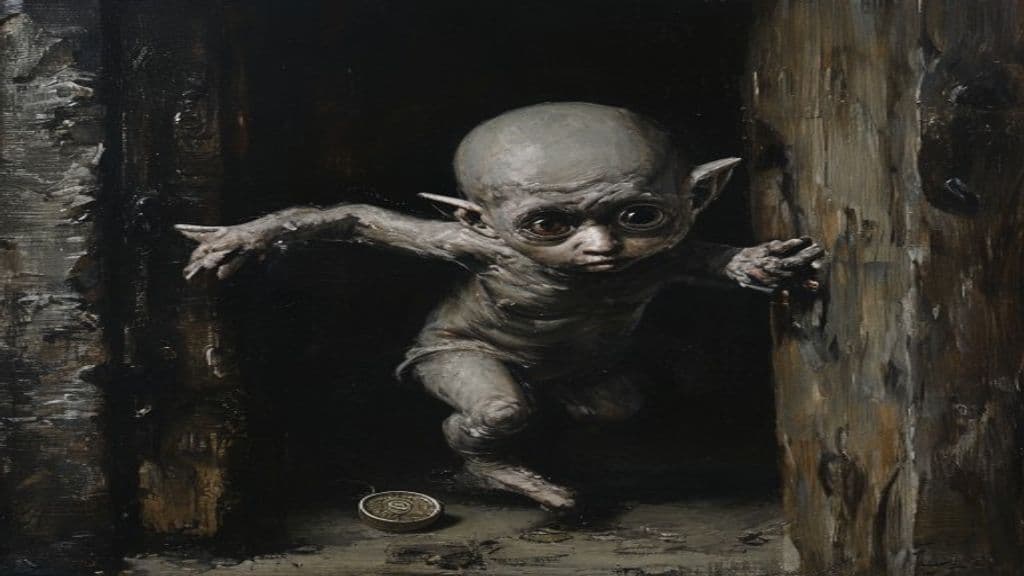
The Toyol (Tuyul in Javanese) is a spirit familiar created from a stillborn or aborted fetus through black magic performed by a dukun (shaman/sorcerer). The practitioner raises the creature as a magical servant, feeding it with blood from their fingertips. The toyol is typically used to steal money and goods from neighbors, which it can do invisibly. Ownership is a moral and social transgression — the toyol must be passed on at the owner's death or it will destroy the owner's family.
A small, child-like creature with a large hairless head, bulging eyes, green or grey skin, and tiny limbs. It moves like a toddler. It has a gnome-like appearance, often described as looking like a cross between an infant and an old man.
Could enter locked homes and steal money or goods invisibly. Extremely difficult to detect during theft. Required regular blood feeding from its master. Could attack people who disturbed it. Passed on at death — the new owner inherited both the familiar and any karmic consequences.
Weaknesses
- substanceMarbles — it will stop to play with them, delaying it indefinitely
- ritualExorcism by a bomoh (shaman) or religious authority
Wards
- ritualPlacing marbles at entry points of money storage
- ritualRegular prayer and keeping religiously clean household

Hantu
Hantu is a Malay and Indonesian lexical and conceptual category for spirits and invisible beings that includes ancestral souls, animistic nature spirits, and, in modern usage, ghosts or demons. The term covers many named subtypes (e.g., Hantu Raya, Hantu Tinggi) whose forms and roles vary across local traditions.
Hantu Penanggal (Penanggalan)
A nocturnal vampiric entity in Malay ghost myth, the penanggalan appears as a floating disembodied woman's head with trailing organs and entrails and is said from a distance to twinkle like a ball of flame.
Hantu Pocong
A Southeast Asian folkloric ghost understood as a dead body wrapped in an Islamic burial shroud (kain kafan), commonly associated with improper funerary procedure or unresolved death-related matters. Representations range from a hopping wrapped corpse in popular media to esoteric readings that interpret the phenomenon as residual energetic or liminal-layer disturbance.
Jin (Malay/Javanese spirit)
No information about a Malay or Javanese spirit called 'jin' is present in the provided source. The supplied material discusses Malaysian Malay ethnicity and does not contain data on supernatural beings, their appearance, abilities, rituals, or cultural role.
Langsuir
A Malay banshee-vampire — the spirit of a woman who died in childbirth, transforming into a beautiful owl-woman who sucks the blood of infants through a hole in the back of her neck.
Orang Bunian
The 'invisible people' of Malay tradition — a sophisticated parallel civilization of beings sharing the world with humans but normally unseen, who can abduct or adopt humans who stray into their realm.
Penanggalan
A Malay vampire consisting of a detached human head with dangling organs that flies at night to feed on the blood of infants and new mothers, then soaks its organs in vinegar to reattach.
Pontianak (Kuntilanak)
A Southeast Asian female vengeful spirit common in Malay‑language traditions, often portrayed as the restless ghost of a woman who died in traumatic circumstances; she commonly appears as a beautiful woman who may reveal a monstrous form and is associated with banana and banyan trees.
Toto (Māori mythology)
A chief in Hawaiki, creator of canoes and leader in Māori mythology. (Note: 1. Power tier: Lesser (Toto is a chief in Hawaiki, but his abilities described do not match Ancient or even Greater levels) 2. Appearance: Add appearance description based on source material 3. Abilit)
Toxeus (Τοξεύς)
Toxeus (Ancient Greek Τοξεύς, lit. 'bowman') is a personal name borne by multiple human figures in Greek myth — chiefly princely/hunter figures tied to the Calydonian hunt and to Oechalian royal genealogies — and later reused as a modern taxonomic and toponymic label. In the classical material assembled in the provided sources, Toxeus denotes mortal mythic humans (princes, hunters, an inventor attestation) rather than a recurring supernatural creature.
Trailokyavijaya
Buddhist wrathful deity and manifestation of the bodhisattva Vajrapāṇi, associated with fierce power and protection. (Note: - Power tier: Trailokyavijaya is not described as Primordial in the source material. Given his association with Vajrapāṇi and being a Wisdom King, it would be more accurate to categorize him as Ancien)
Trambelus
Trambelus (Greek: Τράμβηλος) is a mortal heroic figure in Greek mythic tradition, described as a son of the Achaean hero Telamon and a local ruler or notable associated with Lesbos, Miletus, or the Leleges. Sources relate a narrative in which he pursues a woman named Apriate, is involved in her death, and later dies after being mortally wounded by Achilles; local topography (a tomb and an "Achilles' Well") is said to commemorate these events.
Community Record
- [1]Malay Magic. Skeat, Walter William. 1900. Malay Magic. Macmillan.academic
- [2]Bomoh. Endicott, Kirk. 1970. An Analysis of Malay Magic. Oxford University Press.academic