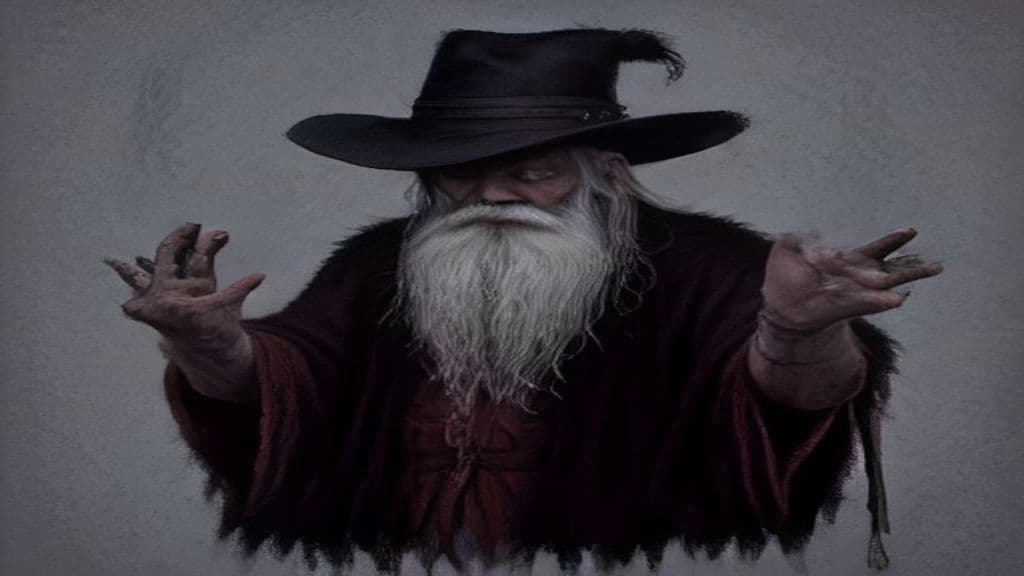
No cosmogonic birth narrative for Tuoni is provided in the supplied sources. Instead, Tuoni appears in Finnish mythic material and poetic tradition as an established sovereign of the realm of the dead (Tuonela). He functions as the lord of that domain and as husband to Tuonetar; together their household includes offspring explicitly named in sources as divinities of suffering, which situates Tuoni within a familial underworld jurisdiction rather than as an isolated elemental force (Source 1; Source 2; Source 9).
Attested descriptions portray Tuoni as an anthropomorphic old man who, in human form, has three fingers on each hand and wears a 'hat of darkness' (Source 1). A later encyclopedic entry additionally describes dark furs (Source 13) — an unsourced detail that is present in modern summaries but not corroborated by primary poetic material. Poetic imagery associates him with rulership of Tuonela's landscape (e.g., 'Prince of Tuoni's fields' and 'Tending the Tuonela cattle'), which functions more as metaphorical evocation of his domain than detailed physiognomy (Source 12).
Primary functions attributed to Tuoni in the sources are sovereign rule over Tuonela (the realm of the dead) and embodiment of darkness (Source 1; Source 2). He is named as husband of Tuonetar and father to figures identified as divinities of suffering (Kipu-Tyttö, Tuonenpoika, Loviatar), which links his household to the administration or personification of pain and affliction within the underworld framework (Source 1). In narrative material (Kalevala Rune 16) the household speaks and confronts a living visitor, demonstrating Tuoni's court as the setting for encounters that can detain, test, or challenge the living; this is a narrative role rather than a catalogued supernatural power set (Source 9). A claim that Tuoni 'constantly changes form' appears in a modern unsourced encyclopedia entry and is not corroborated elsewhere in the provided corpus (Source 13 — treated as uncertain).
Weaknesses
- conditionexposure to fire as a revealing element (narrative context)
Wards
- substancefire (narratively suggested as revealing presence or claim of arrival from fire)

Tuonela
In Finnish mythology, Tuonela is a primordial realm representing the Underworld and the afterlife, sharing similarities with other Finnic cultural traditions. (Note: 1. Summary: Add that Tuonela's significance extends beyond Finnish mythology, as it shares similarities with other Finnic cultural traditions. 2. Power tier: Corrected - Tuonela is indeed associated w)

Tuonetar
Tuonetar is the female sovereign and hostess of Tuonela, the Finnish underworld. In the Kalevala she and her husband Tuoni preside over the dead, administer a lethal 'beer of oblivion', and act to prevent the living from leaving the realm of the dead.

Loviatar
Loviatar is a figure attested in modern reference works as part of Finnish mythic material associated with death and illness; one database entry describes her as a blind daughter of Tuoni. Source material in the supplied corpus also shows nearby or overlapping traditions (notably Louhi) linked to death, disease, and wolves, but the documents provided do not settle whether Loviatar and Louhi are identical, conflated, or distinct in older tradition.
Ahtola (Kalevala) (tradition)
In the supplied sources, no supernatural entity named "Ahtola" is attested in the Kalevala or other Finnish mythic texts. The name Ahtola appears in the source set only as a modern Finnish surname and a place-name; the closely related mythic figure attested in the material is Ahti/Ahto, a Finnish water god associated with the sea.
Aitia (Baltic Finnic)
Primordial figure representing the creative power of the universe, associated with the creation of the world and emergence of life from chaos. (Note: 1. Power tier: Primordial is plausible, but it would be more accurate to indicate "Primordial" as a default power tier without specifying, since there's no further information about its abilities or b)
Haltija
In Finnish mythology, a Haltija is a supernatural guardian that protects specific locations and species, embodying a spirit of preservation within the natural world. (Note: * Power tier: should be "Lesser" instead of "Greater", as Haltijas are described as solitary creatures protecting specific places or species. * Abilities: added information about Haltijas being able t)
Hiiden Hirvi
Mythical moose from Finnish tradition that must be hunted by skiing. (Note: - Power tier: Greater (given its classification as a mythical entity that requires special skills to hunt, it's likely more powerful than a Minor Spirit) - Weaknesses: specify what the source material)
Iku-Turso
In Finnish mythology, Iku-Turso is a malevolent sea monster described in the Kalevala. (Note: - The power tier should be Primordial, given its classification as a "giant" and its association with the sea. - Add sensory cues: The source mentions that it's a malevolent entity, so potential senso)
Kalevi
Finnish giant and heroic figure, often associated with pre-human or archaic layer of existence. (Note: * Power tier is likely Greater (powerful regional) rather than Primordial due to Kalevi being a heroic figure that appears in runic songs. * Sensory cues are missing and should be included based on th)
Kokko
Kokko is an item name that appears in discussions of Finnish mythology but is not described in the single provided source. The available material situates Kokko within the broader corpus of Finnish pagan folklore without providing specific details about its nature, appearance, or associated practices.
Kuippana (Tapio)
Kuippana, also attested as Tapio or Hippa, is a Finnish forest spirit attested in Finnish tradition as the named sovereign or 'King of the Forest.' Hunters in the tradition addressed him ritually before hunts; he is represented as bodily merged with forest vegetation.
Kyöpelinvuori
A mythological location in Finnish culture where dead virgins gather after their death, marking the start of their afterlife. (Note: - Power tier: Lower to Greater (not Primordial), as it is a mythological location associated with the afterlife, but not a cosmic entity. - Abilities: Clarify that the article implies Kyöpelinvuori is)
Lemminkäinen
A young and good-looking hero in Finnish mythology, embodying the ideals and values of his culture. (Note: - Power tier should be changed to "Greater" since Lemminkäinen's abilities are not deity-level but rather that of a powerful regional hero. - Abilities section should be rewritten or removed, as it st)
Loviatar
Loviatar is a figure attested in modern reference works as part of Finnish mythic material associated with death and illness; one database entry describes her as a blind daughter of Tuoni. Source material in the supplied corpus also shows nearby or overlapping traditions (notably Louhi) linked to death, disease, and wolves, but the documents provided do not settle whether Loviatar and Louhi are identical, conflated, or distinct in older tradition.
Menninkäinen
A mischievous, goblin-like spirit in Finnish mythology that guards treasures and enjoys riddles and games of dominance. (Note: 1. Power tier: Lower to Primordial or Ancient, given the description of guarding treasures and enjoying games of dominance. 2. Origin story: Remove "originally described as spirits that lived in isola)
Community Record
- [1]Tuoni - Wikipedia. "In Finnish mythology, Tuoni ... was the god of Tuonela (the world of the dead), and darkness personified. He was the husband of Tuonetar. Their children included Kipu-Tyttö, Tuonenpoika, and Loviatar, who were divinities of suffering. When in human form, he appears as an old man with three fingers on each hand and a hat of darkness."wiki
- [2]Tuonela - Wikidata (realm of the dead). "realm of the dead or the Underworld in Finnish and Estonian mythology" (on Tuonela).wiki
- [3]The Kalevala - Rune 16. "Spake again Tuoni's daughter: 'Well I know the voice of falsehood. If the fire had brought thee hither, Brought thee to Tuoni's empire, Singed would be thy locks and eyebrows, And thy beard be crisped and tangled.'" (Kalevala excerpt, narrative context of a living visitor to Tuonela).literary
- [4]Grove of Tuoni (poetic lines attributed to Aleksis Kivi). "Grove of Tuoni, grove of night... In the Prince of Tuoni's fields Tending the Tuonela cattle." (poetic evocation used in later poetic tradition).literary
- [5]Tuoni | Planewalker. "Tuoni is a Finnish greater Power of the underworld. the husband of Tuonetar and the father of Loviatar. He is dressed in dark furs, but constantly changes form." (unsourced encyclopedic entry — treated as uncertain in analysis).other