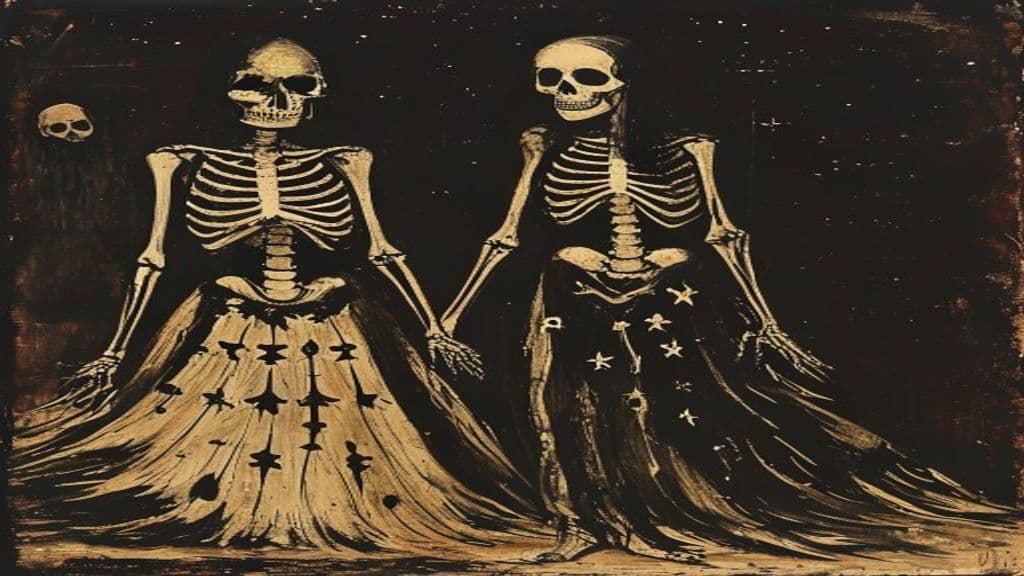
The provided sources do not record a detailed, sourced mythic birth narrative for the Tzitzimime in the excerpts available. What is attested is their placement within Aztec cosmology as celestial beings associated with stars; this situates them among the pantheon of deified cosmic phenomena rather than household or ancestral spirits. Post‑conquest accounts and later summaries sometimes recast them with Christianized language (for example calling them "demons" or "devils"), but the primary attested role in the supplied material is as star‑associated supernatural figures within the Aztec sacred landscape rather than as figures defined by the later European interpretive framework.
Sources describe the Tzitzimime as skeletal female figures. Iconography commonly shows them wearing skirts, and those skirts are frequently decorated with skull‑and‑crossbones motifs. The emphasis in the available descriptions is on a skeletal, female form combined with skull imagery, making their visual presentation tied to death iconography while simultaneously marking them as distinctively feminine celestial personae.
The sources provided identify the Tzitzimime primarily by their association with stars and by their iconography; they do not supply detailed, sourced descriptions of specific supernatural powers, actions, or behaviors in the primary Aztec corpus within the given material. Modern post‑conquest descriptions sometimes label them as "demons" or "devils," but the supplied source cautions that such labels may misrepresent their pre‑contact function. A modern database entry (Wikidata) classifies them as "female fertility deities," indicating that some contemporary taxonomies associate them with fertility, but this classification is not elaborated or supported by details in the supplied texts and must be treated as a later or secondary categorization rather than a documented set of abilities in the primary material.
Cihuateteo
In Aztec tradition, the Cihuateteo (Cihuātēteoh; sing. Cihuātēotl) are the spirits of women who died in childbirth. They occupy an honored cosmic role—guiding the sun toward the west—and, on five calendar days, were believed to descend to the earth as dangerous nocturnal spirits who must be propitiated.
Two Ladies (Egyptian)
In ancient Egyptian tradition, the Two Ladies refer to the goddesses Wadjet and Nekhbet as national symbols of unified Egypt. (Note: - Power tier should be Ancient (not Greater), since the article describes them as "protectors" which aligns with deity-level powers. - Abilities should include specific references to their roles as pa)
Tyche
Tyche (Greek Τύχη, Túkhē) is the personified deity of luck, fortune, and the collective prosperity or destiny of a polis. Originating in Classical Greek religion, she becomes especially prominent in the Hellenistic period as an explanatory and civic principle for unpredictable events and continues to appear in Roman iconography (often parallel to Fortuna).
Tydeus
Tydeus (Ancient Greek: Τυδεύς) is an Aetolian heroic figure of archaic Greek myth, counted among the Seven against Thebes and known as the father of Diomedes (Tydides). He appears in narratives of exile, single combat, and the Theban campaign; in some traditions his extreme violence — notably a reported episode of consuming the brains of his killer — leads the goddess Athena to withdraw a promised immortality.
Tyet
Egyptian symbol associated with the goddess Isis, representing her powers and attributes. (Note: - Power tier: Primordial is not supported by source material (no evidence suggests Tyet has primordial powers or abilities). - Abilities: Add that Tyet is often associated with Isis' protective and nu)
Typhon
The last great monster of Greek mythology — a vast, fire-breathing giant whose shoulders sprouted a hundred serpent heads, nearly toppling Zeus from Olympus.
Tzitzimimeh
Tzitzimimeh (Nahuatl: Tzitzimītl, pl. Tzitzimimeh) are a class of celestial female beings in Aztec tradition associated with the stars. Sources describe them as ambivalent figures: generative and protective of the feminine and linked to fertility, yet feared as dangerous during liminal, cosmically unstable times such as the Nemontemi and the New Fire ceremony.
Tó Neinilii
Navajo rain god, trickster figure associated with precipitation and weather. (Note: 1. Power tier: Primordial (as Tó Neinilii has abilities related to weather control and creation) 2. Origin story: Add a sentence about Tó Neinilii saving the first Navajo people from the sea monster T)
Tübja
No ethnographic, mythological, or folkloric information about a supernatural entity named Tübja is present in the supplied sources. The term appears in the materials only as a family-name entry (Tubjanski) on Wikidata and as fragmented bibliographic/indexing strings in CIA archive documents.
Tühi / Tuhi
The provided sources do not attest to a supernatural being named Tühi or Tuhi. The string appears in the materials as a Māori verb meaning 'to write, draw, record', as the name of an Auckland art institution (Te Tuhi), and as personal and place names; no mythological cosmology, appearance, powers, rituals, or warding practices for a spirit called Tühi are documented in the cited sources.
Tākitimu
An ancestral waka (canoe) in Māori tradition, representing a cultural and historical connection between Polynesia and New Zealand. (Note: - Power tier: Primordial (due to its role in facilitating a major cultural and historical event) - Abilities: Not applicable, as it doesn't possess supernatural powers or behaviors; instead, describe )
Tāne (Māori)
A god in Māori mythology associated with forests and birds, son of Ranginui and Papatūānuku. (Note: - Power tier: Greater (Tāne's association with forests and birds is significant, but not deity-level) - Abilities: Add specific examples from source material, such as his role in shaping the world - A)
Community Record
- [1]Tzitzimime (Wikipedia). Wikipedia contributors, "Tzitzimime," Wikipedia, The Free Encyclopedia, https://en.wikipedia.org/wiki/Tzitzimitlwiki
- [2]Wikidata: Q650572 (Tzitzimitl). Wikidata entry Q650572, "Tzitzimitl," http://www.wikidata.org/entity/Q650572wiki