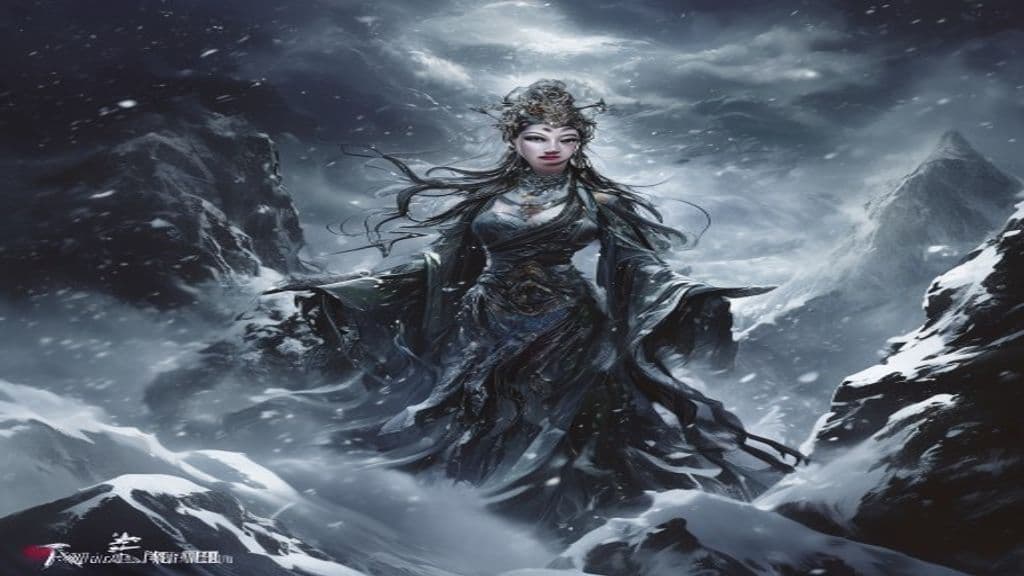
Âu Cơ is described as an immortal mountain snow goddess who bears an egg sac containing the ancestors of the Vietnamese people. This mythological origin story reflects the cultural heritage and reverence for nature, ancestors, and fertility in Vietnamese society.
As a maternal figure, Âu Cơ's powers are related to fertility and creation, including giving birth to 100 children who become the ancestors of the Vietnamese people. This association with creation and immortality suggests her significance as a Primordial entity.
Weaknesses
Wards
Chông Tị (Four Immortals)
One of the Four Immortals in Vietnamese mythology, associated with immortality and appearing on a golden dragon. (Note: - Power tier: Greater (not Primordial) - Chông Tị is associated with longevity and appears on a divine entity (golden dragon), but not cosmic in scope. - Abilities: Remove "His immortality implies ext)
Four Holy Beasts
A set of four sacred animals in Chinese and broader East Asian cultural and astronomical tradition, mapped to the four cardinal directions and used as auspicious, protective, and cosmological symbols in literature, architecture, and material culture.
Lạc bird
A mythical creature in Vietnamese culture, considered the national bird of Vietnam. (Note: * Remove "national bird of Vietnam" from summary, as it only mentions the Lạc bird is considered one. * Power tier should be set to Unknown or Unspecified, as no information is available on its abilit)
Mụ bà (Mười hai Bà mụ)
A collective of twelve female tutelary figures in Vietnamese folk religion who act as midwives and household guardians of newborns, responsible for teaching infants early life skills and auspicious traits. They are ritually acknowledged in some regions at a special ceremony when a baby is one month old.
Shape-shifters
A cross-cultural motif and capability in mythology, folklore, and speculative fiction describing beings or persons who can physically transform themselves through unnatural means. Appears across ancient ritual contexts, foundational epics, and modern popular culture rather than as a single unified species or entity.
Sin-you
A single-horned mythic quadruped in East Asian (especially Japanese) folklore, depicted as an emblem of judicial truth that can detect lies and sometimes execute the guilty. It is portrayed alongside rulers or judges in some accounts and contrasted with other auspicious composite beasts such as the Qilin.
Thuận Thiên (sword)
Mythological sword imbued with magical power associated with Emperor Lê Lợi's liberation of Vietnam from Ming occupation. (Note: 1. Power tier: Reduce to Greater (powerful regional) as Thuận Thiên's abilities are tied to a specific ruler and region, rather than being on a deity-level. 2. Origin story: Clarify that Lê Lợi procla)
Thần Trụ Trời
A Primordial deity responsible for creating the world by establishing pillars in Vietnamese mythology. (Note: 1. Power tier: Primordial (consistent with being a creator deity) 2. Add sensory cues (e.g., description of pillars, sound, or other unique characteristics associated with Thần Trụ Trời's presence) 3)
Tản Viên Sơn Thánh
One of The Four Immortals in Vietnamese mythology, associated with the Ba Vì mountain range and the romance of Sơn Tinh - Thủy Tinh. (Note: - Power tier should be Greater (Tản Viên Sơn Thánh is a regional deity, not on the level of a cosmic entity) - Appearance section needs to be added - Abilities need more specific details from source m)
Ámsvartnir
Ámsvartnir is a named lake in Old Norse mythic geography attested in Snorri Sturluson's Prose Edda (Gylfaginning). Its name literally means "pitch black," and it is described as containing the island Lyngvi, the site where the gods bound the wolf Fenrir.
Áłtsé hashké (Coyote)
A complex figure in Navajo mythology embodying multiple roles and attributes, revered for his powers over rain. (Note: - Power tier should be adjusted to Greater (powerful regional) as the source material does not indicate primordial power. - Sensory cues are not specified but the article could note that Coyote's role)
Äio
No folkloric or mythological entity named "Äio" is attested in the provided source set. The available materials contain unrelated uses of similar letter sequences (e.g., the plant genus Aiouea, the astronomical body Io, software terms "io"), but none describe a being, tradition, or rituals called Äio.
Community Record
- [1]Wikipedia. Âu_C%C6%A1_(mythology)wiki