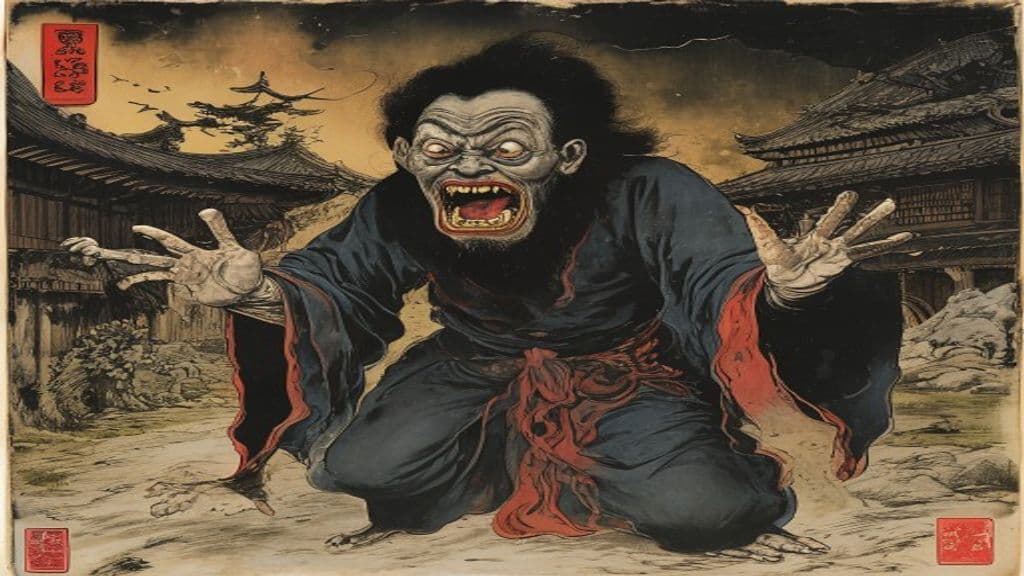
No origin story for the uwan is provided in the Edo-period visual sources that first depict it. The figure appears in yōkai compendia (e.g., Sawaki Suushi's Hyakkai Zukan and Sekien Toriyama's Gazu Hyakki Yagyō) without accompanying explanatory text, so its genesis within classical myth or a theogonic role is not attested. Modern commentators have proposed hypotheses based on visual signifiers — for example, the depiction of blackened teeth (ohaguro) has been read as linking the figure iconographically to social markers of kuge/buke or as a stylized grotesque trait, and the three-fingered hands echo broader oni iconography — but these remain interpretive and are not canonical origin narratives. Later 20th-century and popular sources (including a Tōhoku kaidan retold in Norio Yamada's Tōhoku Kaidan no Tabi and summaries in children's yōkai books) introduce domestic tales and behavioral attributions, though these additions lack primary-source corroboration and are therefore speculative.
In Edo-period illustrated records the uwan appears as a grotesque humanoid with blackened teeth and exaggerated facial features, shown vocally menacing — often with mouth open as if shouting — and gesturing with both hands. Illustrations depict three fingers per hand, a trait commentators note as resonant with oni portrayals. Some images (and later interpretation of Sekien's painting) place the figure emerging from walls or associated with deserted residences. No consistent textual description accompanies these images; what we know of the uwan's look derives mainly from visual depictions in yōkai scrolls and books.
The clearest attested trait in the sources is a loud, startling vocalization transcribed as "uwan!" — the entity is named onomatopoetically for this cry and is described in later summaries as producing audible harassment. Beyond the image-based implication of an alarming shout, later secondary and popular sources ascribe additional behaviors: selective audibility (only certain occupants hearing the cry), appearances near temples or roadsides, and the ability to startle victims potentially to fatal effect. These latter claims originate in modern retellings and children's folklore compilations and lack primary-source documentation; they should be treated as speculative additions rather than established powers in the Edo-period record.
Weaknesses
- conditionfleeing when echoed (attested only in later secondary/popular sources and of uncertain primary basis)
Wards
- ritualrepetition/mimicry of its words (reported in modern secondary sources—repeating back what the uwan said causes it to flee; source basis absent in primary texts)
Urutengangana
In Māori mythology, Urutengangana is a god of light and the firstborn child of Ranginui (Sky father) and Papatūānuku (Earth mother). He plays a significant role in the creation myth and balance between light and darkness. (Note: 1. Power tier: Primordial does not necessarily imply Urutengangana has cosmic powers; consider reclassifying to Ancient or leaving unspecified. 2. Origin story: The article states "firstborn child" bu)
Urðr
Urðr is one of the three Norns in Norse mythic tradition, commonly interpreted as the figure associated with the past. She is attested in the Poetic Edda (Völuspá) and in Snorri Sturluson's Prose Edda (Gylfaginning) as one of the fate-determining women who sit at Urðarbrunnr beneath Yggdrasil and measure or mark the destinies of gods and humans.
Ushi-oni
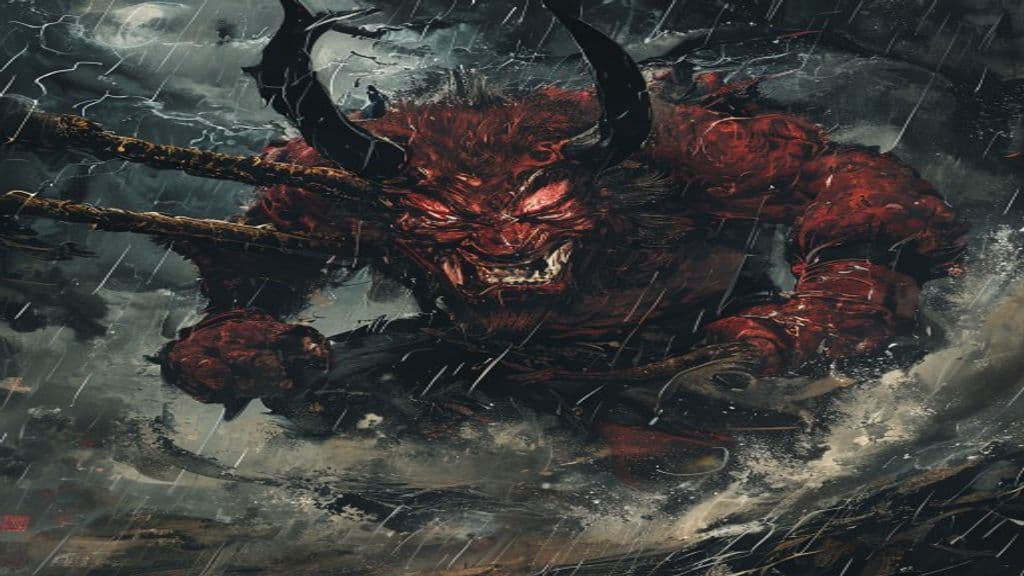
A place‑bound yōkai of western Japan, the ushi‑oni (牛鬼, also gyūki) is depicted as a dangerous ox‑headed monstrous being tied to beaches, stream pools, waterfalls, caves, and mountains. Regional tales portray it as predatory and harmful — spitting poison, devouring humans, or draining a traveler's soul — while some local stories present shape‑shifting variants that may interact with humans in other ways.
Utu (Shamash)
Utu, known in Akkadian as Shamash, is the ancient Mesopotamian sun deity who functions as the personified sun, divine judge, protector of travelers, and a god associated with divination; he was especially venerated at Sippar and Larsa and figures in a family of major gods.
Utukku (Utukku Lemnu)
Utukku (Sumerian udug; Akkadian utukku) is an ambiguous class of underworld-born malignant spirits in ancient Mesopotamian tradition. Treated in ritual literature as agents of disease and affliction, they are distinct from the dingir (gods) and primarily addressed through exorcistic texts collectively known as the Udug Hul.
Uumarnituq and Aakulujjuusi
Uumarnituq and Aakulujjuusi are the pair of first human parents in a corpus of Inuit unipkaaqtuat (origin tales). In overlapping Netsilik, Iglulingmiut, Natsilingmiut, Cumberland Sound and Greenlandic variants they re‑populate the earth after a pre‑historical destruction and act as progenitors whose actions (including performance of magic songs called irinaliuti) explain childbirth, gender transformation in specific tellings, and certain social conditions in particular variants.
Ušum (Ushum)
Ušum (also written Ushum) is a named dragon‑ or serpent‑like monster in Sumerian/Akkadian mythic cycles. In the surviving summaries it appears as one of several monstrous 'warriors' slain by the warrior‑god Ninurta; its corpse is reported as being hung on the seat of his chariot as a demonstration of victory and restored order.
Vadavagni
A supernatural being embodying a submarine fire with the head of a mare in Hindu mythology, associated with destruction. (Note: - Power tier: Greater seems too high given the description as a "submarine fire" and its embodiment by a mare's head; Primordial would be more plausible. - Abilities: The text should clarify that ther)
Vadhusur
Vadhusur is a vengeful immortal spirit presented in the narrated legend of the film Bhooth Bangla. In the film’s diegesis he haunts the Acharya Palace, targets newly married women, can possess a living person as a vessel, and his full resurrection in the story requires a thirteenth sacrifice while he can only be killed by his own hand or bloodline.
Vafþrúðnir
Vafþrúðnir is a jötunn (giant) in Old Norse tradition best known from the Poetic Edda poem Vafþrúðnismál as a supremely wise and 'mighty' figure who engages Óðinn in a formal contest of cosmological questions and answers. His name, often glossed "mighty weaver" or "mighty in riddles," evokes skill in entangling speech and lore.
Vagina dentata
A widespread folkloric motif in which a woman's sexual organ is described as containing teeth; narratives frame it as a potential danger during sexual intercourse that can injure, emasculate, castrate, or kill men. The motif functions symbolically across cultures as a cautionary narrative about sex, power, and boundary transgression rather than as a single named supernatural creature.
Vairocana
A principal cosmic Buddha in Mahayana and Vajrayana Buddhism identified with the Dharmakāya (Dharma-body) of all Buddhas; portrayed in sutric literature as an all-pervasive, illuminating principle whose body contains innumerable world-systems and who functions as the source or universal principle from which other buddhas emanate.
Community Record
- [1]Uwan — Wikipedia. Wikipedia: Uwan entry (summarizes Edo-period illustrations, later folkloric additions, and scholarly caveats)wiki
- [2]Uwan — Wikidata. Wikidata Q249470 (classifies uwan as a 'disembodied voice from Japanese folklore')other
- [3]Perma.cc Captures (archival materials checked). Archive: 2018-12-14 Perma.cc captures (checked; no substantive folkloric material on uwan)other
- [4]CIA Reading Room document (checked). Archive: CIA document (checked; no substantive folkloric information on uwan)other
- [5]CIA Reading Room document (checked). Archive: CIA document (checked; no substantive folkloric information on uwan)other