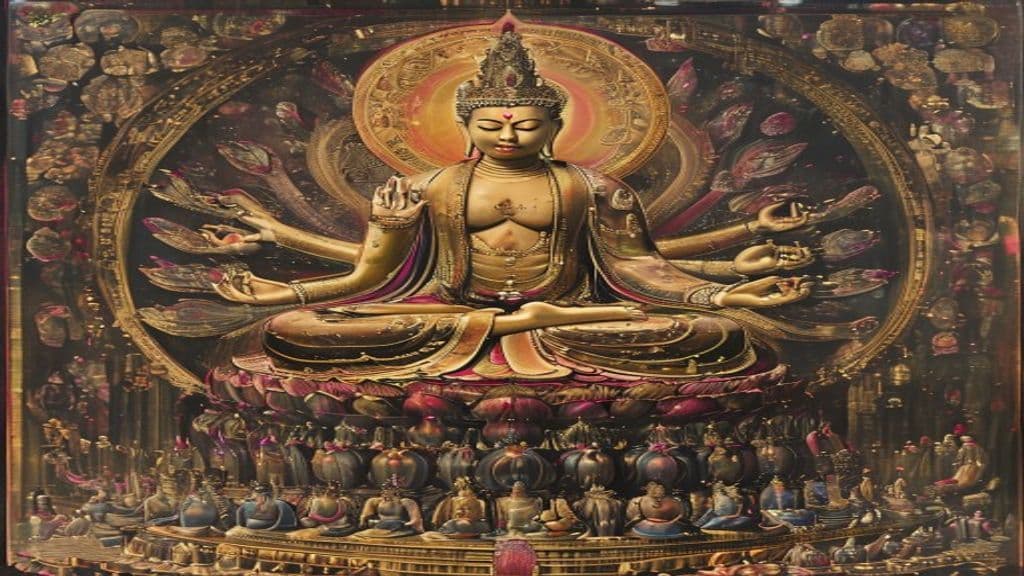
Sutric and tantric sources present Vairocana both doctrinally and narratively: doctrinally he is the Dharmakāya, the formless, ultimate reality that is the 'true body' of all buddhas; sutras such as the Avataṃsaka and the Brahmajāla depict Vairocana as a cosmic Buddha whose practices and presence have purified countless world-systems and whose original-body (dharmakāya) is the source from which other buddhas (e.g., Shakyamuni as an emanation) manifest. These accounts coexist in the tradition as complementary ways of expressing Vairocana's universal and soteriological role rather than as a single linear biographical narrative.
Iconography commonly depicts Vairocana in majestic seated Buddha form (e.g., atop a lotus pedestal surrounded by countless buddhas), but the sutras emphasize an inconceivable, universe-containing body. The Brahmajāla Sūtra describes him 'sitting atop a lotus pedestal' surrounded by innumerable Shakyamuni buddhas; the Avataṃsaka states 'The body of [Vairocana] Buddha is inconceivable. In his body are all sorts of lands of sentient beings. Even in a single pore are countless, immeasurable vast oceans,' language that functions as a cosmological metaphor in the doctrinal sources.
Texts attribute to Vairocana omnipresent, illuminating wisdom (radiance) that pervades all things; doctrinally he is identified with emptiness/ultimate reality (the Dharmakāya). The Avataṃsaka presents him as purifying the cosmos and establishing vast pure buddha-fields, and the Brahmajāla passage presents other buddhas as having Vairocana as their original body (source of emanations). In Vajrayana contexts Vairocana is the focus of tantric sadhana and ritual embodiments (e.g., Sarvavid forms), and the Three Bodies (Dharma‑, Enjoyment‑, and Emanation‑bodies) teaching in the literature qualifies how his different aspects are visible to beings depending on spiritual attainment.
Amida Nyorai
Amida Nyorai (Amitābha / Amitāyus) is a principal Mahayana Buddha venerated across East Asia as the embodiment of Infinite Light and Infinite Life who presides over a Western Pure Land and is invoked as the savior who receives the dying into rebirth there.
Amitābha
Amitābha is a central celestial Buddha of Mahayana Buddhism who presides over the western Pure Land called Sukhāvatī. Devotional practices invoking his 'measureless' light and life (nianfo/nembutsu) are presented in Pure Land traditions as a path by which beings may be reborn in his buddhafield and quickly attain Buddhahood.
Amoghasiddhi
Amoghasiddhi is one of the Five Tathāgatas (Five Wisdom Buddhas) in Mahayana and Vajrayana/Esoteric Buddhism, representing the Karma family and the quality of "unfailing accomplishment". He functions as an archetypal, protective, and contemplative buddha-body within tantric mandalas, presiding over the northern quarter and invoked in mantras and ritual iconography.
Aparajita (Wisdom King)
Aparajita is named in secondary sources as a member of the broad class of East Asian Buddhist 'wisdom kings'—wrathful protective emanations associated with Buddhas and bodhisattvas. The supplied materials do not provide a focused, primary textual profile for an individual Aparajita; most attestations address the wisdom-king category and the protective powers of dharani/mantra (notably the Shurangama Mantra).
Bhagavatī
Bhagavatī is an honorific Sanskrit epithet applied to revered female divinities in Hinduism and Mahayana Buddhism rather than a single individualized spirit. The title functions as a respectful form of address for goddesses such as Sarasvati, Lakshmi, Parvati and certain Buddhist female deities (e.g., Cundā) and is the feminine counterpart to Bhagavān.
Cintāmaṇi
A wish-fulfilling jewel in Hindu and Mahayana Buddhist traditions, described as a pearl-like object. (Note: 1. Power tier: "Primordial" may be too strong; the source describes it as a "wish-fulfilling jewel", which suggests deity-level power (Ancient) rather than cosmic. 2. Origin story: None provided, shou)
Huangmei Dawang
A formidable supernatural being in the Buddhist tradition associated with immense power and strength. (Note: - Summary: Inaccurate. Huangmei Dawang is a major antagonist, not associated with "immense power and strength". - Power tier: Possibly incorrect. Although it has significant spiritual authority and ca)
Mahāsthāmaprāpta
Mahāsthāmaprāpta is a Mahāyāna bodhisattva associated with the Pure Land devotional tradition, commonly represented alongside Amitābha and Avalokiteśvara. His name is glossed in sources as 'arrival of the great strength' or 'one who has attained great power' and he is understood as embodying or representing the power of wisdom.
Samantabhadra
Samantabhadra is a sacred name used across Indian-origin traditions. In Mahāyāna Buddhism it denotes a major bodhisattva associated with practice, vows, and the transfer of merit; in Tibetan Buddhism the name (Tibetan: Kuntu Zangpo) is also used for an Adi‑Buddha or primordial principle in Dzogchen contexts; separately, Samantabhadra is the name of a historical second‑century Digambara Jain monk and author of works such as the Ratnakaranda Gaurav.
Vajrapāṇi
Vajrapāṇi is a bodhisattva in Buddhist textual and iconographic traditions who personifies and protects the Buddha’s power. Appearing in early Mahāyāna and some Theravāda texts and in wide-ranging artistic forms (including Greco-Buddhist Gandhāran renderings), he functions as a Dharmapāla, a companion to the historical Buddha, and a tantric yidam associated with the vajra and the seed syllable hūṃ.
Vināyaka / Ganapati (Ganesha in Buddhism)
A Buddhist tantric deity known variously as Vināyaka, Vighnāntaka, Gaṇapati, tshogs bdag (Tibetan) and Kangiten/Shōten (Japanese). Integrated into Mahāyāna and Esoteric Buddhist cosmologies, he functions as a remover and subjugator of obstacles, protector, and occasional wealth/pleasure‑granting figure and is often treated as an emanation of bodhisattvas such as Avalokiteśvara or of Vairocana.
Wrathful Deities
In Mahayana and especially Vajrayana Buddhism, wrathful deities are fierce or wrathful forms (Tibetan: trowo; Sanskrit: krodha) of enlightened Buddhas, Bodhisattvas, or Devas. They function as protectors and transformative meditational yidams whose terrifying imagery is a skillful means (upaya) to remove obstacles, protect the Dharma, and transform afflictive emotions into wisdom.
Community Record
- [1]Vairocana - Wikipedia. Wikipedia: Vairocanawiki
- [2]Wikidata: Vairocana. Wikidata entry Q239847 summaryother
- [3]Brahmajāla Sūtra (quoted passage as provided in notes). Quoted passage from the Brahmajāla Sūtra as provided in the research notesliterary
- [4]Avataṃsaka (Buddhāvataṃsaka) sutra passages (quoted). Quoted passages from the Avataṃsaka/Buddhāvataṃsaka materials as provided in the research notesliterary
- [5]Archive: Sarvadurgatiparisodhana manuscript record. Archive catalog entry: Collection of ritual texts for the practice of the Sarvavid form of Vairocana from the Sarvadurgatiparisodhana. Written by Ngor Khenchen Kunga Zangpo (1382-1456)other
- [6]Universe Leap (archive item referencing Vairocana imagery). Universe Leap archive item referencing Avataṃsaka/Vairocana imagery (interpretive usage)other