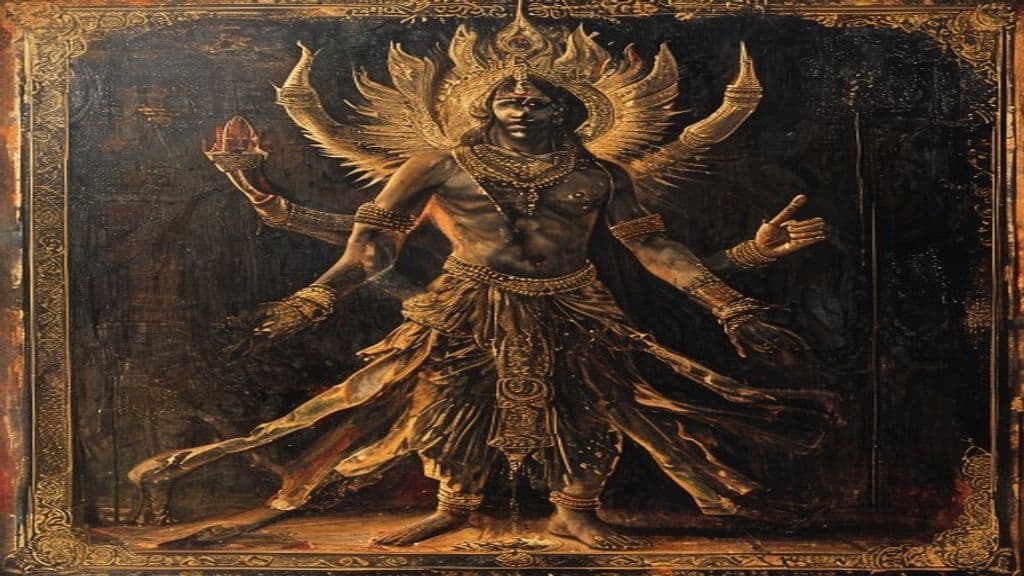
The Asuras are mentioned in various Vedic texts, including the Rigveda, as eternal enemies of the Devas. Their presence is associated with chaos and disorder.
No detailed physical description is provided in the source material.
Asuras are often depicted as having magical powers and engaging in battles with the Devas.
Weaknesses
- unknownno specific weakness mentioned
Wards
- ritual|mantra|conditionno specific ward mentioned
Agneya / Āgneyī
Āgneyī (feminine) or Āgneya (masculine adjective) is a Vedic–Puranic divine figure and ritual principle tied to the fire-god Agni and the southeastern direction. In textual traditions she appears both as a personified daughter/shakti of Agni and as an adjectival/technical term applied to fire-consecrated things (direction, astra, etc.). She also occurs as the name Agneya (or Anala) among items revealed in a Shaiva-Agamic list associated with the Aghora face of Sadashiva.
Angiras
Angiras (Sanskrit Aṅgiras/Aṅgirāḥ) is primarily a Vedic rishi (sage) and eponymous lineage (Angirasa) associated with authorship of Vedic hymns, priestly/fire functions, and transmission of mantras; later Puranic accounts multiply his identities in genealogies and lists of sages.
Ap (the Waters)
Ap (Vedic áp-, Classical Sanskrit āpas/āpa-) denotes the sacred category of 'the waters' in Vedic/Hindu thought: a physical element (water), an animate cosmic principle addressed in Rigvedic hymns, and an elemental category later counted among the Panchamahabhuta. The term names collective waters invoked in ritual, is linked to deities such as Varuna and the epithet Apām Napāt, and survives in related Indo-Iranian vocabularies (Avestan āpō/Aban, Persian āb).
Atri
Atri is a principal Vedic rṣi (seer) and eponymous founder of the Atreya lineage credited with composing hymns in the Rigveda (notably Mandala 5). He is portrayed in epic and puranic narratives as a mānasputra of Brahma, a practitioner of tapas whose austerities attract the Trimurti, and as the hospitable hermit-counselor in Ramayana episodes.
Brahmahatya (Hindu tradition)
A grave sin and entity in Hindu tradition, representing the act of killing a Brahmin. (Note: 1. Power tier should be Primordial (cosmic) instead of Ancient (deity-level), as Brahmahatya represents a grave sin and not a deity. 2. The article lacks an appearance description, which needs to be a)
Daksha yajna
A significant mythological event in Hindu tradition, the Daksha yajna is a ritual-sacrifice organized by Daksha that has far-reaching spiritual and mythological implications. (Note: - Power tier should be Ancient (deity-level) instead of Primordial, as the Daksha yajna is a significant mythological event caused by the wrath of a deity (Shiva), rather than a cosmic power. - Appear)
Dragon (Long)
Long (龍, "dragon") is a pervasive cultural and artistic motif that appears in Taoist sacred-geographical contexts, Chinese literature, and modern exhibitions; the provided sources treat it as part of the broader mythic imagery present around Taoist sites and ritual scenes rather than as a single, consistently described doctrinal entity.
Epic-Puranic Royal Genealogies (Hindu tradition)
Historical accounts of ancient Indian dynasties as recorded in the Epic-Puranic narratives. (Note: - Power tier: Should be Primordial=cosmic (given the historical and genealogical significance), not Minor Spirit. - Summary: Should mention that these are considered historical events by Indian tradit)
Ghoshayatra Parva
Episode from the Hindu epic Mahabharata where Kauravas are captured by gandharvas and released by the Pandavas. (Note: - Power tier: Ancient (deity-level abilities would fit better with the described events in the source material) - Appearance: Should be added as per source material does not describe but one can infer)
Gāyatrī
Gāyatrī is the personified form of the Gāyatrī Mantra in Vedic–Puranic Hindu tradition: simultaneously a 24‑syllable Vedic metre, the hymn composed in that metre, and a goddess—often titled Vedamātā, the mother of the Vedas—who embodies sacred Vedic speech and knowledge.
Harana (Elopement)
In Hindu tradition, a 'Harana' is an act of elopement or abduction, often against the will of the person being taken. (Note: - Power tier: Primordial (this seems too high given the description; consider Lesser or Minor Spirit) - Abilities: Consider adding that Harana's "powers" are more related to social and cultural influe)
Hiraṇyagarbha
Hiraṇyagarbha (Sanskrit: हिरण्यगर्भ, 'golden womb') is a Vedic and later Hindu cosmological concept: a primordial golden seed or 'cosmic egg/womb' from which the manifested universe is said to originate. It is presented variously as an impersonal formative principle, the 'Soul of the Universe' in Upanishadic language, and in Purāṇic and exegetical contexts as the first-born or creator (identified with Prajāpati or Brahmā).
Community Record
- [1]The Hymns of the Rigveda. Griffith, R.T.H. (1889)academic
- [2]Historical Vedic Religion. Wikipedia: Historical Vedic Religionwiki