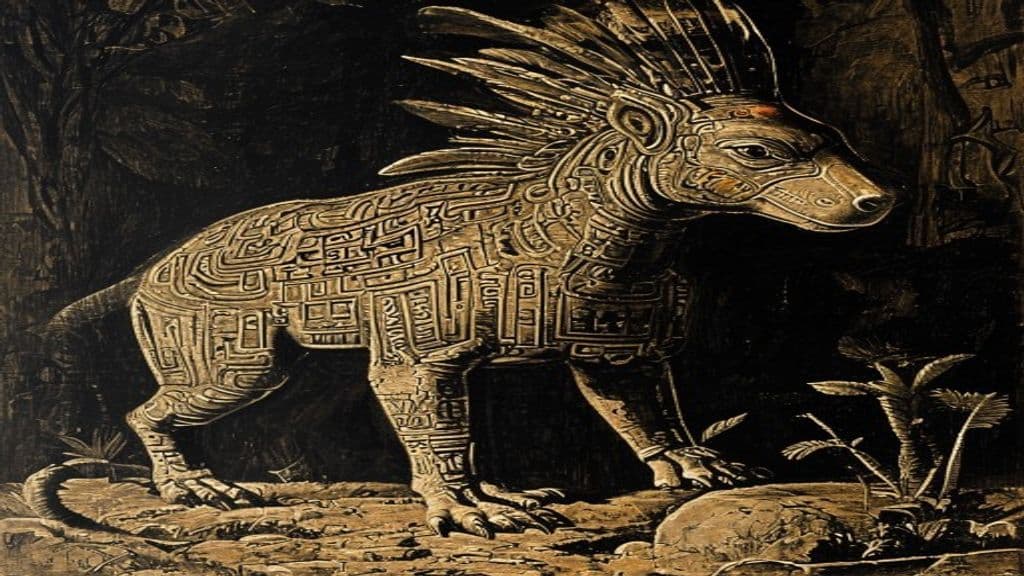
There is no single preserved origin myth for the way/wayob in the supplied sources. Lexically the Maya root denotes 'sleep(ing)', and in Yucatec usage the term came to mark persons who can assume animal form during sleep or the animal forms themselves. Archaeological and iconographic evidence from the Classic period (including a dedicated 'special hieroglyph' for way animals) shows that wayob were an established category in Classic Maya religious imagination; museum interpretation of ritual objects (for example a serpentine pipe representing a Wayob that 'may have been smoked by a King or Priest' and noting that a king was 'accompanied by his Wayob' on journeys to the Otherworld) places the phenomenon within royal and ritual contexts rather than in a single cosmogonic origin narrative.
Descriptions in the sources present wayob primarily as animal forms associated with humans rather than as independent singular monsters. Classic-period evidence identifies 'way animals' in iconography by a special hieroglyph, indicating recurrent animal representations in Maya art. The Musée de Racine example—an anthropogenic serpentine pipe whose shape 'represents a Wayob'—demonstrates material-culture depictions of the animal aspect. Thus appearance is typically dual: the human person linked to an animal companion or transformation, and that animal-form rendered in Classic imagery and ritual objects.
Two principal functional registers are attested in the provided sources. First, in Yucatec usage the way denotes a person who 'can transform into an animal while asleep in order to do harm,' tying the entity to nocturnal transformative action with potentially harmful intent (the comparative term 'nagual' is used in summaries). Second, museum interpretation of Classic material describes wayob as companions or escorts: a king making a journey to the Otherworld 'was accompanied by his Wayob,' indicating an attendant or supportive role in ritual or cosmological journeys. Classic inscriptions and art that single out way animals with a special glyph imply the beings had ongoing ritual and mythic agency, but the supplied texts do not elaborate other specific powers beyond nocturnal transformation/agency and attendant companionship.
Howler Monkey Gods
Paired supernatural patrons in Classic and Postclassic Maya religion who oversee scribal arts, sculpture, music, and related ritual knowledge; personifications of the day-sign Batz in calendrical/divinatory contexts and remembered in colonial-era narratives such as the Popol Vuh and accounts by Bartolomé de las Casas.
Itzamná
Itzamná is a principal upper-world creator deity in Maya religious thought, associated with the sky, priestly arts (including writing), calendrical authority, agriculture (maize), and rulership. He appears across Classic iconography and Postclassic codices in multiple transformative aspects (aged tonsured maize form, a Principal Bird Deity, and within a two‑headed caiman earth image) and is invoked in specific ritual months in early‑colonial reports.
Kʼinich Ahau
Kʼinich Ahau is the Classic and post‑Classic Maya sun deity — a personified solar force associated with the day, calendrical patronage, rulership/apotheosis, and a set of iconographic types (monumental stucco masks, codex imagery of 'God G', and aquatic/eastern sunrise scenes). He appears in epigraphic, colonial, and modern Lacandon traditions with overlapping cosmological roles rather than a single fixed persona.
Wandjina
The Wandjina (also Wanjina, Wondjina; sometimes listed as Gulingi) are ancestral cloud-and-rain spirit-beings of the Wanjina Wunggurr cultural bloc in northwestern Australia. They are depicted prominently in Kimberley rock art, some paintings of which date to approximately 4,000 years ago, and are integrated in a local cosmology that includes the creator-being Wunngurr (analogous to the Rainbow Serpent).
Wanjina Wunggurr (unverified)
Insufficient sourced information available in the provided material to describe Wanjina Wunggurr. The only confirmed fact from the source is that the Worrorra (Worora) are an Aboriginal Australian people of the Kimberley region; no reliable details about Wanjina Wunggurr are present in the supplied source.
Warg
A large, malevolent wolf-like being whose modern fictional form was popularized by J. R. R. Tolkien as an intelligent, war‑capable wolf-race allied with Orcs; the term derives from Old Norse vargr and Old English wearh, words that blur natural wolf, outlawry, and destructive agency.
Watcher
Watcher is a polyvalent label applied across religious, literary, and technical domains to beings or systems defined primarily by observation, surveillance, or guarding. In the supplied sources it names an apocryphal class of angels (the Grigori), a localized monstrous guardian in Tolkien's fiction (the Watcher in the Water), a race of cosmic observers in Marvel Comics, and various monitoring programs in computing.
Water deity
A water deity is a god or goddess associated with water or specific bodies of water (sea, ocean, great river, spring, or well). The term is a functional, comparative category used by scholars to group diverse culture-specific divine figures whose primary domain is water.
Wayland the Smith
Wayland the Smith is a legendary master craftsman from early Germanic and Norse tradition, famed for superlative metalwork, cunning devices, and a narrative of capture, mutilation, vengeance, and escape. He appears as a culture-hero/artisan in poetic and saga contexts (not a formal deity) and is later equated with classical craft-figures such as Daedalus in medieval manuscript tradition.
Wayob
Wayob (singular way or uay) are Maya supernatural companions or transformative alter-forms tied to the state of sleeping: humans (especially sorcerers or elites) send forth or become animal or apparition forms while asleep to act in the world. In ethnographic sources they appear often as domestic animals or meteorological powers and are implicated in harm and disease; Classic Maya inscriptions and art show a broader typology including jaguars, birds, hybrids and skeletal underworld figures linked to rulership and death imagery.
Weather god
A class of deity in many mythological traditions responsible for meteorological phenomena—thunder, lightning, rain, wind, storms and related atmospheric forces—often linked to sky sovereignty, fertility, warfare, or protection within local pantheons.
Wechselbalg
The Changeling of Germanic and Norse tradition — a fairy or demonic child substituted for a stolen human infant, identifiable by its voracious appetite, failure to thrive, and uncanny behavior.
Community Record
- [1]Wayob (way) - Wikipedia. Wikipedia: 'Wayob is the plural form of way... a Maya word with a basic meaning of "sleep(ing)"... in Yucatec Maya is a term specifically denoting the Mesoamerican nagual... a person who can transform into an animal while asleep in order to do harm, or else the resulting animal transformation itself. Already in Classic Maya belief, way animals, identifiable by a special hieroglyph, had an important role to play.'wiki
- [2]Mayan Wayob Pipe - Musée de Racine. Musée de Racine Mayan Wayob Pipe caption: 'This pipe, carved in serpentine may have been smoked by a King or Priest for the conduct of religious ceremonies. Its shape represents a Wayob. When the king made a journey to the Otherworld he was accompanied by his Wayob, or compan[ion].'other
- [3]Maya death gods - Wikipedia. Wikipedia: Maya death gods (cited for contextual placement among Maya supernatural beings; the supplied excerpt does not establish a direct link between wayob and the named death gods).wiki