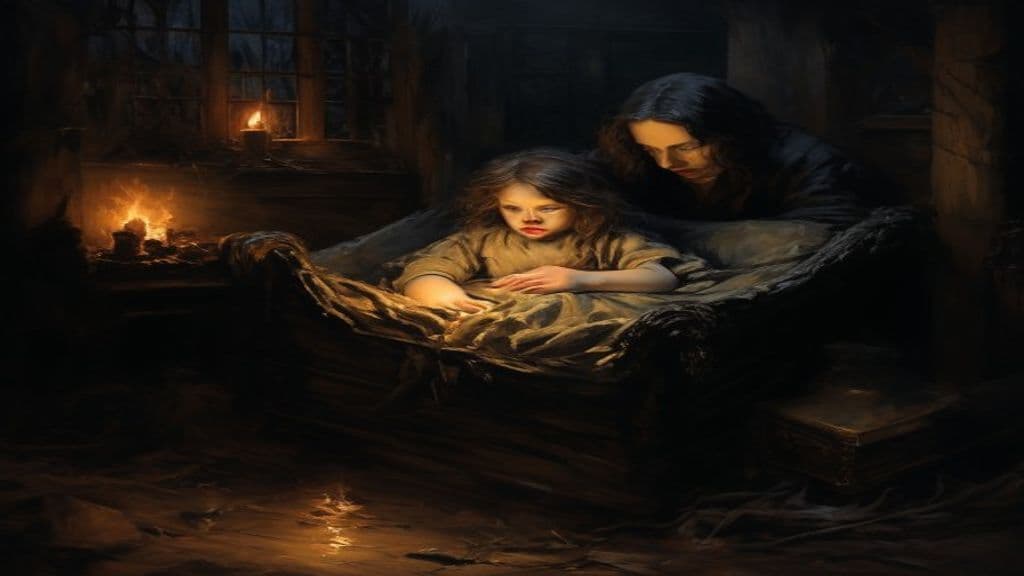
Across Germanic and Norse tradition, supernatural beings were believed to steal unbaptized human infants and replace them with their own kind — sickly, deformed, or simply 'other'. The substituted creature would eat endlessly without growing, scream inconsolably, and seem somehow wrong. Identifying and removing the changeling was a matter of desperate urgency.
Looks like the stolen infant but somehow wrong — too thin, too heavy, eyes too knowing, features not quite right. It cries more than normal, refuses to be comforted, eats far more than a human infant could, and fails to grow.
The changeling's presence indicated the theft of the real child. If the changeling was tricked into revealing itself (by performing an impossible task in front of it), it would typically vanish, and the real child might be returned.
Weaknesses
- ritualTricking it into speech or action beyond infant capacity forces it to reveal itself and vanish
Wards
- ritualBaptism immediately after birth
- substanceSteel placed in the cradle
- symbolOpen scissors placed over cradle
Alp
A German nightmare demon — often the projected spirit of a living person — who sits on sleeping victims' chests causing terrifying dreams, sleep paralysis, and wasting illness.
Baldr
Baldr (Old Norse Baldr; Old English Bældæġ; Old High German Balder/Palter) is a god in Germanic mythology. In the Norse branch he is named as a son of Odin and Frigg and as a member of the Aesir, attested alongside brothers such as Thor and Váli in the supplied sources.
Black Shuck
A spectral black dog of East Anglian legend, with glowing red or green eyes. Its appearance is an omen of death. Its howl has been heard on clifftops during storms for centuries.
Deutsche Mythology
A collection of mythological narratives representing the collective myths, legends, and beliefs of ancient Germanic cultures. (Note: 1. Power tier: Primordial (Deutsche Mythology as a collective mythological narratives does not have supernatural abilities and behaviors attributed to it; rather, it contains those of individual Germa)
Domar (Dómarr)
Domar (Old Norse Dómarr, 'Judge') is a legendary Swedish king of the Yngling dynasty attested in medieval Scandinavian genealogical sources. He is presented as a mytho-historical ancestral ruler whose long and peaceful reign follows the sacrificial death of his father Domalde and whose own death was marked by cremation at Fyrisvellir and erection of a memorial stone at Uppsala.
Dragon (Long)
Long (龍, "dragon") is a pervasive cultural and artistic motif that appears in Taoist sacred-geographical contexts, Chinese literature, and modern exhibitions; the provided sources treat it as part of the broader mythic imagery present around Taoist sites and ritual scenes rather than as a single, consistently described doctrinal entity.
Draugr
In Nordic folklore the draugr (plural draugar; anglicized draug) is an archaic term for a malevolent revenant — a dead person who returns and remains active in the world of the living. Accounts emphasize variability: traits, behaviours, and descriptions change between stories and across regions, especially in early medieval Icelandic sagas and surviving Norwegian folklore.
Dís (dísir)
In Norse/North Germanic tradition, a dís (pl. dísir) is a collective term for female supernatural beings whose roles range from protective ancestral spirits and fertility figures to fate‑linked women comparable to valkyries or norns; they are invoked in both private and public cult (notably the dísablót) and can be benevolent or hostile toward humans.
Erlking
A sinister Germanic spirit of forest and mist who takes children — appearing to them as a welcoming figure while adults see nothing, the child dying in its parent's arms.
Eystein Halfdansson
Eystein Halfdansson (Old Norse: Eysteinn Hálfdansson) is presented in Norse king-list and saga tradition as a semi-legendary Norwegian petty king of the House of Yngling who ruled Romerike and acquired Vestfold by marriage. He is depicted as a dynastic ruler and Viking raider whose death is attributed in Snorri's Ynglinga saga to a magical act performed by King Skjöld of Varna.
Fairy
A class of anthropomorphic supernatural beings found across multiple European folk traditions, fairies are magical, liminal entities variously described as spirits, an older race, or enchanted people; their depiction ranges from human-sized to diminutive and their attributes and moral alignment vary by region and period.
Fenrir
The monstrous wolf son of Loki, bound by the gods with a magical ribbon until Ragnarök — when he will break free and swallow Odin, and the world.
Community Record
- [1]Deutsche Mythologie. Grimm, Jacob. 1835. Deutsche Mythologie, Vol. 2. Frankfurt.folk
- [2]Strange and Secret Peoples. Silver, Carole G. 1999. Strange and Secret Peoples: Fairies and Victorian Consciousness. Oxford University Press.academic