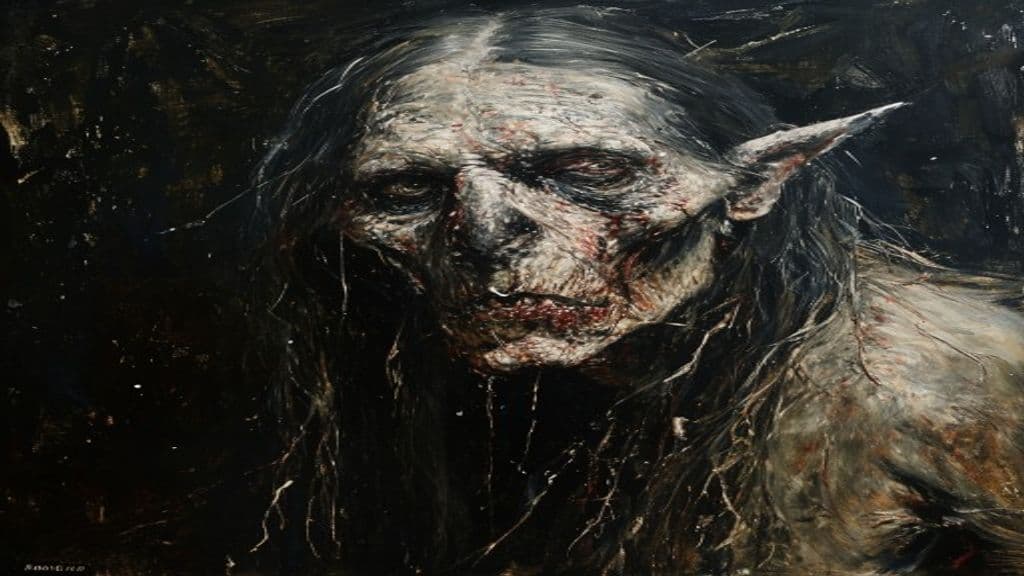
Within Algonquian-language cultural contexts, the wendigo is a morally charged phenomenon rather than a single uniform creature: some traditions describe humans becoming wendigos after committing cannibalism during famine, others link transformation to extreme greed or prolonged contact with the being, and possession by an outside spirit is also reported. Regional variation is strong—some groups emphasize the being's role as a punishment for taboo transgression (e.g., cannibalism, hoarding), while others stress possession or psychosocial collapse. The concept functions as an explanatory and normative force tied to survival pressures such as northern winter and starvation.
Descriptions collected in ethnographic and popular summaries portray the wendigo as emaciated and gaunt with desiccated skin pulled tight over bone, ash-gray complexion, pushed-back eyes, tattered and bloody lips, and an odor of decay (description attributed to Ojibwe account quoted via Basil H. Johnston). In several Algonquian traditions (notably Ojibwe, Eastern Cree, Westmain Swampy Cree, Naskapi, and Innu) it is described as a giant many times larger than humans; other accounts omit the giant aspect. Folktales also record behaviors such as tool use (e.g., knives) and extraordinary physical resilience in particular stories.
Core abilities and behaviors reported in the sources include an insatiable hunger for human flesh and the capacity to cause or compel cannibalism, the power to possess or transform humans into wendigos, retained human cognition and speech in some depictions, and growth after consuming humans (each meal causes the creature to grow yet never be satisfied). Specific folktales (e.g., a tale collected by Lottie Chicogquaw Marsden) describe survival of severe injury and autocannibalism; sources note that such capacities vary by account. Atmospheric and sensory signs such as a foul stench and sudden unseasonable chill are also associated with the being's presence.
Weaknesses
- otherphysical disabling and communal killing
Wards
- ritualwiindigookaanzhimowin (taboo-reinforcement ceremonial dance)

Mishipeshu (Underwater Panther)
Mishipeshu, often rendered in English as the Underwater Panther or Great Water Lynx, is a major mythic water-being of the Northeastern Woodlands and Great Lakes region, especially in Anishinaabeg/Ojibwe-related traditions. Described as a hybrid feline–aquatic monster, it personifies powerful and potentially dangerous forces associated with deep lakes and is repeatedly cited in modern summaries as one of the most important regional water spirits.
Nanabozho (Nanabush)
Nanabozho (also Nanabush) is a spirit figure in Anishinaabe aadizookaan, foremost among the Ojibwe as a trickster and culture hero who appears in oral narratives including creation stories. The figure functions within storytelling as a foundational and didactic agent rather than a documented historical person.
Wayob
Wayob (singular way or uay) are Maya supernatural companions or transformative alter-forms tied to the state of sleeping: humans (especially sorcerers or elites) send forth or become animal or apparition forms while asleep to act in the world. In ethnographic sources they appear often as domestic animals or meteorological powers and are implicated in harm and disease; Classic Maya inscriptions and art show a broader typology including jaguars, birds, hybrids and skeletal underworld figures linked to rulership and death imagery.
Weather god
A class of deity in many mythological traditions responsible for meteorological phenomena—thunder, lightning, rain, wind, storms and related atmospheric forces—often linked to sky sovereignty, fertility, warfare, or protection within local pantheons.
Wechselbalg
The Changeling of Germanic and Norse tradition — a fairy or demonic child substituted for a stolen human infant, identifiable by its voracious appetite, failure to thrive, and uncanny behavior.
Weiße Frauen
A class of elf-like luminous female spirits in German folklore associated with sunlight, nature, and particular locales (brooks, castles). Scholars (notably Jacob Grimm) interpret them as survivals or localizations of older Germanic light-elves and goddess-figures.
Wekufe
In Mapuche cosmology the wekufe (wekufü) is a class of harmful external force or spirit whose essential quality is to disturb or destroy the natural and social order. The term covers a range of beings and energies—from extracorporeal disruptive forces to material monstrous forms—and is tied to ritual order, sorcery (kalku), and healing practices (machi, machitún).
Weneg (Weneg-Nebty)
Weneg, attested as Weneg or Weneg-Nebty, is the throne name of an early Egyptian king conventionally placed in the Second Dynasty. Scholarly sources identify Weneg as a historical/rulerial name, but specifics of his reign length and exact identification with archaeologically attested Horus-named kings remain unclear.
Wepset
Wepset (wps.t, "she who burns") is an ancient Egyptian goddess who personifies the royal uraeus cobra and functions as one of the Eyes of Ra. She appears in funerary literature (the Coffin Texts) as "the Eye" and in New Kingdom texts is said to destroy the enemies of Osiris; in the Greek and Roman periods she is also depicted in anthropomorphic composite forms.
Werecat
A werecat is a folkloric category of therianthropic beings or people associated with transformation between human and feline forms. The motif appears across Europe, Africa, South and Southeast Asia, and China, with locally specific explanations (witchcraft, hereditary curse, sorcery, ghostly influence, or divine/royal descent).
Werehyena
A supernatural being from Central African tradition and the Arabian Peninsula that can shapeshift between human and hyena forms. (Note: 1. Power tier: Should be "Greater" instead of "Ancient", as the source material does not describe the Werehyena as a deity-level entity. 2. Origin story: Should state that the origin is unknown or not)
Werejaguar
The werejaguar is an Olmec iconographic motif and reconstructed supernatural found throughout the Olmec archaeological record; scholars treat it variously as a recurring visual type, a class of supernaturals, a possible rain-associated deity, or a spirit-helper used in elite ritual contexts.
Community Record
- [1]Wendigo - Wikipedia. Wikipedia contributors, 'Wendigo', Wikipedia, The Free Encyclopediawiki
- [2]BRAVE (PS2) — Archive entry (example of modern adaptation). Archive.org, 'BRAVE (PS2)'other
- [3]Sudden Storm: A Wendigo Reader — Glass Eye Pix / Larry Fessenden Collection (modern cultural adaptations). Glass Eye Pix, 'Sudden Storm: A Wendigo Reader'other