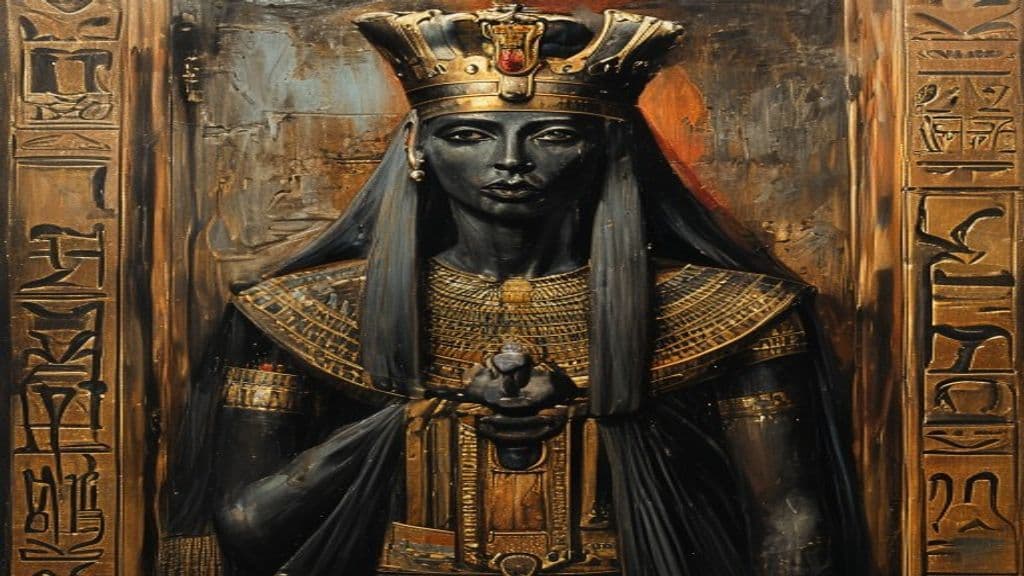
Weneg appears in Egyptological scholarship as a throne name (Weneg, also Weneg-Nebty) attributed to a king of Egypt's Second Dynasty. The extant materials supplied locate Weneg within early dynastic chronological frameworks but do not supply a continuous narrative of origin or mythic genealogy. Academic discussion focuses on identifying which archaeologically attested Horus-name ruler corresponds to the throne name Weneg and on the chronological placement of that reign; the supplied sources note that while the chronological position is relatively clear to specialists, the length of Weneg's reign and his exact archaeological correlate remain unresolved.
The supplied sources do not provide iconographic or mythological depictions of Weneg. Attestations are nominal/epigraphic: the name Weneg (Weneg-Nebty) functions as a royal throne name in king lists and modern Egyptological references. No description of physical appearance, anthropomorphic form, or standard royal portraiture tied specifically and unambiguously to Weneg is present in the provided materials.
Within the supplied corpus Weneg's 'abilities' are those conventionally associated with kingship—political and administrative authority as an early dynastic ruler—rather than supernatural powers. The sources do not attribute magical, divine, or other supernatural behaviors or interactions with the living or dead to Weneg. Discussions in the provided material are historiographic and epigraphic, concerned with identification and chronology rather than mythic agency.
Wayob
Wayob (singular way or uay) are Maya supernatural companions or transformative alter-forms tied to the state of sleeping: humans (especially sorcerers or elites) send forth or become animal or apparition forms while asleep to act in the world. In ethnographic sources they appear often as domestic animals or meteorological powers and are implicated in harm and disease; Classic Maya inscriptions and art show a broader typology including jaguars, birds, hybrids and skeletal underworld figures linked to rulership and death imagery.
Weather god
A class of deity in many mythological traditions responsible for meteorological phenomena—thunder, lightning, rain, wind, storms and related atmospheric forces—often linked to sky sovereignty, fertility, warfare, or protection within local pantheons.
Wechselbalg
The Changeling of Germanic and Norse tradition — a fairy or demonic child substituted for a stolen human infant, identifiable by its voracious appetite, failure to thrive, and uncanny behavior.
Weiße Frauen
A class of elf-like luminous female spirits in German folklore associated with sunlight, nature, and particular locales (brooks, castles). Scholars (notably Jacob Grimm) interpret them as survivals or localizations of older Germanic light-elves and goddess-figures.
Wekufe
In Mapuche cosmology the wekufe (wekufü) is a class of harmful external force or spirit whose essential quality is to disturb or destroy the natural and social order. The term covers a range of beings and energies—from extracorporeal disruptive forces to material monstrous forms—and is tied to ritual order, sorcery (kalku), and healing practices (machi, machitún).
Wendigo
A malevolent spirit or being from Algonquian-language traditions associated with cannibalism, famine, winter, and insatiable greed. Tales describe humans transformed into wendigos or beings that possess humans, serving social and moral functions within affected communities.
Wepset
Wepset (wps.t, "she who burns") is an ancient Egyptian goddess who personifies the royal uraeus cobra and functions as one of the Eyes of Ra. She appears in funerary literature (the Coffin Texts) as "the Eye" and in New Kingdom texts is said to destroy the enemies of Osiris; in the Greek and Roman periods she is also depicted in anthropomorphic composite forms.
Werecat
A werecat is a folkloric category of therianthropic beings or people associated with transformation between human and feline forms. The motif appears across Europe, Africa, South and Southeast Asia, and China, with locally specific explanations (witchcraft, hereditary curse, sorcery, ghostly influence, or divine/royal descent).
Werehyena
A supernatural being from Central African tradition and the Arabian Peninsula that can shapeshift between human and hyena forms. (Note: 1. Power tier: Should be "Greater" instead of "Ancient", as the source material does not describe the Werehyena as a deity-level entity. 2. Origin story: Should state that the origin is unknown or not)
Werejaguar
The werejaguar is an Olmec iconographic motif and reconstructed supernatural found throughout the Olmec archaeological record; scholars treat it variously as a recurring visual type, a class of supernaturals, a possible rain-associated deity, or a spirit-helper used in elite ritual contexts.
Wererat
A gaming monster from tabletop role‑playing bestiaries presented as a humanoid shapechanger that can take human, rat‑humanoid hybrid, and giant rat forms. The wererat appears primarily in modern fantasy role‑playing game materials (Dungeons & Dragons, Pathfinder) and associated hobby media such as miniatures and adventure conversions.
Werethekau
Werethekau (Egyptian wrt-ḥk3w) is the personification of magical efficacy and protective potency in ancient Egyptian religion. She functions both as a goddess in some contexts and as an epithet applied to major goddesses and objects (crowns, funerary weapons, household charms) to endow them with safeguarding power.
Community Record
- [1]Weneg (pharaoh) — Wikipedia. Wikipedia contributors. "Weneg (pharaoh)." Wikipedia, The Free Encyclopedia. https://en.wikipedia.org/wiki/Weneg_(pharaoh)wiki
- [2]Weneg — Wikidata entry Q297258. Wikidata: Q297258. http://www.wikidata.org/entity/Q297258other
- [3]Archive: xqgwxs emebwfq 2 (fragment containing 'weneg'). Archive.org. Unintelligible fragment containing the token 'weneg'. https://archive.org/details/02_20240627_20240627_1843other
- [4]Anna Mielnik — Antrovis (cover text: 'Pozdrawia Ksiądz Weneg'). Mielnik, Anna. Cover text including 'Pozdrawia Ksiądz Weneg'. Archive.org. https://archive.org/details/AntrovisAnnaMielnik-Bog-czlowiekowi-taki-los-zgotowalother