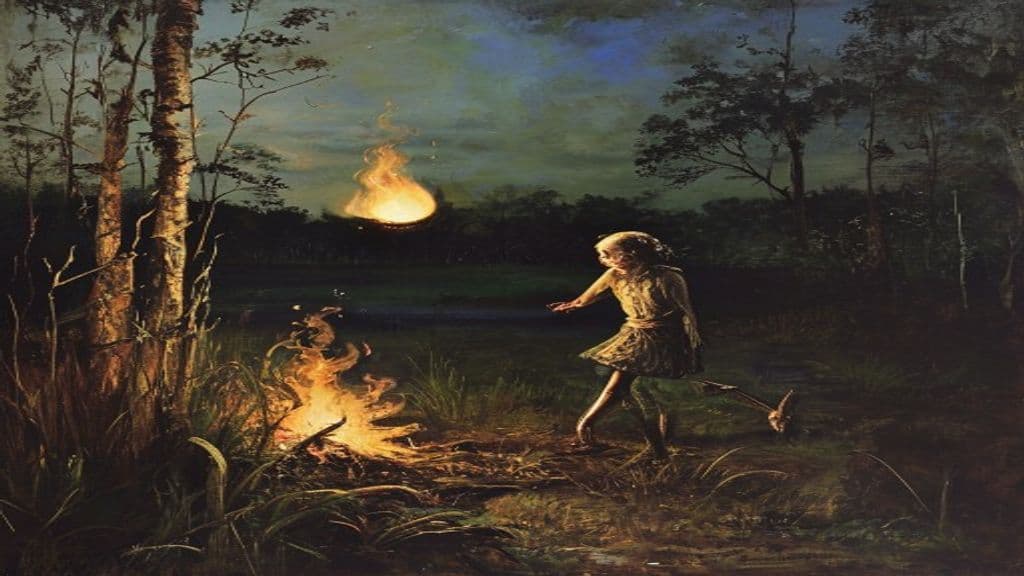
There is no single origin story; names and etiologies vary by region. Folkloric explanations include wandering lights of nature-spirits, souls of the dead (corpse/ghost candles), witches transformed into lights, returned souls performing penance (Louisiana fifollet), markers of buried treasure (Mexico, Paraguay), or serpent-like fiery beings (Brazilian Boi-tatá, from Old Tupi mboî tatá). The learned Latin term ignis fatuus ('foolish fire') appears in early modern literature (16th century) as a translation of German folk names such as Irrlicht rather than as an ancient Roman concept. Modern scientific interpretations (chemiluminescence from gases produced by organic decay) are separate, post-folklore explanations noted alongside traditional accounts.
High-level common features recorded across sources: a small, flickering, dancing or floating ball or lamp-like light seen at night, often hovering low over ground, especially marshes, bogs, or graveyards. Regional variants supply distinct imagery: the Brazilian Boi-tatá described with great fiery eyes and serpentine form (mboî tatá), the Argentine/Uruguayan luz mala as an extremely shiny ball of light floating a few inches above the ground, and graveyard variants referred to as ghost or corpse candles appearing among graves.
Folkloric behaviors include wandering or dancing motion and the tendency to resemble lamps or lanterns that may lead travellers astray or, alternately, guide them; when followed or closely observed the lights commonly seem to fade or disappear. Some local traditions attribute harmful actions to particular variants: the Louisiana fifollet is described as a returned soul that mostly mischiefs but sometimes attacks or sucks the blood of children; the Boi-tatá is said to eat the eyes of animals and corpses and to possess great fiery gaze at night. Other traditions treat the lights as indicators of buried treasure or as omens. Modern scientific accounts interpret some sightings as natural chemiluminescent phenomena caused by oxidation of gases (phosphine, diphosphane, methane) from organic decay.
Weaknesses
- conditionbeing observed closely (commonly causes the light to fade or disappear)
Wards
- othernone attested in provided sources
Abraun
Abraun is an attested name in German-language plant-legend scholarship (Der abraun, ein beitrag zur pflanzensagenkunde, 1916) and a short database entry (Wikidata) labels it as a spirit from German mythology. Surviving accessible documentation is extremely limited: the principal academic treatment is a 1916 contribution to pflanzensagenkunde (plant-saga studies), but the excerpts available here contain only bibliographic metadata and do not record tales, descriptions, or rituals.
Alp
A German-speaking folkloric figure associated with nocturnal disturbance of sleepers. Historically tied to the broader Germanic family of 'elves' and treated variously as an eerie nature-being in medieval glosses and as a male nocturnal spirit in later folk accounts that sits on sleepers' chests and causes nightmares (Alptraum) and 'elf-pressure' (Alpdruck).
Alp-luachra
Alp-luachra is an Irish folkloric fairy described as an invisible being that consumes half of a person's nourishment by taking the unseen 'pith' or 'quintessence' of food; accounts say it appears in the form of a newt and crawls down a sleeping person's mouth at water margins.
Aufhocker
The Aufhocker is a German folkloric shapeshifting 'pressure' or 'perching' spirit that leaps upon the backs or shoulders of solitary travelers, weighing them down with each step until victims become exhausted, incapacitated, or—in some variants—killed. It is associated with liminal places (bridges, crossroads, hollow paths, cemeteries) and exists in multiple narrative roles including punitive agent, nightmare embodiment, and theriomorphic attacker.
Bergmönch
A German mountain spirit associated with pits and mines; described as a hooded, giant figure who aids favored miners and punishes those who offend him or violate mining-community mores. He appears in mining locales and may manifest as a monk-like giant, a miner, a horse, or become invisible.
Bieresel
A German household/local spirit associated with beer, breweries, inns and cellars, the Bieresel alternates between helping by performing chores in exchange for a nightly portion of beer and causing mischief or harm when neglected; some regional variants in Thuringia and former German‑speaking Bohemia depict street‑roaming, aufhocken behavior.
Biróg
Biróg (also Biroge, Birog of the Mountain) is a female supernatural helper in Irish narrative tradition who aids Mac Cinnfhaelaidh/Cian in gaining access to the imprisoned Ethniu and rescues the surviving infant of that union; later retellings variably portray her as a leanan sídhe (female familiar spirit), a filidh (poet/seer), or a druidess.
Buschgroßmutter
A female wood/forest spirit of German folklore, especially attested in Thuringia, Saxony, German Silesia and parts of Bohemia and Transylvanian Saxon tradition. She is an ancient, ambivalent grandmotherly figure of the underwood who may reward respectful helpers or punish mockery and transgression of forest norms.
Cat sìth
A feline supernatural being in Celtic folklore, especially Scottish tradition, described in some accounts as a large black cat with a white spot on its chest associated with the fairy/otherworld; alternative traditions identify it as a witch able to transform into a cat up to nine times.
Clurichaun
A solitary Irish fairy-like household and cellar spirit associated with drinking places (breweries, pubs, wine cellars). He is a heavy drinker and smoker, a mischievous trickster who can also act as a protective domestic spirit for a household that tolerates him; accounts are primarily from 19th-century collectors and later summaries.
Crom Dubh
Crom Dubh is a fluid mythological and folkloric figure from Irish tradition, variously represented as a remnant cultic god, a pagan chieftain or robber, a servant-figure, and the focal figure of seasonal first-fruits rites (Crom Dubh Sunday). In later narratives he is frequently framed as an antagonist subdued or reinterpreted by St. Patrick.
Drak
The Drak is a household spirit in German folklore, attested under several regional names and frequently identified with the kobold or the devil (Teufel). Surviving references are brief and primarily classificatory, indicating a household-associated supernatural figure with variable local naming and associations.
Community Record
- [1]Will-o'-the-wisp. Wikipedia, 'Will-o'-the-wisp'.wiki
- [2]will o' the wisp (Wikidata). Wikidata entry Q160569.wiki