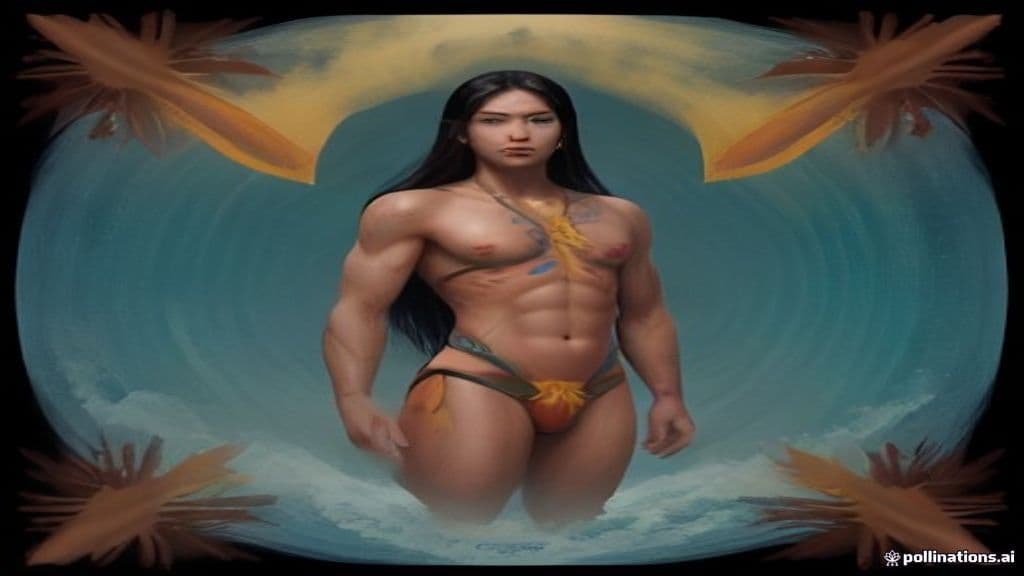
In Hawaiian genealogical cosmology Wākea (whose name means expansive space, zenith, or heaven) is the sky parent who, together with Papahānaumoku (the earth mother), produces the islands, staple crops, and human lineages. Variants record Wākea and Papahānaumoku creating land and sea from Papahānaumoku's calabash (‘ipu); in some accounts Wākea throws the calabash up to become the heavens, makes rain from its juice, and fashions the sun, moon, and stars from seeds he made (Wikipedia). Wākea is described as the ancestor of the aliʻi and as a High Chief when on earth; genealogical placements in the sources name him as a son of Kahiko ('Ancient One') in tradition (Wikipedia; Internet Sacred Text Archive).
Traditional sources provided in the cited corpus offer little sustained physical description or fixed iconography of Wākea; he is primarily represented as a sky/ancestral force and progenitor rather than by detailed bodily features. The meaning of his name—expansive space or zenith—frames him conceptually as the personification or agency of the sky and celestial expanse, and some narratives also present him as a High Chief when dwelling on earth (Wikipedia; Internet Sacred Text Archive).
Accounts attribute cosmogenic actions to Wākea in certain versions: co‑creating islands with Papahānaumoku, forming land and sea from Papahānaumoku's calabash, producing rain from its juice, and making the sun, moon and stars from seeds (Wikipedia). He is the progenitor in the origin of kalo (taro) and humans: after an incestuous union with his daughter Hoʻohokukalani the stillborn child Haloa‑naka becomes the first kalo and a later child, Haloa, becomes the first human—establishing the reciprocal kinship between land and people (Wikipedia; Internet Sacred Text Archive). Socially and ritually, Wākea institutes the ʻaikapu (a sacred eating regimen separating men and women and specifying food taboos) and is associated with priestly authority (his first high priest is named Komoʻawa in the sources). He is also described as the destination where departed souls are judged for purity; the impure are sent to Lua‑o‑Milu while the pure remain in his realm (Wikipedia).
Community Record
- [1]Wākea. Wikipedia: Wākea (entry summarizing Hawaiian mythic traditions, etymology, cosmogenic acts, genealogies, ʻaikapu, Komoʻawa, Haloa narrative, and afterlife adjudication).wiki
- [2]Hawaiian Mythology: Part Three. The Chiefs: XX. Papa and .... Internet Sacred Text Archive: Hawaiian Mythology (accounts of Papa and Wākea including the Haloa narrative and genealogical material).folk
- [3]Mauna a Wākea — Terra Incognita Media. Terrain Incognita Media feature discussing contemporary invocations of Mauna a Wākea (Mauna Kea) as sacred and linked to the Sky Father in modern cultural and activist contexts.other
- [4]First Light: Kanaka 'Oiwi Resistance to Settler Science at Mauna a Wakea. Reference to contemporary work treating Wākea/Mauna a Wākea in present‑day cultural and scientific contestation (cited in research notes).other
- [5]The Triumph of Wakea. A Mythological Reoccurrence (ScholarSpace Manoa reference). Scholarly title referenced in the research notes addressing Wakea's role in mytho‑historical patterns and chiefly sovereignty.academic
- [6]Last Real Indians: Niijii Radio summary — Mauna Kea. Radio summary referenced in research notes linking Mauna Kea to Wakea in contemporary discourse.other