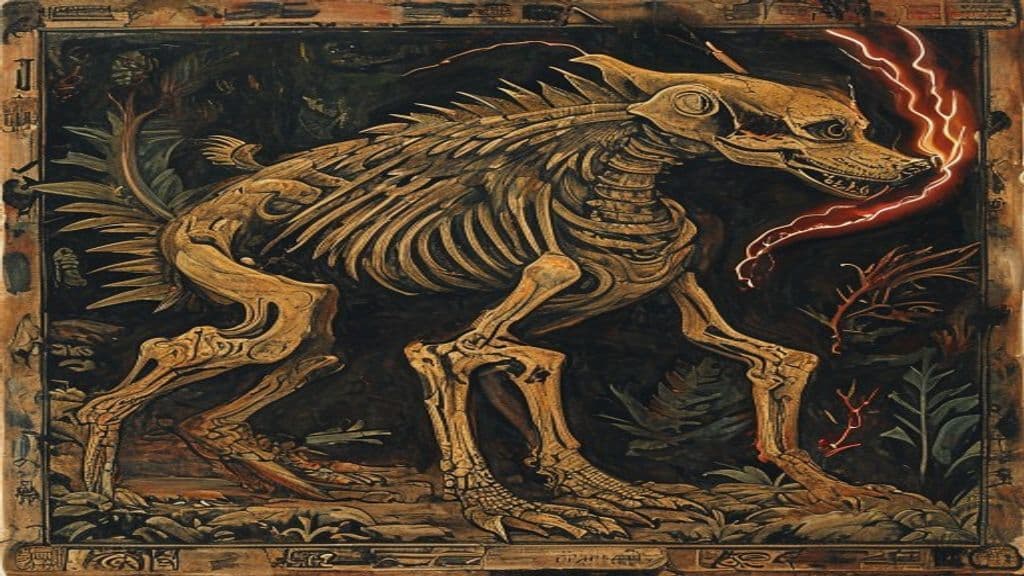
In Aztec mythic tradition Xolotl is the canine twin or brother of Quetzalcōātl and participates in creation episodes and the cycle of suns. Notably, in the retrieval-of-bones myth Xolotl accompanies Quetzalcōātl into Mictlān to obtain the bones of prior peoples so that humans for the present era can be remade. In one account Xolotl refuses or withdraws from a sacrificial act, transforms repeatedly (into doubled plant forms and an amphibious animal) to avoid being sacrificed, and in some versions is later slain—narratives that place him among the gods whose deaths or sacrifices enable cosmic renewal. Scholarly readings (e.g., Eduard Seler as reported in summaries) interpret his twin status as part of a darkness/lightness twin motif, though this interpretation is an academic hypothesis recorded in secondary sources.
Sources commonly depict Xolotl as a dog-headed man, a skeletal canine, or a deformed monster often shown with reversed feet; pictorial manuscripts and ethnographic summaries also associate him with torch- or lightning-bearing canine imagery. Material-culture attestations linked in summaries include censers and representations interpreted as skeletal canines, and archaeological finds of dog remains and dog sculptures in burials that connect the deity's canine aspect to funerary practice. A Teotihuacan legend recorded in sources offers an explanatory motif for his empty eye sockets (he wept so much his eyes fell out), which appears in artistic representation.
Xolotl is described as a psychopomp who guides the dead to Mictlān and as the necessary escort for souls (hence dogs placed with the dead), a protector and helper for Quetzalcōātl in underworld retrievals of bones, and a transformer who in myths changes into doubled plant forms and an amphibious creature (linked to the axolotl) to evade sacrifice. He is also identified with fire and lightning and with the evening aspect of Venus (the Evening Star), and is associated with misfortune, sickness, monsters, twins, and deformity—domains that mark boundary states and anomalous conditions in Aztec cosmology.
Weaknesses
None recorded.
Wards
- ritualfunerary provision of dogs or dog effigies

Wākea
Wākea is the Hawaiian Sky father and primordial ancestral progenitor who, with Papahānaumoku, forms the founding parent‑couple of the Hawaiian cosmos and chiefly genealogies. He is credited in some accounts with cosmogenic acts (creating islands, heavens, rain, and celestial bodies), is ancestor of the aliʻi, and is associated with moral adjudication of departed souls.
Wōden
Wōden (reconstructed Proto‑Germanic Wōðanaz) is the chief figure of Germanic paganism attested across Norse mythological sources and historical records of Northern Europe; scholarship reconstructs his name as linked to frenzy or possession and to poetic inspiration. Surviving information about him comes largely from medieval Norse literature and later historical commentaries of the Germanic world.
Xanthe
Xanthe (Greek: Ξανθή, Xanthē) is primarily a Greek-derived personal name meaning "blond-haired" attested across mythological, toponymic, astronomical, and modern personal-name usages. In the supplied sources it appears as the name borne by multiple distinct figures in Greek myth (an Oceanid, an Amazon, and as an alternate name applied to Epione) and as a modern given name and place/asteroid name, rather than as a single unified supernatural entity with its own cult or powers.
Xanthus (Ξάνθος)
Xanthus (Ancient Greek: Ξάνθος) is a recurring proper name in Greek myth and geography applied to multiple distinct beings and places: a river-personification (the divine name for the Scamander at Troy), one of Achilles' pair of immortal horses, several mortal figures (e.g., a Theban king), and the Lycian city and river Xanthus/Xanthos. The name literally means "yellow" or "blond" and functions as a descriptive epithet transferred across persons, animals, and places.
Xezbeth
Xezbeth (alt. Shezbeth; Arabic: al‑Kadhāb, "The Liar") is attested in Western demonological reference works and modern creative uses as a named demon associated with lies, invented tales, and the propagation of false legends.
Xoanon (Greek)
A wooden cult image used in Archaic Greece, often associated with deities or legendary figures. (Note: - Power tier should be Primordial (since Xoana are described as having spiritual significance and being associated with legendary figures/deities, implying they may have had more fundamental or univer)
Xtabay
A supernatural being in Maya tradition, described as a 'demonic femme fatale' who preys upon men in the Yucatán Peninsula. (Note: 1. Power tier should be Primordial, as Xtabay's described abilities have no clear limits in the region and imply an otherworldly power. 2. Origin story: add that it is inferred from the context of May)
Xuan Wu (Xuanwu Dadi)
Xuan Wu, often titled Xuan Wu Dadi, is a Taoist deity associated with the north and with water who functions as a protective and martial tutelary figure; he was venerated in popular Taoist religion and incorporated into state cult practice (notably honored as a tutelary patron during the Ming dynasty).
Yakka (Yakka Deviyo)
Yakka (Yakka Deviyo) is a name attested in Sri Lankan contexts as a term for spirit-beings or deities in island traditions. The single provided source does not supply description, functions, or rituals for Yakka; it only situates the broader religious landscape of the Kataragama shrine complex where many local deities are venerated.
Yakrub-El
Yakrub-El (also attested Ikrub-El) is a local Old Babylonian–period divine figure attested in the Mari/Terqa corpus. Scholarly treatments present him as a district-level deity of Terqa whose name and cultary role reflect a deified personal-name type (e.g., a clan ancestor or chief) integrated into civic ritual, legal practice, and oracular correspondence.
Yaksha
Nature spirits of Hindu, Buddhist, and Jain cosmology — guardians of forests, treasures, and wilderness. Ambivalent beings, capable of great benevolence to the respectful and terrible harm to the greedy.
Yakshi
A class of female nature-spirits in South Asian religious and folk traditions associated with sacred groves, fertility, and the liminal boundaries of sacred enclosures. Represented in Hindu, Buddhist, and Jain contexts and in regional folklore, with archaeological and artistic attestations dating to antiquity.
Community Record
- [1]Xolotl. Wikipedia, article 'Xolotl' (access provided in research notes)wiki
- [2]Wikidata item for Xolotl. Wikidata item cited in research notesother
- [3]Mapa de Hueyapan (archive record). Archive entry cited in research notes (contextual archive material)other
- [4]Indie Game Gauntlet Vol. 4! [v1928147031] (archive record). Archive entry cited in research notes (modern cultural reference)other
- [5]El laboratorio del Dr. Levin (archive record). Archive entry cited in research notes (modern cultural reference)other