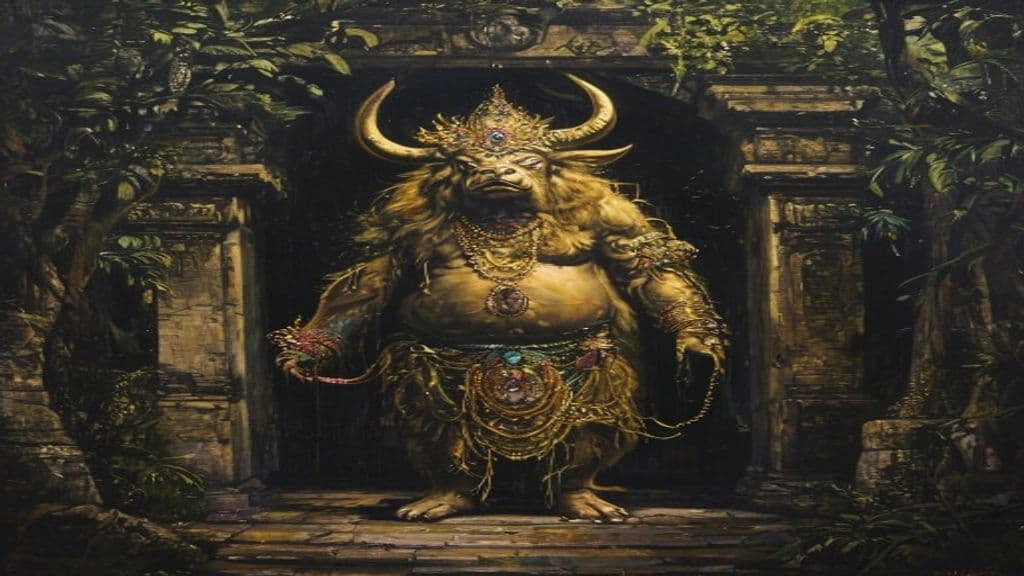
The Yakshas (and their female counterparts, Yakshinis) are among the oldest beings in Indic religion, attested in Vedic literature as guardians of the wild places. Their king is Kubera, lord of wealth.
Over millennia they have been absorbed into both Buddhist and Jain cosmologies, appearing as guardian figures at the gates of stupas and temples across Asia, from Bharhut in India to the temples of Java and Thailand.
The source does not supply detailed universal physical descriptions for Yakshas/Yakshinis. It notes, however, that they appear in ancient and medieval South and Southeast Asian temples as guardian deities—indicating a prominent role in sculpture and iconography associated with sacred architecture. The source does not record standardized morphological traits, only that they are represented in temple contexts.
According to the provided material, Yakshas/Yakshinis are associated functionally with natural sites and forces (water, trees, forests, wilderness) and with material abundance (treasure) and fertility. They function as guardians of particular places such as temples, groves, and water sources and are characterized as usually benevolent but sometimes mischievous or capricious. The source does not enumerate discrete supernatural powers beyond these roles and associations.
Weaknesses
- conditionCannot break a vow once given — bound by the rules of their nature
Wards
- ritualOfferings of flowers, rice, and milk at sacred trees and shrines
- symbolYaksha figures carved at gates and thresholds
Community Record
- [1]Yaksas: Essays in the Water Cosmology. Coomaraswamy, Ananda K. 1928. Yaksas. Smithsonian Institution.academic
- [2]The Mahabharata. Vyasa. c. 4th century BCE. Mahabharata. Book 3, Vana Parva, Yaksha Prashna.literary
- [3]Yaksha/Yakshini (Nature-spirits/guardian spirits). Wikipedia contributors. "Yaksha." Wikipedia, The Free Encyclopedia. https://en.wikipedia.org/wiki/Yakshawiki