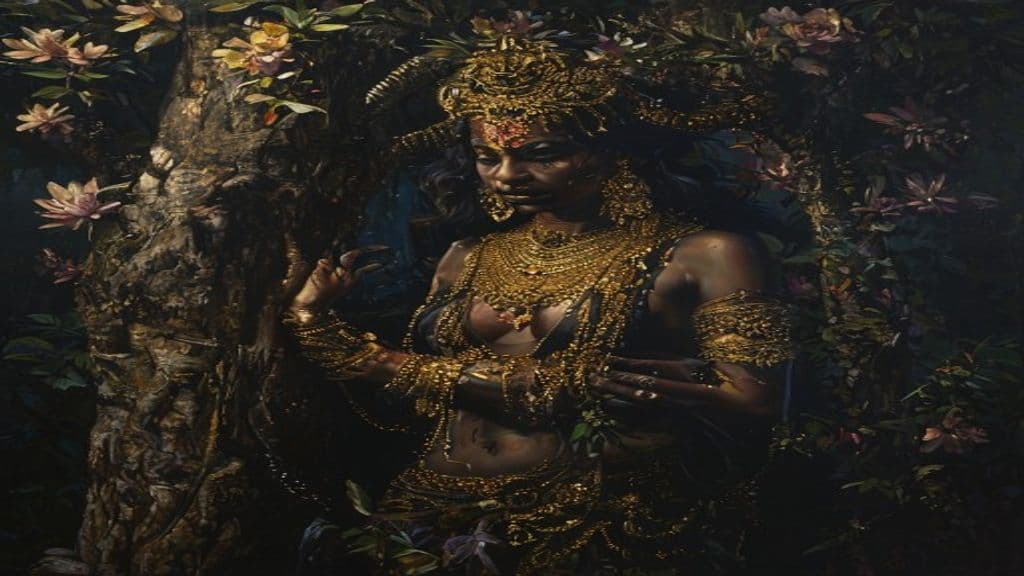
Yakshinis appear in all three major South Asian religious traditions — making them one of the oldest and most cross-culturally attested supernatural classes in the subcontinent. In Hindu tradition, they are part of the retinue of Kubera, the god of wealth, and are associated with fertility, trees, hidden treasure, and the generative abundance of the forest. Their male counterparts, the Yakshas, appear in the Mahabharata's famous Yaksha Prashna — the series of riddles posed to Yudhishthira at a sacred lake.
The Uddamareshvara Tantra (attributed to Shiva's instructions to Parvati) contains detailed descriptions of 36 named Yakshinis, each with her specific appearance, the offerings she requires, and the precise powers granted to someone who successfully completes her sadhana. This text treats Yakshinis not as beings to be feared but as beings to be engaged — a transaction between human and nature spirit, with specific terms.
The Yakshini is typically depicted as a voluptuous woman of extraordinary beauty, emerging from or intimately associated with a specific species of tree — pipal, mango, kadamba, or banyan, depending on the Yakshini. Her skin may be dark, forest-green, or golden. She wears heavy gold jewellery and garlands of flowers, and is often shown reaching upward into the branches, her body forming a continuity with the tree.
In encounter accounts, she appears as a beautiful woman standing at the base of a large tree at dusk or night. Her feet may not quite touch the ground. Several accounts across North India describe an overwhelming scent of flowers — specific to her tree's bloom — that arrives before she is seen.
A propitiated Yakshini grants her primary function as a Kubera-servant: material prosperity, hidden treasure revealed, and protection of the household. She can also grant beauty and attract love relationships, according to the Uddamareshvara Tantra's specific prescriptions for each of the 36.
When angered — by cutting her tree, urinating near it, approaching without ritual acknowledgment, or breaking a compact made during sadhana — she causes sudden swelling illness, skin conditions, miscarriage, and afflictions of the lower body. Entire villages near a large felled pipal tree have attributed subsequent misfortune to a displaced Yakshini.
Weaknesses
- ritualCorrect Yakshini propitiation sadhana from Uddamareshvara Tantra
Wards
- substanceRed thread and flowers tied at the tree's base before felling
- ritualRequesting permission from the tree before cutting — in the form of an apology and a small offering
Abhinandananātha
Abhinandananātha is the fourth Tīrthaṅkara (ford-maker) of the current Jain cosmic age (avasarpini). Traditional accounts place his birth in Ayodhyā to the Ikshvāku (Solar) dynasty, describe his renunciation and attainment of omniscience beneath a priyangu tree, and record his liberation on Mount Śikharjī.
Adi (asura)
Adi is attested in modern reference works as the name of an Asura who 'appears in the Matsya Purāṇa.' Beyond this single-line citation in secondary sources, no descriptive material about the figure is provided in the supplied research notes.
Adi Shakti
Adi Shakti (also Adi Parashakti, Mahadevi, Adya Shakti) is the primordial feminine power in Hindu/Shakta theology, regarded as the ultimate reality (Para Brahman) and the source from which all goddesses and gods manifest. She is both an impersonal cosmic principle (Mulaprakriti) and a focus of devotional invocation in temples, mantras, and pilgrimage sites such as Shakti Peethas.
Adi Vinayaka
Adi Vinayaka (Ādi Vināyaka; also called Nara Mukha Vinayaka) is a named iconographic and devotional form of the Hindu god Ganesha portraying the deity with a human head, described in sources as the form before the episode of decapitation by Shiva. It is rarely worshipped and appears in a small number of South Indian shrines and in devotional/musical repertoires.
Aditi
Aditi is a major Vedic goddess in Hindu tradition who personifies the boundless, infinite cosmic principle and functions as the maternal matrix from which many celestial deities (the Ādityas and other groups) are born. In the Vedic hymns she is invoked as a protective liberator who guards petitioners, provides wealth and safety, and frees devotees from hindrances such as sin and sickness.
Agiya Baital
The fire-form of the Vetala — a cremation ground spirit of UP and Bihar that manifests as a wandering flame rather than a corpse-inhabitor, leading night travellers off roads and into marshland or flames with a dancing fire that seems always just ahead.
Agni
Agni is the Vedic personification of fire in Hindu tradition: a sacred, mediating principle that manifests as terrestrial fire, atmospheric lightning, and celestial sun, and that receives and conveys sacrificial offerings. Prominent in the Rigvedic corpus, Agni functions as sanctifier, witness of rites of passage, and a transformational inner principle in later Upanishadic literature.
Ahalya
Ahalya is a mytho-legendary woman of South Asian (primarily Hindu) narrative tradition, described as created by the god Brahma, married to the sage Gautama, seduced (or tricked) by Indra, cursed by her husband, and ultimately redeemed by Rama. Her tale is a locus for themes of creation, desire, curse/penance, and redemption and she is counted among the ritual-mnemonic panchakanya.
Aindri (Indrani / Shachi / Paulomi)
Aindri (commonly rendered in sources as Indrani, also called Shachi or Paulomi) is a Hindu goddess presented as the queen-consort of Indra. She is depicted in the available material as a courtly queen associated with beauty, pride and kindness who also appears in at least one account as an active martial participant in the devas' battles with asuras.
Ajitanātha
Ajitanātha is the second tirthankara of the current cosmic age in Jainism: an enlightened spiritual teacher who renounced worldly life, attained omniscience (kevalajñāna), and achieved liberation (moksha), and who is credited with establishing a large four-part monastic order in the tradition's hagiography.
Akshayavata
In Hindu mythology, Akshayavata is a sacred banyan tree and/or lake that symbolizes eternal life. It is mentioned in both Hindu and Jain traditions and associated with the Puranas. (Note: - The power tier should be "Greater" or at least "Ancient", as it is associated with the Puranas, which are considered ancient texts. - No specific physical description is provided, but that doesn't m)
Alakshmi
Alakshmi is an inauspicious female supernatural figure in Hindu tradition, presented as the negation or shadow-counterpart of the prosperity-goddess Lakshmi. She personifies poverty, grief, jealousy and social discord and is managed in domestic ritual and festival practice.
Jokhini (Jokkhini) is the Bengali-Assamese regional form — a beautiful spirit haunting rivers and forests who leads travellers astray. Yakshini is the pan-Indian Yaksha-class spirit from Vedic-Puranic cosmology, often a guardian or tree-spirit with a much wider documented tradition.
Community Record
- [1]Uddamareshvara Tantra — the 36 Yakshinis. Shastri, H.P. (1926). Catalogue of Palm-Leaf MSS in the Durbar Library, Nepal, Vol. 3. Calcutta.academic
- [2]Yakshis in Indian art and religion. Coomaraswamy, A.K. (1928). Yaksas: Essays in the Water Cosmology. Smithsonian Institution, Washington D.C.academic
- [3]Yakshini — Wikipedia. Wikipedia contributors. Yakshini. Wikipedia, 2024.wiki