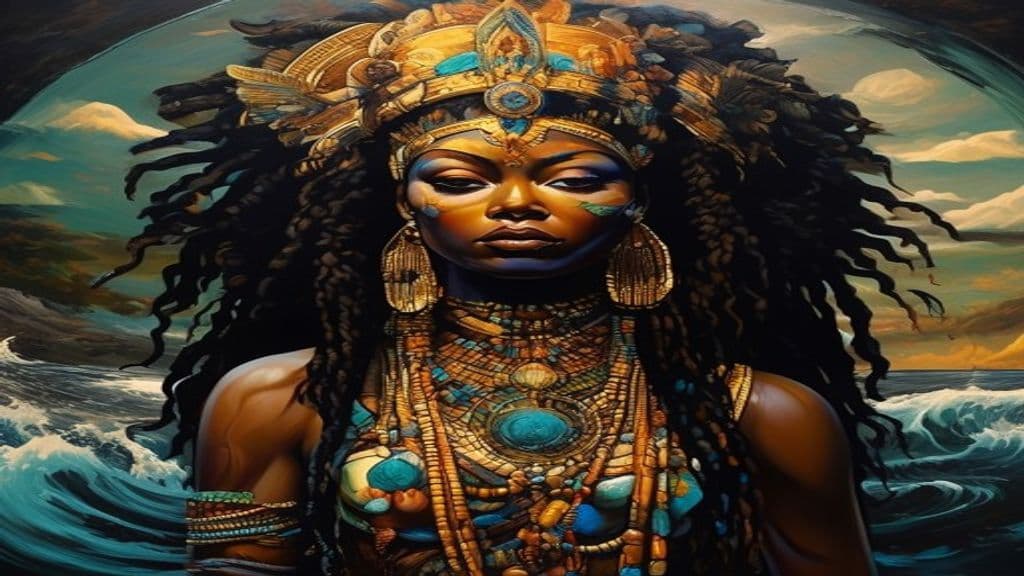
Within Yoruba cosmology Yemọja is an orisha—one of the divine forces active in creation and human life. The source records that some priests of Yemọja teach she contributed fresh water to Ọbàtálá during the molding of human beings from clay, indicating a role in certain priestly accounts of human formation. This attribution situates her as a cooperating divine agent in creation narratives rather than presenting a single, universally authoritative origin myth across all Yoruba and diasporic communities.
The provided source does not supply a standardized physical description or iconography. It does note symbolic attributes commonly linked to her in the recorded tradition: association with rivers and oceans and the use of cowrie shells as a symbol of her wealth. In Afro-Cuban contexts she is frequently syncretized with Marian images such as Our Lady of Regla, indicating that visual representations may vary by locale and historical circumstance rather than following a single canonical likeness.
The source describes Yemọja primarily in maternal and restorative terms: she is ‘‘motherly and strongly protective,’’ caring for her children by comforting them and cleansing them of sorrow. She is said to be able to cure infertility in women and is associated with wealth symbolism (cowrie shells). Her domain is water—patron of rivers in Yorubaland and of the ocean in Cuban and Brazilian Orisha religions—and her temperament reflects water’s dual nature: generally patient but capable of pronounced destructiveness when angered, comparable to flood waters. Additionally, priestly teachings attribute to her a creative function in some accounts, supplying fresh water to assist Ọbàtálá in molding humans from clay. The source also records occasional association or overlap with the water deity Olokun, suggesting shared or related aspects of watery power within the tradition.

Ajogun
Ajogun are a class of malevolent spiritual forces in the Yoruba religious worldview that regularly interfere with human lives, responsible for death, disease, curses, loss, conflict and related misfortunes. They are described as the polar opposite of the benevolent Oriṣa, led by Iku (Death), and can be warded off or appeased through intercession by Eṣu and by observing Ifá divinatory counsel.
Egungun (ancestral masquerade spirits)
Egungun refers both to Yoruba masked, costumed masquerades and to the collective force of departed ancestors who manifest through those masquerades. In performance the layered costumes are treated as a dwelling for ancestor presence; egungun appear periodically—especially at annual festivals—to remember the dead, bless the community, and mediate between the living and the otherworld.
Gelede (Gẹlẹdẹ)
Gelede is a Yoruba public masquerade spectacle and the ritual institution that honors and manages the spiritual power of 'Mothers' (senior women, female ancestors and deities). As a multi-media performance of carved and painted headdresses, masks, dance and music, Gelede functions to celebrate fertility and motherhood, educate the community, and placate potentially dangerous female powers.
Obalufon Alayemore
Obalufon Alayemore (Ọbalùfọ̀n II, Alayemore) is a historical Ooni of Ile Ife who was deified after death and is venerated in the Yoruba religious-cultural corpus as an oríṣa and patron of art, weaving, and bronze/brass casting. He appears in royal succession lists as the third Ooni of Ife and is associated with material-culture representations such as brass heads and masks.
Obatala
Obatala is a high-ranking primordial orisha in the Yoruba religious framework, widely described as the sculptor of humankind who molds human bodies and is regarded as father of humanity and owner of all heads. He is associated with wisdom, coolness of thought, and senior or royal status among the orisha; some traditions connect him to the founding of Ife.
Odùduwà
Divine king and Oriṣa in the Yoruba religion, progenitor of the Ife Empire. (Note: - Power tier is uncertain; source material does not provide clear information on Odùduwà's abilities or power level. - Appearance should be included for completeness. - Abilities need to be rewritten,)
Orisha
Orisha (Òrìṣà) are named divine or supernatural figures in Yoruba religious thought and its Afro‑diasporic continuations (for example, Candomblé and Cuban Yoruba associations). They function as central agents of worship, ritual engagement, and divinatory communication in Yoruba communal and individual religious life.
Oriṣa (Orisha / Orixá)
Oriṣa (Yoruba: òrìṣà; Portuguese: orixá; Spanish variants: orisha, oricha, orichá) are the class of divine spirits or deities central to the Yoruba religion of West Africa and to Yoruba-derived religious systems in the Atlantic diaspora (notably Lucumí/Santería in Cuba and Candomblé in Brazil). They function as active sacred presences and intermediaries in communal and individual religious life; in diaspora settings they were often syncretized with Catholic saints as a strategy of continuity under colonial Christian rule.
Oshun
Oshun (Ọṣun, Ochún, Oxúm) is a major orisha and Irunmole in the Yoruba religious corpus and its diasporic traditions, associated with freshwater (rivers), love, fertility, femininity, divination, prosperity and beauty. She is honored at the Osun-Osogbo Sacred Grove and in festivals and ritual forms across Yorubaland and Afro‑Atlantic religions such as Candomblé and Regla de Ocha/Santería.
Sopona (Ṣọ̀pọ̀na, Shapona)
Sopona is the Yoruba orisha associated with smallpox and related illnesses; the deity is understood to be capable of causing outbreaks through divine displeasure and—in traditions that identify him with Ọbaluaye/Obaluaiye—exists within a wider power to both afflict and remove pestilence. Beliefs about Sopona traveled with Yoruba peoples to the Americas and were syncretized in Orisha-based religions (e.g., as Babalú-Ayé).
Èṣù
Èṣù is a central orìṣà in the Yoruba religious system associated with trickery, chance, crossroads, judgement, duality, and languages. Described as a primordial divinity who descended from Ìkọ̀lé Ọ̀run, he functions as an intermediary who enforces natural and divine laws and governs liminal spaces and communication.
Ògún
Ògún (also Ogum, Gu, Egu) is a major West African and diaspora deity (orisha/vodun) associated with iron, metalworking, hunting, war and the crafts that use iron. In Yoruba cosmology he is described in some traditions as an Irunmọlẹ (primordial orisha) who cleared a path for other orisha and functions as patron and protector for blacksmiths, hunters, warriors, drivers and related occupations.
Community Record
- [1]Yemoja (Yemọja, mother of waters) — Wikipedia. Wikipedia entry "Yemoja (Yemọja, mother of waters)"wiki