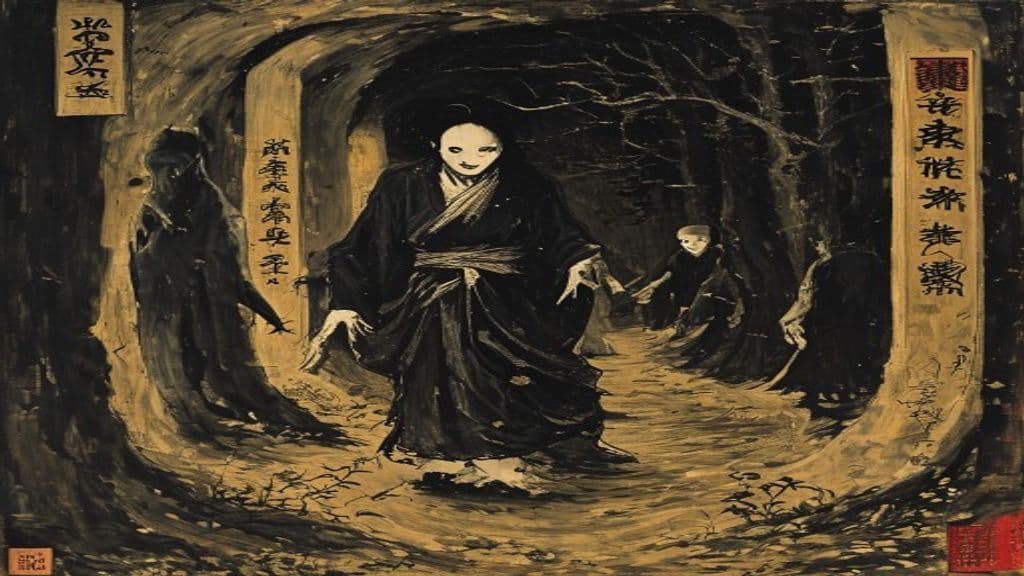
Within syncretic Shinto–Buddhist frameworks, when a person dies their reikon (霊魂) leaves the body and enters a liminal purgatorial state, waiting for proper funeral and post-funeral rites; if rites are incomplete, death is sudden or violent, or intense emotions (revenge, love, jealousy, sorrow) remain, the reikon can become a yūrei that returns to the world of the living. Social factors such as rank and the circumstances of death shape how and whether a reikon manifests as a potent haunting (examples in tradition include tales of Oiwa and Okiku as victims whose violent deaths produced powerful revenants).
Sources treat yūrei as attenuated or insubstantial presences (the name itself combines kanji for 'faint/dim' and 'soul/spirit'). While no single canonical physical description is exhaustively given in the supplied material, visual and narrative traditions frequently portray partial, faint apparitions; artistic series and popular tales often show pale, floating figures and regional accounts commonly report sightings of a 'ghostly woman in white.' The supplied excerpts caution that these motifs are common in art and local legend but stop short of defining a universal costume or exhaustive iconography.
Yūrei are described as reikon that bridge back to the physical world: they linger, haunt locations or people connected to their death or emotional ties, and remain until the missing rites are performed or their emotional cause is resolved. Specific subtypes display characteristic behaviors—onryō (vengeful spirits) may cause disaster or possession, ubume return to care for children, funayūrei haunt seas or ships, and zashiki-warashi act as mischievous child-spirits. Living spirits (ikiryō) can exhibit similar agency while their body remains alive. Sources emphasize these social and ritualized behaviors rather than grand cosmological powers.
Weaknesses
- conditionavoidance of reflective gaze (local anecdote)
Wards
- conditionavoidance/physical avoidance of haunted loci (practical caution as attested in Kiyotaki Tunnel accounts)
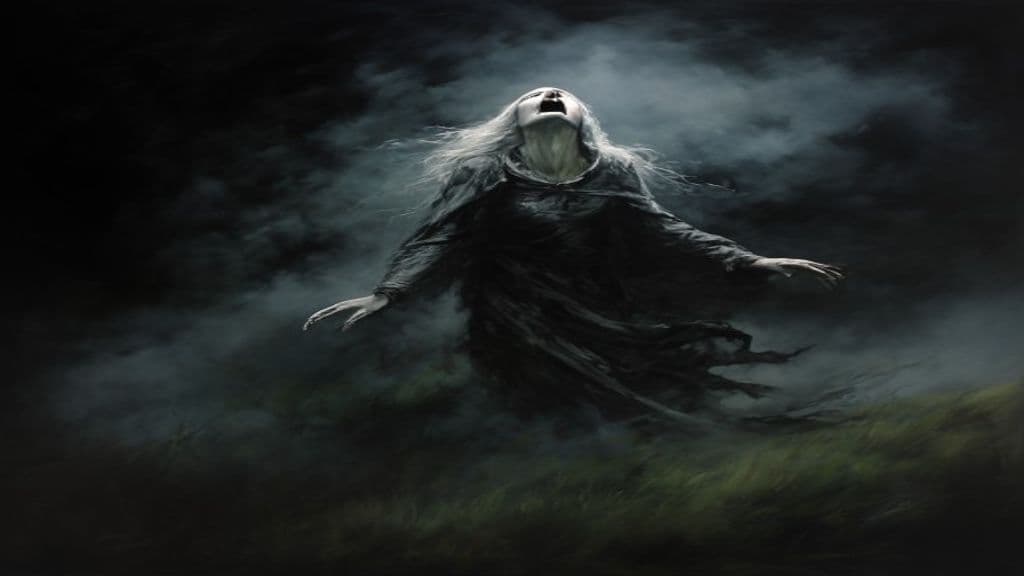
Banshee
A female spirit of Irish and Scottish folklore whose wail heralds an impending death in a family of Gaelic descent. Not a cause of death — a witness to it.
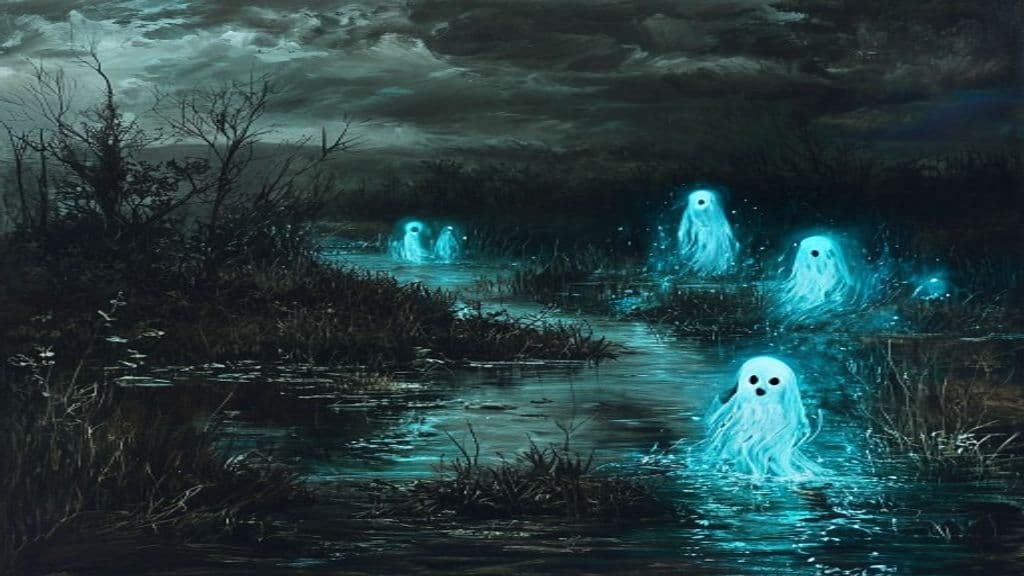
Will-o'-the-Wisp
A wandering light seen over marshy ground at night, leading travellers astray into bogs and fens. Possibly a spirit, possibly the soul of the unbaptised dead, possibly the devil himself.
Abumi-guchi
A Japanese yōkai classed as a tsukumogami: an animated stirrup (abumi) depicted in Sekien Toriyama's Gazu Hyakki Tsurezure Bukuro. Traditional accounts say it is formed from a stirrup that belonged to a soldier who fell in battle and that it waits where the stirrup lies for its dead owner to return.
Abura-sumashi
A yōkai spirit from the Amakusa region of Kumamoto Prefecture, Japan, said to inhabit mountain passes. Traditionally explained as the ghost of a person who stole oil, it appears to surprise travelers and is represented in modern media with a straw-coat body and a potato- or stone-like head.
Ajisukitakahikone
Ajisukitakahikone is a kami in Japanese mythic literature (Kojiki/Nihon Shoki). He appears in the transfer-of-rule cycle between heaven and earth, is described as a son of Ōkuninushi, associated with the Kamo cult (called Kamo no ōmikami in some modern museum/catalog entries), and features in narratives that explain landscape formation and meteorological genealogy.
Akaname
Akaname is a Japanese yōkai associated with baths, bathtubs, toilets, and other places where scum and filth accumulate. Traditionally depicted as a child-like creature that licks grime, it functions in folklore as a cautionary figure tied to cleanliness; a few narrative variants cast it as dangerously predatory.
Akateko
Akateko (赤手児, lit. 'red child's hand') is a yōkai from Japanese folklore commonly told as a small, red, disembodied child's hand that appears from trees—especially the Japanese honey locust—and startles travelers; in some regional variants it is accompanied by a specter of a young woman or manifests as paired foot- or leg-like apparitions. Accounts vary between mostly harmless trickster apparition and a violent variant that attacks humans.
Akubōzu
Akubōzu (灰坊主, Akubōzu) is a household yōkai from parts of Akita and Iwate Prefectures in northern Japan said to live in the ashes of the hearth. Sources say they appear when people (notably children) play with or dig in hearth/furnace ash; the figure is cited as part of a broader Tōhoku motif warning against disturbing ash.
Akuma
Akuma (悪魔/あくま) in Japanese sources is an evil spirit, devil, or demon associated with misfortune and mental disturbance. The term appears in Buddhist texts and Heian-period literature and was later used to translate the Christian figure of Satan, as well as the Buddhist Mara.
Akurojin-no-hi
Akurojin-no-hi (悪路神の火, "fire of the god of the bad road") is a flamelike ghost from the folklore of Mie Prefecture, Japan. It is reported to appear on rainy nights; those who encounter it and do not run away are said to become gravely ill. The phenomenon is sparsely documented and is usually compared to will-o'-the-wisp type ghost-lights.
Amabie
Amabie is a mid-19th-century Japanese yogenjū-type wondrous creature attested in kawaraban and related pamphlet culture that emerges from the sea (in canonical accounts) to prophesy about harvests and epidemics and prescribes that its image be drawn and shown to the sick as a protective measure.
Amanojaku
Amanojaku (天邪鬼 / あまのじゃく) is a Japanese yōkai-type being portrayed as a contrarian, heart-reading trickster. Treated in different contexts as a small ogre (ko-oni), a wicked demon (jaki) in Buddhist iconography, and a folkloric spirit that provokes human vice, it appears across regional tales with variable roles from malicious kidnapper to household oddity.
Amanozako
Amanozako is a Japanese divine/monstrous figure described in classical summaries as a furious, contrarian kami produced from the ferocious aspect (ara-mitama) of the storm-god Susanoo; later glosses present her as an ancestor-figure for ill-tempered yōkai such as tengu and amanojaku.
Amaterasu Ōmikami
Amaterasu Ōmikami is the sun deity and a principal kami in Shinto tradition, presented in classical Japanese sources as ruler of Takamagahara (the High Celestial Plain) and the mythic ancestress of the Imperial House through her grandson Ninigi. She is central to shrine cult at Ise and to ritual nomenclature and practice within institutional Shinto.
Community Record
- [1]Yūrei (Wikipedia). Wikipedia, entry 'Yūrei' (accessed via provided notes)wiki
- [2]Haunted Kyoto — Kiyotaki Tunnel accounts (Archive). Haunted Kyoto (archive source describing Kiyotaki Tunnel legends and local warnings)folk
- [3]Yurei (Magical Japanese) — NHK WORLD / Lafcadio Hearn reference. NHK WORLD program description referencing Lafcadio Hearn and Kwaidan (linking Matsue and literary treatment of yūrei)literary
- [4]Kosodate Yūrei – The Child-Raising Yūrei | Hyakumonogatari Kaidankai. Hyakumonogatari Kaidankai site (local tale and commentary on yūrei requiring a 'tether')folk
- [5]Aizuwakamatsu no Yurei – The Yurei of Aizuwakamatsu | Hyakumonogatari Kaidankai. Hyakumonogatari Kaidankai (regional yūrei tale)folk
- [6]One Hundred Ghost Stories. Reference to the Hyakumonogatari / kaidan storytelling tradition and its role in yūrei literaturewiki
- [7]Yurei: Discover the Chilling World and Tales of Japanese Ghosts (Voyapon). Popular overview summarizing cultural and visual traditions around yūreiother
- [8]Wikidata: Q135044606 (Yurei — video game entry). Wikidata entry Q135044606. http://www.wikidata.org/entity/Q135044606other
- [9]MIRROR MAN COMPLETE JUNIPERCLAW MINI MAP (Archive.org participant list). Archive.org. "MIRROR MAN COMPLETE JUNIPERCLAW MINI MAP" (participant list includes the string 'YUREI'). https://archive.org/details/mirror-man-complete-juniperclaw-mini-mapother
- [10]Yūrei (Mingei Gallery: Rosetsu entry / Hyakumonogatari Kaidankai context). Mingei Gallery entry linking Edo-period storytelling, Rosetsu paintings, and the codification of yūrei imagery; notes Hyakumonogatari Kaidankai as a cultural context.other
- [11]What’s the Difference Between Yurei and Yokai? | Hyakumonogatari Kaidankai. Hyakumonogatari Kaidankai: discussion of classification distinctions and storytelling practice.folk
- [12]Shinto Deities in Japan, Japanese Shinto-Buddhist Syncretic Deities. Summary noting syncretism between Shinto and Buddhist frameworks in Japan and their mutual influence on spirit beliefs.other