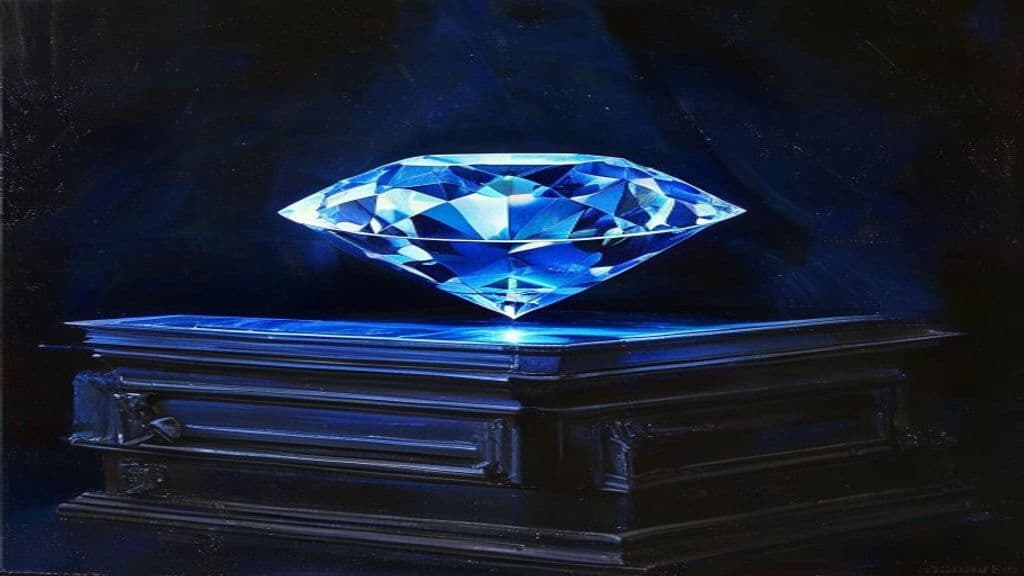
The Hope Diamond is a 45.52-carat fancy deep-blue diamond, one of the largest known blue diamonds in the world. It originated in the Golconda mines of the Deccan plateau — present-day Andhra Pradesh — which produced most of the world's historically significant diamonds before the 18th century. The stone was acquired by the French gem merchant Jean-Baptiste Tavernier around 1666 and sold to Louis XIV of France.
The curse tradition attached to the Hope Diamond is largely a 20th-century invention. A 1909 article in The Washington Post listed a series of supposed victims and their misfortunes. Researchers who traced the list found it was either fabricated or attributed misfortunes that had preceded ownership of the stone. The British banker Henry Philip Hope, who gave the diamond its name, lost his fortune — but this occurred independently of the stone, through unrelated family legal disputes.
What is empirically verified: the diamond emits a red phosphorescent glow after exposure to ultraviolet light — an unusual property caused by trace boron atoms in its crystal structure. The Smithsonian acquired it in 1958 when jeweller Harry Winston mailed it to the institution by registered post, insured for one million dollars. It has been on public display ever since.
Community Record
- [1]Hope Diamond. Wikipedia.wiki
- [2]The Smithsonian Hope Diamond. Smithsonian National Museum of Natural History.other