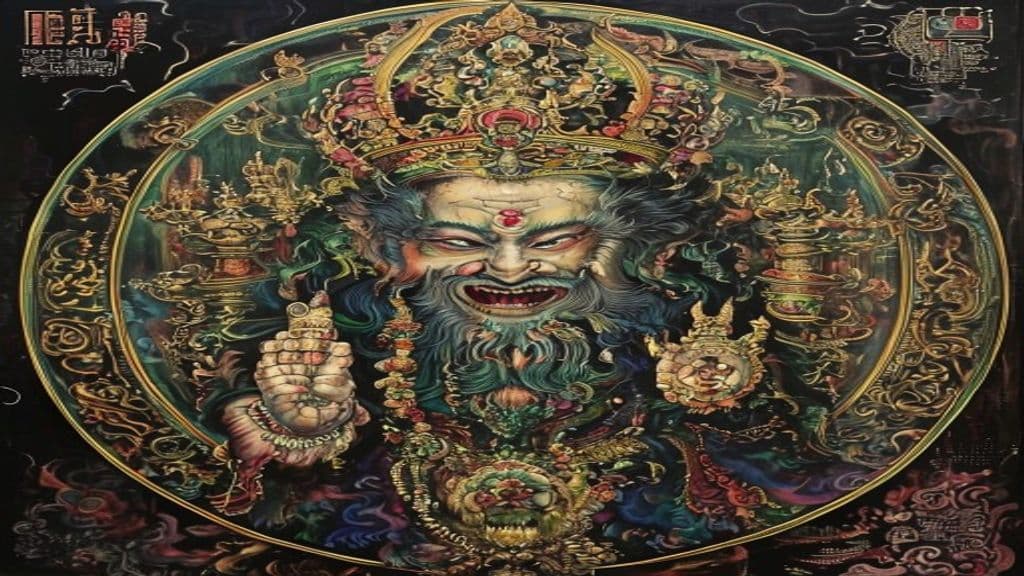
Within the tradition the Zhitro cycle is believed to present the deceased with the mandala of 100 peaceful and wrathful deities in the bardo and to provide teachings and practices that, if recognized or correctly applied, guide, instruct, and transform the deceased's bardo experiences toward liberation or a favorable rebirth.
The Zhitro cycle is a tantric corpus concerned with the intermediate state (bardo) between death and rebirth. It teaches that following dissolution of the body and consciousness the deceased encounter a mandala of one hundred peaceful (zhi) and wrathful (khro) deity-appearances; these deities represent purified elements of body and mind. The cycle includes teachings and tantric practices addressing those manifestations and includes, as one section, the Bardo Thodol (commonly called The Tibetan Book of the Dead) as revealed in the Karma Lingpa transmission. Sources classify Zhitro teachings as closely related to the Guhyagarbha Tantra and as an Inner Tantra, situating its practices within Tibetan tantric methods of deity-visualization and transformative practice. The provided source gives a descriptive and doctrinal overview but does not supply an ordered liturgical sequence, specific recitations, timings, or concrete ritual gestures.
- 01No ordered stepwise ritual procedure is specified in the provided source; the source indicates the cycle involves a mandala of 100 peaceful and wrathful tantric deities and associated teachings and tantric practices but does not provide numbered ritual actions, precise recitations, or timings.
- ⚠The provided source does not list any contraindications, prohibitions, or risks for performance; no such statements can be attested from the cited material.
Community Record
- [1]Zhitro. Wikipedia: Zhitro. Accessed source summarizing the Zhitro cycle, its relation to the Bardo Thodol, Karma Lingpa, Padmasambhava attribution, the mandala of 100 peaceful and wrathful deities, and doctrinal affiliations.wiki