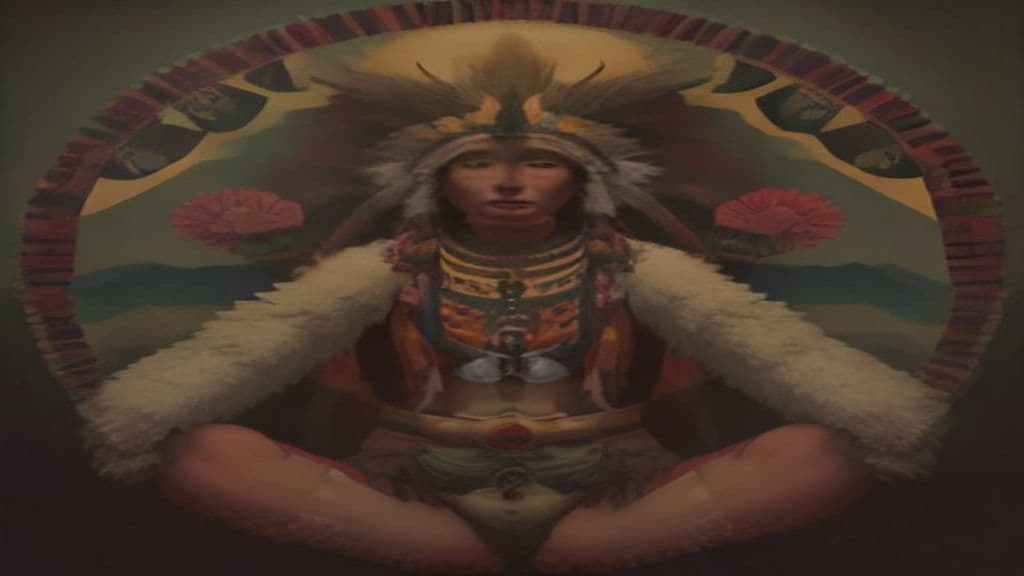
Within the tradition, offering libations and gifts to Pachamama and apus maintains reciprocity so the earth will provide fertility and protection for crops and communities and will not punish neglect with adverse weather (lightning, hail, sleet) or misfortune.
The sources collectively describe Pachamama-related offering practices rather than a single standardized liturgy. These practices are situated in communal and festival contexts (for example, offerings made during local fiestas) and in collective actions by social movements that invoke Pachamama for environmental defense. Libations of coca and alcohol and the burning of candles are repeatedly attested as elements associated with offerings to the earth goddess. Rituals function cosmologically as reciprocal exchanges with Pachamama and apus: humans give offerings so the earth continues to provide and to avoid cosmological sanction. In contemporary contexts, Pachamama imagery and offering language are also mobilized symbolically by activists and sometimes by state actors in environmental governance debates. The supplied sources do not provide a full, reproducible liturgy, specialist formulas, or a named rite called "Hacienda de la Pachamama"; instead they document recurring materials and the social contexts in which Pachamama offerings occur.
- 01Note: the provided sources do not contain a complete, reproducible step-by-step liturgy for any rite called 'Hacienda de la Pachamama'; the following are only the specific, attested actions referenced in sources, not a full ritual sequence.
- 02Prepare offerings commonly attested in Pachamama-related contexts: gather coca leaves, a small amount of alcohol for libations, and candles to be burned (sources attest these materials are used in offerings).
- 03In a communal or festival context (for example, during local fiestas tied to agricultural cycles or in collective activist gatherings), place the coca leaves and other small offerings in a visible location associated with the earth or land to be honored (sources indicate offerings are made collectively in festival and communal settings).
- 04Perform libation by pouring a small amount of alcohol onto the earth or into a designated offering spot as an offering to Pachamama (sources report libations of alcohol as a common offering form).
- 05Burn candles as part of the offering assemblage, keeping them attended while lit (sources note burning candles in offerings associated with the earth goddess).
- 06Use coca leaves as part of the offering exchange—present them on the offering spot or include them in libations (sources describe coca as culturally central in Andean offerings).
- 07Conclude the communal observance according to local custom and context; in activist contexts, collective ritualized acts and public invocations of Pachamama may accompany political action (sources document collective mobilization by groups such as Frente de Mujeres Defensoras de la Pachamama).
- ⚠The sources do not document explicit ritual taboos or contraindications for performing Pachamama offerings; however, the tradition as reported warns that failure to make proper offerings can invite punishment by apus (adverse weather) — omission is regarded as risky in cultural terms.
Community Record
- [1]Q'ero (Wikipedia entry). Wikipedia: Q'ero is a Quechua-speaking community dwelling in the province of Paucartambo, in the Cusco Region of Peru.wiki
- [2]Sucre, Cochabamba and the central valleys Travel Guide (Rough Guides). Rough Guides: 'They also make libations of coca and alcohol and burn candles, offerings associated with the Andean earth goddess...'.other
- [3]Journal of Cosmology (Ancient Astronomy & Andean apus reference). Journal of Cosmology: 'The apus watch over Andean villages, castigating them with lightening, hail, or sleet when they do not make proper...'.other
- [4]The Ethnographic Case — 'Frente de Mujeres Defensoras de la Pachamama' reference. The Ethnographic Case: 'Within CNDVS they established a womens group, Frente de Mujeres Defensoras de la Pachamama, Women Defenders of the // Earth Beings: Ecologies of Practice across Andean Worlds...'.academic
- [5]Environmental Governance in Latin America (Pachamama and Buen Vivir imagery). Environmental Governance in Latin America: 'interestingly, although Andean governments today also use the symbolic indigenous images of Pachamama and Buen Vivir in their...'.academic