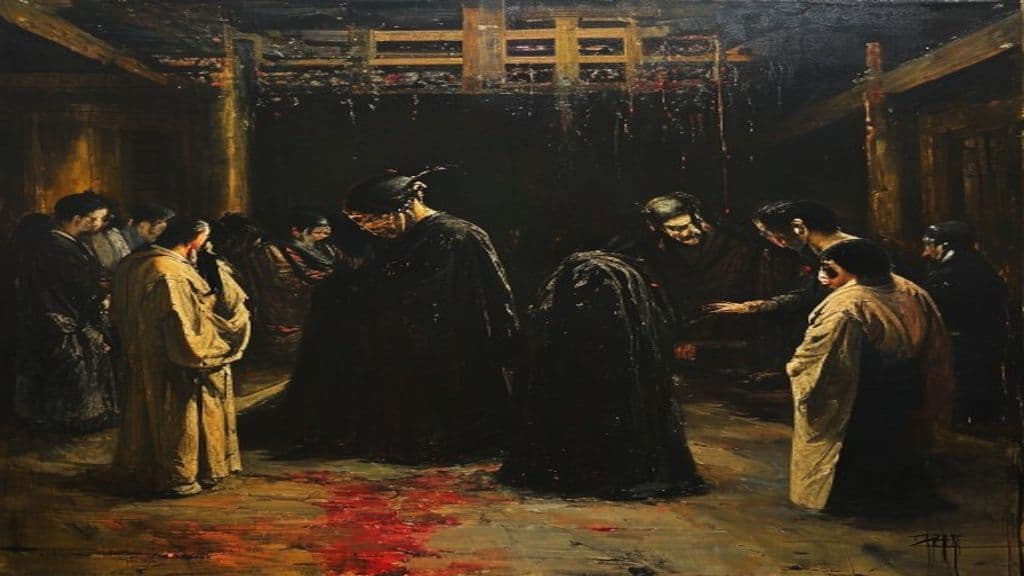
Within the tradition, performing jesa maintains proper relations with departed ancestors, expresses filial gratitude, and provides the ancestors with offerings and respect as if they were still living; this sustains familial bonds across life and death.
Jesa is a domestic, family-based memorial ceremony held to commemorate departed ancestors and to express gratitude toward them. Sources describe it chiefly as a memorial and commemorative rite rather than an exorcistic or healing ceremony. It is usually held on the anniversary of an ancestor's death and is also commonly observed during major holidays (for example Seollal and Chuseok). The National Folk Museum of Korea emphasizes that the ceremony is performed with utmost sincerity, 'as if the departed ancestor was still alive,' indicating a reenactment of filial duty. Food offerings and a carefully arranged table are central visible elements; specific foods such as traditional confections and dried meats are documented as commonly prepared for jesa tables. Practice is family-centered: lay family members perform the rites rather than a fixed priestly specialist, and the ritual is practiced across Catholic, Buddhist, and nonreligious households in Korea, while Protestants typically do not participate. Detailed liturgical texts, verbatim prayers, and a canonical minute-by-minute sequence are not provided in the cited sources; descriptions in the sources allow reconstruction only of the principal components (timing, sincere attitude, offering foods, table arrangement, and family participation).
- 01Select date: Schedule the ceremony on the anniversary of the ancestor's death or on an established major holiday when family jesa are customarily held (for example Seollal or Chuseok) — as described in general-source accounts of jesa.
- 02Prepare attitude: Ensure participants approach the ceremony 'with utmost sincerity, as if the departed ancestor was still alive' (National Folk Museum of Korea).
- 03Prepare offerings: Cook and arrange traditional foods commonly associated with jesa offerings, including confectionery and preserved/dried meats documented as jesa items (see Materials).
- 04Set the table: Arrange an offering table according to established household/custom guidance for jesa table setting (The Soul of Seoul provides instructional guidance on table arrangement; exact household layouts vary and are not verbatim in the cited material).
- 05Family participation: Have family members take their roles at the table; the sources indicate jesa is performed by family participants rather than a designated cleric (family roles and precise order of bows/invocations are variable and not specified in the provided sources).
- 06Present offerings: Place the prepared foods on the jesa table as offerings to the ancestor; foods such as traditional confections and dried meats are explicitly mentioned in cultural sources as typical jesa items.
- 07Conduct commemorative actions: Perform the family's customary commemoration (this may include naming the ancestor, bowing, and shared meals) in the household's established pattern; the provided sources describe these elements broadly but do not supply a canonical verbatim liturgy or exact sequence of bows and spoken prayers.
- ⚠No explicit contraindications or ritual taboos are specified in the provided sources; specific prohibitions or penalties for incorrect performance are not documented in the supplied material (marked as uncertain).
Community Record
- [1]Jesa. Wikipedia: Jesa entry (overview of ceremony, timing, and participation across religious groups).wiki
- [2]What is Jesa (Ancestral Rite)?. National Folk Museum of Korea: explanatory entry stating jesa commemorates departed ancestors, expresses gratitude, and is performed 'with utmost sincerity, as if the departed ancestor was still alive.'other
- [3]How To Set The Table for Jesa. The Soul of Seoul: practical guidance and discussion of table-setting practices for jesa (used as a referenced source for the importance of table arrangement; the provided excerpt does not reproduce a full canonical layout).other
- [4]Citrus & Chestnut Yakgwa (holiday cookie) — yakgwa note. YAM Magazine: recipe note indicating yakgwa was typically offered in a jesa and enjoyed on festive occasions.other
- [5]Po (food). Wikipedia: article on po (dried meat/fish) as a form of Korean preserved food associated with traditional cuisine and occasions.wiki
- [6]Yukpo. Wikipedia: Yukpo entry noting dried beef as 'one of the foods prepared for traditional occasions' and cited here as an example of foods prepared for jesa contexts.wiki
- [7]Myoje (Gravesite Rite). National Folk Museum of Korea: description of related gravesite rites (Myoje) and their relation to jesa practice.other
- [8]How to Celebrate Seollal, the Korean New Year's Day!. KoreanClass101: discussion of Seollal as a holiday when ancestral veneration and family rituals such as jesa commonly occur (used to support holiday timing; cited material is descriptive rather than liturgical).other