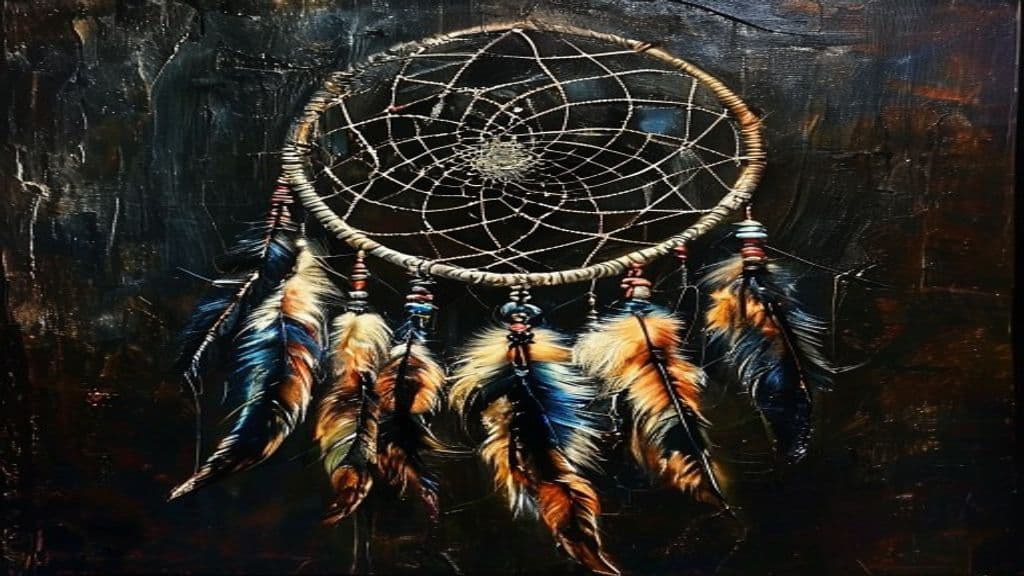
The tradition holds that the hoop with its woven web replicates a spider's web and functions as a snare that catches or prevents harmful dreams or nocturnal influences from reaching an infant or sleeper.
Within the Anishinaabe cultural context, the object known as asubakacin ('net-like') or bwaajige ngwaagan ('dream snare') is a handmade willow hoop on which a net or web of string or sinew is woven to replicate a spider's web. It is primarily associated with the protection of infants and is traditionally hung over a cradle or bed. The source describes construction and placement as the central elements of its use; additional decoration with sacred items such as certain feathers or beads is sometimes added. The provided account does not enumerate liturgical speech, specialist roles, precise weaving patterns, or detailed cosmological mechanisms beyond the web-as-snare metaphor.
- 01Construct a hoop from willow: form and secure a handmade willow hoop of a size appropriate to hang over a cradle or bed.
- 02Weave a net or web inside the hoop using string or sinew: create a pattern meant to replicate a spider's web across the interior of the hoop.
- 03Optionally decorate the hoop with sacred items such as certain feathers or beads: attach these items to the hoop where desired, noting that the source identifies such items as sacred but does not specify species or meanings.
- 04Hang the finished object over a cradle or bed: suspend the completed dreamcatcher above the infant's sleeping place for protection.
Community Record
- [1]Dreamcatcher (Wikipedia). Wikipedia, 'Dreamcatcher' entry (excerpt summarizing Anishinaabe origin, construction, decoration, and use over cradles/beds).wiki