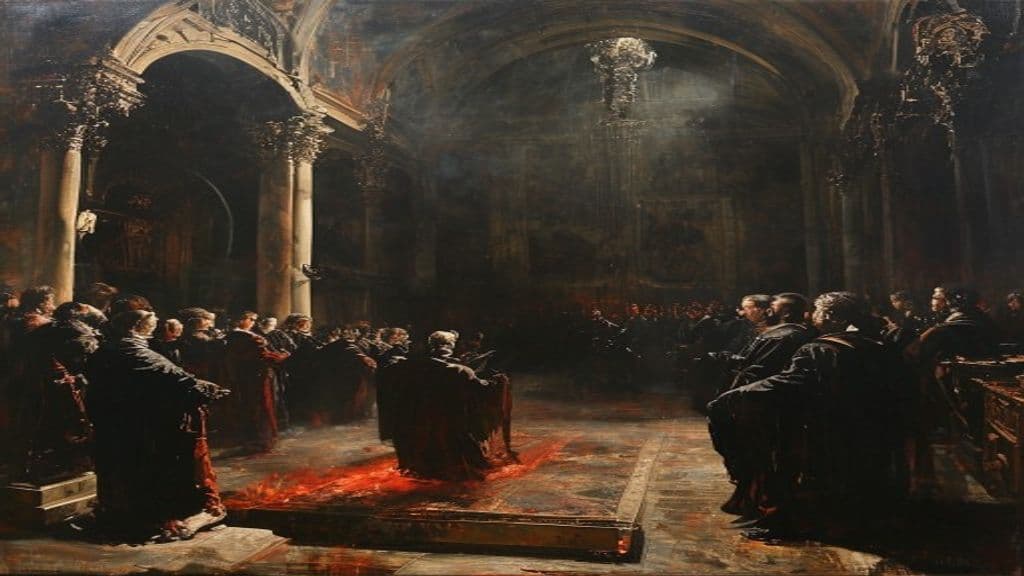
Within the tradition as described in the provided sources, the rite is understood to cause a malevolent spiritual entity to depart from a person or place — accomplished either by compelling the entity (for example, causing it to swear an oath or commanding it to depart in the name of a higher power) or by performing an elaborate ritual whose actions are intended to effect eviction.
The Major Exorcism in the traditional Roman Catholic context is presented in the sources as the religious practice aimed at evicting demons, jinns, or other malevolent spiritual entities from a person or area believed possessed. The sources available do not include or reproduce the canonical liturgical text (e.g., the Rituale Romanum exorcism formulae) or a full ordered sequence of prayers and rites; rather, they describe exorcism in broad terms and indicate that, historically and in traditionalist contexts, the office or minor order of Exorcist has been conferred within clerical formation. One archival seminary account documents the conferral of the minor order of Exorcist alongside other clerical rites in an SSPX seminary ceremony, illustrating that at least some traditional Catholic communities embed the role within clerical training. The sources emphasize a range of practical approaches attributed to exorcists generally (compelling, commanding, or using formal ritual actions) but do not provide the ritual text, specific liturgical steps, or a canonical list of sacramentals from the Rituale Romanum or later official exorcism manuals.
- 01No verbatim liturgical steps or ordered ritual sequence are present in the supplied sources; the following reflects only general methods described in those sources rather than a reconstruction of the traditional Roman Catholic rite.
- 02If enacted according to descriptions in general exorcism literature cited by the supplied sources, an exorcist may: command the entity to depart in the name of a higher power (a direct verbal imperative).
- 03Alternatively, an exorcist may cause the entity to swear an oath (a confrontational interrogation and compulsion tactic referenced in general descriptions).
- 04Alternatively, an exorcist may perform an elaborate ritual (a formal sequence of actions and prayers) — the supplied sources note this as a possible mode but do not provide the ritual text, order, or specific prayers.
- ⚠The provided sources do not supply canonical contraindications, medical or psychological cautions, or explicit ritual risks; therefore no specific contraindications can be asserted from these materials.
Community Record
- [1]Exorcism - Wikipedia. "Exorcism is the religious or spiritual practice of evicting demons, djinns, or other malevolent spiritual entities from a person, or an area, that is believed to be possessed." and "Depending on the spiritual beliefs of the exorcist, this may be done by causing the entity to swear an oath, performing an elaborate ritual, or simply by commanding it to depart in the name of a higher power."wiki
- [2]SSPX: 24 Men take the Cassock in Virginia - St. Thomas Aquinas Seminary (archival description). "Bp. Fellay also conferred the minor orders of Exorcist and Acolyte as well as the Subdiaconate." and "By the former, seminarians receive the 'habit' of the SSPX; the latter introduces them into the clerical state and the hierarchy of the Church."other