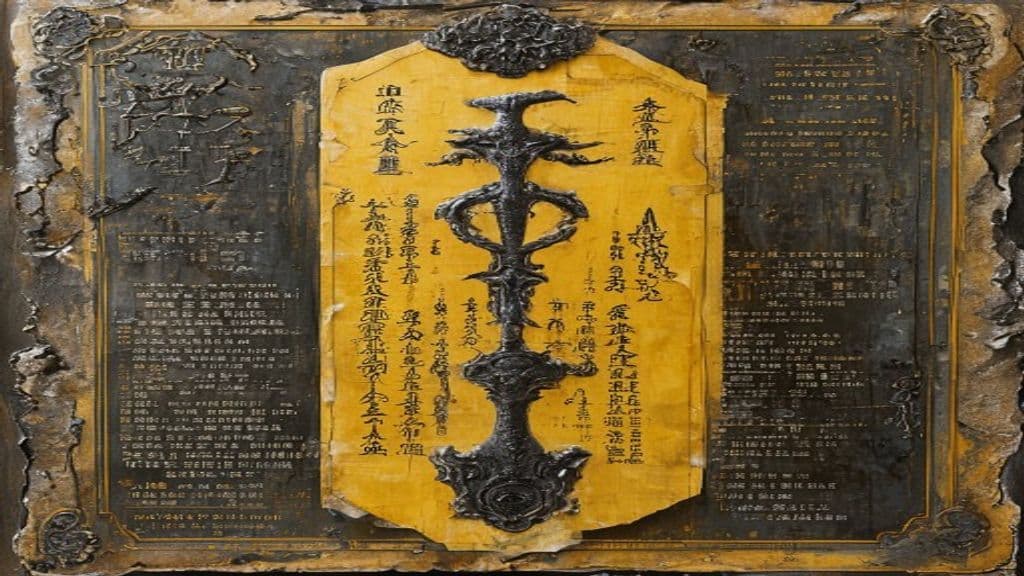
Within the Daoist talismanic idiom represented in the sources, coin charms and inscribed talismanic objects are believed to function apotropaically — their inscriptions, symbols, or esoteric writing are treated as having protective or amuletic power. The Huangdi Yinfujing, by its title 'Yellow Emperor's Hidden Talisman Classic', is associated in sources with astrological and Neidan (internal alchemy) knowledge, implying that its authority contributes to esoteric/astrological efficacy rather than functioning as a documented physical talisman in these excerpts.
The source material assembled for this entry covers two related but distinct attestations in Daoist cultural history. First, popular and religious numismatic objects described as Taoist (Daoist) coin charms are documented as physical amulets that incorporate Taoist religious elements: they take various shapes and sizes, may carry inscriptions in traditional Chinese characters or specialized Taoist 'magic' script, and serve apotropaic or amuletic functions in Chinese (and comparably in Vietnamese) contexts. Second, the Huangdi Yinfujing (黃帝陰符經; Huángdì Yīnfújīng) is an early Daoist scripture whose English title translates as the 'Yellow Emperor's Hidden Talisman Classic' and which, in the sources cited, is associated with Chinese astrology and Neidan (internal alchemy). The supplied sources do not provide a documentary account of a ritual procedure, manufacture, consecration, or deployment of a distinct 'yellow paper talisman' object; nor do they present a direct linkage between the Huangdi Yinfujing text and a specific paper talisman production ritual. Consequently, this entry refrains from reconstructing unstated procedures and instead presents what is present in the sources: numismatic talismans with inscriptions used for protection/warding, and a scripture whose title evokes talismanic language and is associated with esoteric astrological practice.
- 01No step-by-step ritual procedure is attested in the supplied sources for a named 'Yellow Paper Talisman'; the available sources describe (a) Daoist coin/numismatic charms in terms of form and inscriptions but do not provide manufacture or activation steps, and (b) the Huangdi Yinfujing as a scripture associated with astrology and Neidan without ritual instructions.
- ⚠No contraindications, taboos, or ritual risks are attested in the provided sources for a 'Yellow Paper Talisman'—such information is not present in the dataset.
Community Record
- [1]Taoist coin charm. Wikipedia: 'Taoist coin charms ... incorporate elements of the Taoist religion. Taoist coin charms come in various shapes, sizes, and formats and can contain inscriptions or wholly pictorial designs. ... a subset ... have inscriptions written in Taoist "magic" writing.'wiki
- [2]Huangdi Yinfujing. Wikipedia: 'The Huangdi Yinfujing (Chinese: 黃帝陰符經 ; pinyin: Huángdì Yīnfújīng ; Wade–Giles: Huang-ti Yin-fu Ching lit. "Yellow Emperor's Hidden Talisman Classic"), or Yinfujing, is a circa 8th century CE Daoist scripture associated with Chinese astrology and Neidan-s.'wiki
- [3]Jiangshi. Wikipedia: entry on jiangshi included in source set; the supplied excerpts do not link jiangshi to 'yellow paper talisman'.wiki
- [4]Marsilio Ficino — Venus talisman example (comparative material). Comparative material on astrological talismans and consecration practices in a distinct Western tradition; included as comparative context in source set.other
- [5]Astrological Talismans > Amulet | Magic Talismans and Amulets. Comparative material on talismanic theory and practice in astrological contexts; included in source list as analogical material.other