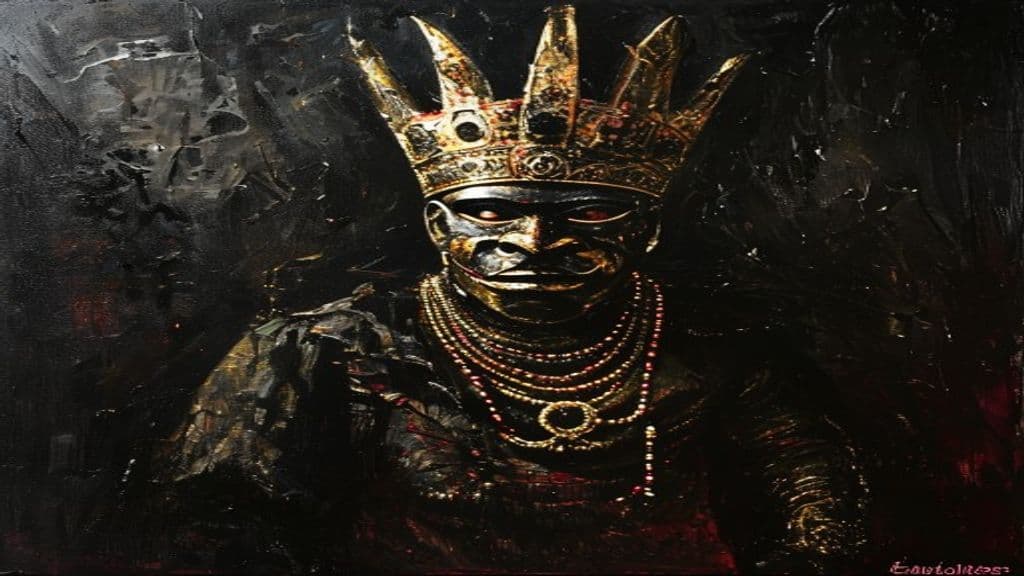
Within the tradition and in museum and scholarly descriptions, Egungun masquerades are believed to embody or visibly manifest the spirits of departed ancestors who periodically revisit the community to be remembered, to celebrate, and to bestow blessings (including protection and communal welfare) on the living.
Egungun (also written Eégún) denotes both a class of Yoruba masquerades and, more specifically, a masquerade for ancestor reverence; it may also refer to the ancestors themselves as a collective spiritual force. Egungun appearances are part of periodic communal festival cycles (described in sources as appearing during annual festivities) in which masked, costumed performers enact dances and processions. The layered, multi-panel garments—composed in museum examples of dozens or hundreds of fabrics arranged according to Yoruba design sense (oju-ona)—are described in the sources as creating a locus or 'dwelling place' for ancestral spirits. The dance, performance, and concealment of the wearer combine aesthetic, social, and ontological elements so that the masquerade can serve as a bridge between the living and the otherworld, enabling remembrance, celebration, and communal blessing.
- 01Hold the Egungun performance as part of an annual or periodic communal festival (sources describe Egungun as appearing during annual festivities).
- 02Equip the masquerader with a layered multi-panel costume composed of multiple fabrics arranged according to Yoruba design sense (oju-ọnà); in museum descriptions these panels form the garment that is said to provide a dwelling place for ancestral spirits.
- 03Ensure the masquerader's face is concealed with striped netting or similar veiling that permits the wearer to see out while keeping their identity concealed, maintaining the social fiction of spirit embodiment (as documented in museum catalogs).
- 04Present the masquerader in motion—procession and dance—so that the costumed figure 'swirls into motion' and performs before the community, enacting the manifestation of ancestral spirits and offering communal blessing (sources emphasize performative movement as integral).
- ⚠No contraindications, taboos, or risks are listed in the provided sources; the materials reviewed do not supply documented prohibitions or explicit rules about who may or may not wear Egungun costumes.
Community Record
- [1]Egungun. "Egungun in the broadest sense is any Yoruba masquerade or masked, costumed figure. More specifically, it is a Yoruba masquerade for ancestor reverence, or the ancestors themselves as a collective force." and "Egungun is a visible manifestation of the spirits of departed ancestors who periodically revisit the human community for remembrance, celebration, and blessings." (Wikipedia)wiki
- [2]Egúngún Masquerade Dance Costume (Cleveland Museum catalog 1976.187). "The striped netting on the 'face' of this masquerade costume allows the wearer to see out while keeping their identity concealed." and "Swirling into motion, egúngún masquerade costumes appear during annual festivities to bless the community. Manifesting ancestral spirits, they serve as a bridge between the living and the otherworld." (Cleveland Museum of Art catalog, 1976.187)other
- [3]Egúngún Masquerade Dance Costume (Cleveland Museum catalog 1976.188). "The fabric panels create a dwelling place for ancestral spirits. Arranged and selected according to Yorùbá design sense (ojú-ọnà), this mask incorporates hundreds of African, Asian, and European fabrics." (Cleveland Museum of Art catalogs 1976.187 and 1976.188)other
- [4]The Yoruba Artist: New Theoretical Perspectives on African Arts (book summary). Book summary describing Yoruba oral and performative arts (drumming, dance, oriki, Ifa) as part of the ritual and artistic milieu in which practices like Egungun occur.academic