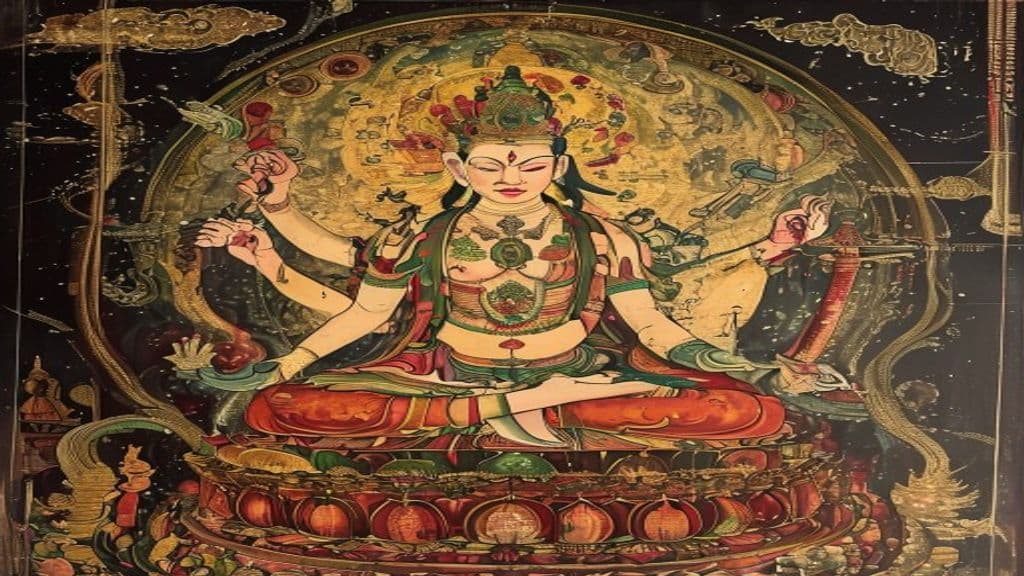
In early tantric and mandalic texts Acala appears as an acolyte or messenger of Vairocana (Amoghapāśakalparāja Sūtra placement in a mandala), initially a minor attendant figure who, across later tantric literature and commentarial traditions, rose to independent prominence as a wrathful protector. Mahāvairocana Tantra and subsequent sādhanic texts reframe him as a central Wisdom King in the Womb Realm mandala and as an emanation or wrathful manifestation of higher buddhas or bodhisattvas (interpretations include embodiment of Vairocana in some East Asian systems, association with Akṣobhya and the vajra family in Tibetan systems, and identification with Mañjuśrī in certain Nepalese contexts). Later tantras such as the Caṇḍamahāroṣaṇa Tantra develop his demon-subduing, exorcistic profile.
Canonical descriptions and iconographic tradition represent Acala as wrathful in expression, often seated in half-lotus posture. Early textual description (Amoghapāśakalparāja Sūtra) depicts him holding a sword in his right hand and a noose or rope in his left; later tantric sources and the Sādhanamālā emphasize the rope used to bind hostile beings, even gods. In Tibetan renderings he may wear a crown bearing an effigy of Akṣobhya when associated with the vajra family; in Nepalese and Tibetan contexts he can appear in yab-yum union with a consort (Viśvavajrī) in tantric iconography. The sword symbolizes cutting delusion and obstacles; the rope symbolizes binding and subduing.
Across the cited tantric corpus Acala's principal function is ritual and soteriological: he 'burns away all impediments (antarāya) and defilements (kleśa)' and is invoked to remove obstacles to spiritual progress (Mahāvairocana Tantra instruction to recite mantras and visualize as Acala). Later tantras (Caṇḍamahāroṣaṇa Tantra) portray him as a demon-subduer and exorcist who 'slays ghosts and evil spirits with his fierce anger' and is described as a 'frightener of gods, titans, and men, the destroyer of the strength of demons.' He is therefore both a protective figure invoked by practitioners and a wrathful emanation of buddhas/bodhisattvas, enacted through mantra, visualization, mandala placement, and formal sādhanas recorded in tantric and Tibetan Tengyur collections.
Weaknesses
- otherNo specific vulnerabilities recorded in the cited sources; traditional texts do not list particular weaknesses of Acala
Wards
- mantraRecitation and visualization practices from the Mahāvairocana Tantra
- ritualInvocation via sādhanā (Acala sādhanas/Abhisamaya texts in Tibetan Tengyur collections) used to invoke protection and remove obstacles
Vairocana
A principal cosmic Buddha in Mahayana and Vajrayana Buddhism identified with the Dharmakāya (Dharma-body) of all Buddhas; portrayed in sutric literature as an all-pervasive, illuminating principle whose body contains innumerable world-systems and who functions as the source or universal principle from which other buddhas emanate.

Akshobhya
Akshobhya is a transcendent buddha of Mahāyāna and Vajrayāna Buddhism, one of the Five Wisdom (Dhyāni) Buddhas. He personifies 'mirror knowledge' (ādarśa-jñāna), is conventionally placed in the East, and is lord of the eastern Pure Land Abhirati; in esoteric texts he is associated with the eastern Vajra division and invoked in mantra/mandala ritual contexts.
Amitābha
Amitābha is a central celestial Buddha of Mahayana Buddhism who presides over the western Pure Land called Sukhāvatī. Devotional practices invoking his 'measureless' light and life (nianfo/nembutsu) are presented in Pure Land traditions as a path by which beings may be reborn in his buddhafield and quickly attain Buddhahood.
Bhrikuti
Bhrikuti is a historic-legendary 7th-century Nepali princess of the Licchavi line who became queen-consort to the Tibetan king Songtsen Gampo and, in Tibetan religious imagination, is represented iconographically and devotionally as an emanation or incarnation of Green Tara. Sources credit her with bringing sacred Buddhist images, skilled Newar craftsmen, and patronage that aided the establishment of Buddhism in Tibet; she is not presented in the sources as a harmful folk spirit.
Bodhisattva
A bodhisattva is a being or practitioner in Buddhist thought who has generated bodhicitta — the wish and compassionate intention to attain awakening (bodhi) for the benefit of all sentient beings. In Early/Theravāda contexts the term often denotes the Buddha in his pre‑awakening lives, while Mahāyāna expands it into an ideal and category of spiritually advanced, active helpers and devotees.
Bönpo Lu (local mountain spirits)
A research label for local mountain-associated spirits situated in Himalayan/Tibetan ritual worlds; the term as presented is not documented in detail in the supplied sources. The available materials place such landscape spirits within a broader Bön and Tibetan Buddhist milieu where mountains and local non-human agents are engaged through offerings and ritual specialists.
Dakinī
A dakini is a feminine spiritual figure attested in Hindu and Buddhist literature and in Himalayan Vajrayāna cultural contexts; sources in this set characterize the dakini as a type or class of goddess and as a figure embedded in tantric and Himalayan religious landscapes. Specific iconography, powers, and ritual formulas are not documented in the supplied sources.
Dharmapāla
In Buddhist traditions, a dharmapāla is a protective deity or guardian whose role is to defend the Dharma (the Buddha's teaching) and to avert obstacles to spiritual practice. Appearing across Mahāyāna and Vajrayāna contexts (notably Tibetan, Chinese, and Japanese), dharmapālas range from local worldly guardians to wrathful enlightened emanations invoked in tantric ritual.
Dīpankara Buddha
A Buddha of the past in Buddhist sacred history who, according to traditional narratives, recognized and predicted the future Buddhahood of the bodhisattva Sumedha (a previous life of Gautama/Śākyamuni). He is venerated in ritual contexts, represented in Asian Buddhist art, and commemorated in contemporary temple and festival practices.
Green Tara
Green Tara (Tārā, Ārya Tārā, Jetsün Dölma) is a central female buddha/bodhisattva figure in Mahāyāna and especially Vajrayāna Buddhism, venerated as a liberator who grants swift assistance, removes obstacles, and functions as a meditation deity (yidam) embodied in green form.
Lha
Lha is a Tibetan term used in Buddhist and related Himalayan contexts to denote local or regional deities and divine presences that have been incorporated into the ritual and popular religion of Tibet and neighbouring areas. The category overlaps with indigenous spirits and classical Buddhist beings (devas, yakshas) and functions within ritual life as objects of veneration, territorial sacralization, and protective or beneficent cult practice.
Mahāmāyūrī
Mahāmāyūrī is a bodhisattva and female Wisdom-figure in Mahāyāna and Vajrayāna Buddhism, venerated chiefly as a protective deity whose sutra and mantras are employed in ritual to avert harm and remove afflictions. She is associated with peacock symbolism and appears in temple art and liturgical practice across South and East Asian Buddhist contexts.
Phurba (kīla) spirits / Phurba (kīla)
The phurba (Tibetan) or kīla (Sanskrit) is principally a three‑sided ritual stake/knife used in Indo‑Tibetan Vajrayāna and Bön ritual repertoires as the implement through which hostile or disruptive spiritual forces are bound, restrained, or transformed. Sources describe the instrument as embodying the transformative, wrathful power associated with the meditational deity Vajrakīlaya.
Preta (Hungry Ghost)
A post-mortem supernatural being associated with extreme, unremitting hunger and thirst. In Hindu usage the Sanskrit term can mean a deceased person, while Buddhist traditions develop the category into a distinct realm of hungry spirits whose condition illustrates karmic consequences for demeritorious action.
Community Record
- [1]Acala - Wikipedia. Wikipedia contributors, 'Acala,' Wikipedia, The Free Encyclopediawiki
- [2]Acala - Wikidata. Wikidata entry Q337624wiki
- [3]Tara Sadhana And Acala Abhisamaya Collection By Arya Nagarjuna And Others Tibetan Vajrayana (Tengyur Series) - Archive. Archive: Tengyur sādhanā metadata for Tara and Acala collectionsother
- [4]Tara Sadhana And Acala Abhisamaya Collection By Arya Nagarjuna And Others Tibetan Vajrayana (Tengyur Series) - Archive (mirror). Archive: Tengyur sādhanā metadata for Tara and Acala collections (mirror)other