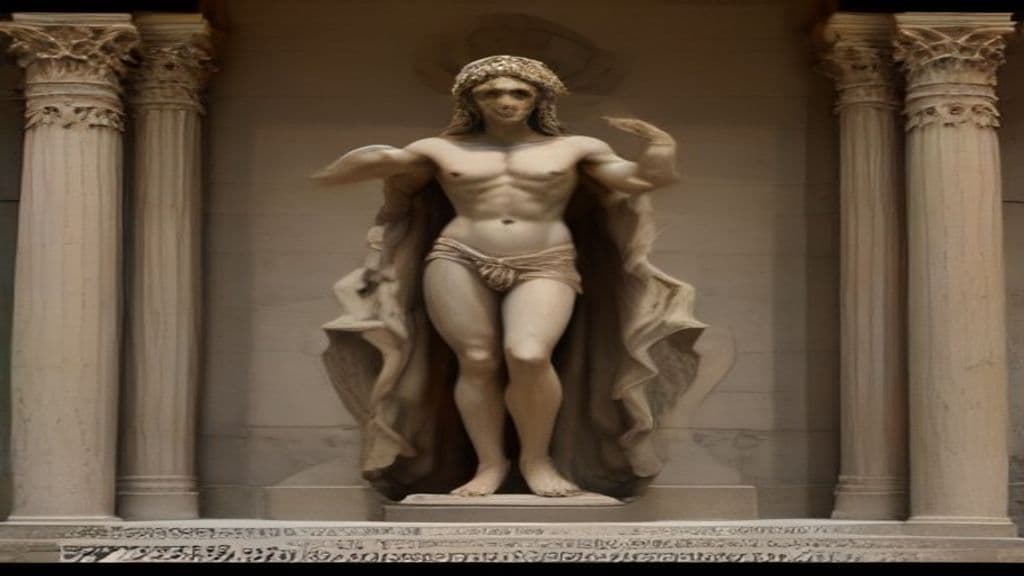
In surviving classical summaries of Phoenician tradition (as preserved by authors such as Justin in his epitome of Pompeius Trogus and in later Roman literary reception), Acerbas is a Tyrian priest of Melqart who married or was the uncle of Elissa (Dido). Possessing considerable wealth, he hid his treasure in the earth for fear of the avarice of Pygmalion, who succeeded the throne. Pygmalion had Acerbas murdered in hopes of obtaining the hidden riches; Elissa secured the treasure, fled Phoenicia, and emigrated to North Africa where she founded Carthage. Later Roman authors such as Virgil use a related name-form (Sychaeus) in their accounts, and commentators note variation and adaptation of the name across traditions.
Classical summaries do not supply a physical or iconographic description. Sources identify Acerbas by office and social rank — priest of Melqart (the Tyrian Hercules) with a dignity described as next to that of the king — which implies a high ceremonial status but does not record specific attire or bodily features.
No supernatural powers are ascribed in the cited sources. Acerbas' recorded capacities are social and practical: he holds the priesthood of Melqart (a high religious office), controls considerable personal wealth which he conceals, and functions within the dynastic politics of Tyre. His vulnerability is political rather than magical.
Weaknesses
- conditionpolitical vulnerability (mortal, subject to dynastic violence)
- otherno recorded supernatural protection (sources note concealment of treasure but no magical warding)
Wards
- othernone recorded
Acastus
Acastus is a mortal heroic figure of ancient Greek tradition: son of Pelias who became king of Iolcus, an Argonaut who sailed with Jason, and an actor in the post-Argonautic cycle involving Medea, Peleus, and the aftermath of Pelias’s death. He is attested as performing civic and ritual actions (burying Pelias, instituting funeral games, purifying Peleus) and as a participant in vendetta episodes that end in violent reprisals.
Acat
Acat is a Maya deity associated with the craft and ritual of tattooing, described in the cited sources as being invoked in relation to the tools, inks, and workspaces of tattoo artists and as steadying the artists' hands so tattoos made in the image of gods could confer those gods' power.
Accolon
Accolon is a mortal knight of the Arthurian court, presented in the Post-Vulgate Merlin tradition and Malory's Le Morte d'Arthur as Morgan le Fay's paramour and instrument in a plot to supplant King Arthur; his tale centers on enchanted weapons (Excalibur and its scabbard), love-manipulation, and a tragic duel with Arthur.
Ace Lightning
Ace Lightning is the titular playable character of the fictional in‑universe video game Ace Lightning and the Carnival of Doom. In the television series, game characters come to life in the real‑world town after a lightning strike and electrical surge; Ace functions as a superheroic 'Lightning Knight' from the Sixth Dimension who recruits a human sidekick to pursue game objectives (recovering pieces of the Amulet of Zoar) in the human world.
Ace West
Ace West (Wallace Daniel "Ace" West) is a contemporary American comic-book character in DC Comics continuity, a young speedster who channels the metaphysical Speed Force and occupies legacy-hero roles such as Kid Flash and Ace. Introduced in New 52-era stories as a biracial reinterpretation of Wally West and later retconned in DC Rebirth as a distinct Wallace West, son of Daniel West (Reverse-Flash), he appears across present-day and alternate/future timelines and participates in team and sacrifice narratives tied to the Speed Force.
Ace the Bat-Hound
Ace the Bat-Hound is a fictional canine companion and crime‑fighting ally in American superhero comic books published by DC Comics. Primarily a trained, loyal dog partnered with Batman and allied animal heroes, Ace appears in multiple continuities with varying breeds and occasional fantastical variants.
Aceso
Aceso (Ancient Greek: Ἀκεσώ, Akesó) is an ancient Greek goddess who personifies the process of healing and convalescence. She is attested as a daughter of Asclepius and Epione and was worshipped in healing centers such as Athens and Epidauros, appearing in sculptural reliefs alongside her family.
Acessamenus
Acessamenus (Ancient Greek: Ἀκεσσάμενος, Akessamenos) is attested in Greek sources as a mortal king of Pieria and the eponymous founder of a Macedonian place called Akesamenai. He appears in Homeric genealogy as the father of Periboea, whose union with the river-god Axius links Acessamenus into the ancestry of the hero Asteropaios.
Acestes
Acestes is a Roman/Greek founder-hero associated with the Sicilian city Segesta (Aegesta/Acesta). Presented as son of a Trojan woman and, in one tradition, the Sicilian river-god Crinisus (in animal form), he hospitably receives Aeneas and the Trojans, participates in the funeral games in Virgil's Aeneid (Book V), and functions as an eponymous culture-founder and local ruler.
Achaeans (Homer)
In Homeric epic, 'the Achaeans' (Ancient Greek: Ἀχαιοί, Akhaioí) is a collective ethnonym used to refer to the Greek peoples as a single grouped human contingent—the army of Greeks in the Trojan War narratives such as the Iliad and the Odyssey. The term functions as a poetic designation for human actors within the moral, social, and military universe of Homeric poetry rather than as a supernatural class of beings.
Achaemenides
Achaemenides is a literary mortal figure introduced into Virgil's Aeneid as a marooned member of Odysseus' crew whom Aeneas rescues on Sicily. In Roman epic he functions as a chance survivor and eyewitness who helps link the Homeric tradition to the Trojan refugees and to illustrate Aeneas' magnanimity.
Achaeus
Achaeus (Ancient Greek: Ἀχαιός, Akhaiós) is an eponymous personal name borne by three mythological human figures in Greek tradition; best attested is Achaeus, son of Xuthus and Creusa, brother of Ion and grandson of Hellen, who is named as father of Archander and Architeles in Pausanias. The name is glossed as meaning "griever," from ἄχος (achos, "grief, pain, woe").
Community Record
- [1]Justin, Epitome of Pompeius Trogus (Books 11–20). Justin, Epitome of the Philippic History of Pompeius Trogus, translation (1886), Books 11–20 (accounts of the founding of Carthage and the role of Acerbas/Sychaeus).literary
- [2]Pompeius Trogus on the Founding of Carthage (summary). Summary and translation commentary on Pompeius Trogus' account of the foundation of Carthage (discussing Acerbas/Sychaeus and Elissa/Dido).literary
- [3]Attalus — Acerbas in ancient sources. Compilation of ancient references to the name Acerbas and variant forms (notes on identity with Sychaeus/Sycharbas).literary
- [4]Wikipedia — Acerbas. Encyclopedic summary noting Acerbas = Sychaeus, priest of Melqart, concealment of wealth, murder by Pygmalion, and link to the foundation of Carthage; mentions comparative etymology with Zikarbaal.wiki