
In Virgil's Aeneid Achaemenides is presented as one of Odysseus' crew who was left marooned on Sicily after Odysseus fled the Cyclops Polyphemus. He survives living rough on the island until the Trojans, led by Aeneas during their wanderings after the fall of Troy, find and rescue him and take him to Italy with their company. Virgil's reuse of a name derived from the Persian Achaemenes (rendered as Greek) and interpreted as suggesting 'he who waits with affliction' supplies literary onomastic resonance for the character's plight.
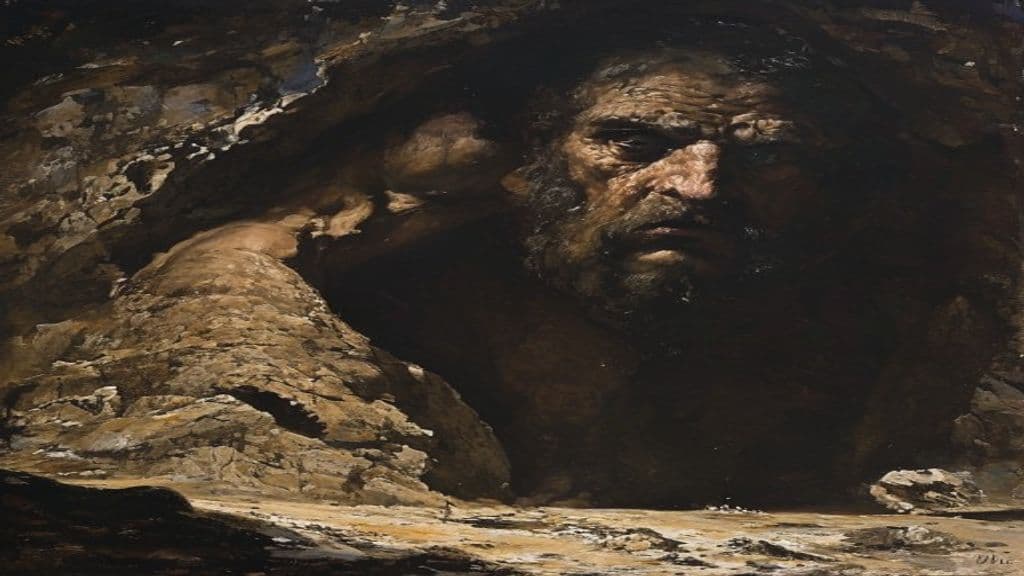
Sources describe Achaemenides as filthy, dirty, and desperate — a castaway living in the woods of Sicily after being left behind following the Polyphemus episode. His appearance in the Aeneid episode is that of a worn, dishevelled survivor who suddenly runs from the woods to the arriving Trojans to beg rescue.
No supernatural powers are attributed. His notable behaviours are mundane human endurance and survival under adverse conditions and, in later Latin treatments, functioning as an eyewitness narrator or informant for episodes of Odysseus' adventures. His narrative role enables poets to portray Aeneas' clemency and to bridge Homeric material with Roman epic themes.
Achates
Achates is the faithful human companion and attendant of Aeneas in Virgil's Aeneid, conventionally known by the epithet 'fidus Achates' and used in Latin literature as the by-word for an intimate, loyal companion.
Alcander (Alcandrus)
Alcander or Alcandrus is a personal name borne by several distinct mythic humans in Greek and Roman epic traditions: a Molossian seer who was transformed by Zeus into a wren, a Lycian warrior slain at Troy, and a companion of Aeneas killed in Italy. The entries are separate narrative figures rather than a single recurrent supernatural species.
Anchises
Anchises is a mortal Trojan noble of myth, famed as the father of Aeneas and as a lover of the goddess Aphrodite/Venus; he appears in Greek and Roman epic traditions as a living elder rescued from Troy and later as an advising shade in the Roman underworld vision.
Androgeus
Androgeus is a mythic human name borne by at least two distinct figures in Classical Greek and Roman tradition: a Cretan prince, son of Minos and Pasiphaë, famed for athletic victories and whose death in some accounts is linked to the Marathonian/Cretan bull; and Androgeos, a Greek soldier named by Virgil in the Aeneid who, during the sack of Troy, mistakes Aeneas and his companions for fellow Greeks. Both are mortal figures woven into larger heroic and epic cycles rather than supernatural beings.
Camilla
Camilla is a legendary Volscian warrior maiden appearing in Virgil's Aeneid (Book 11). Presented as an exceptional human fighter and huntress who leads Volscian forces against the Trojans, she is celebrated for her speed and martial skill and is slain in battle during the Latium wars.
Capaneus
Capaneus (Ancient Greek Καπανεύς) is a mortal warrior of the generation known as the Seven against Thebes, famed in Greek and Roman literary tradition for exceptional size and strength and for extreme pride; his taunt that even Zeus could not stop him results in divine execution by a thunderbolt as he scales the walls of Thebes. Later authors (Statius, Dante) reuse him as a figure illustrating hubris and blasphemy.
Cisseus
Cisseus is a personal name borne by several distinct human figures in ancient Greek and Roman mythic traditions. Bearers of the name appear as kings, fathers, warriors, and members of dynastic genealogies across Homeric, tragic, mythographic, and Roman epic sources rather than as a single supernatural being.
Deiphobus
Deiphobus (Ancient Greek Δηΐφοβος) is a Trojan prince, son of King Priam and Hecuba, attested across Homeric epic and later Greek and Roman narratives as a warrior of the Trojan War. He appears in the Iliad among Trojan leaders, is given expanded roles in post‑Homeric sources (notably Euripides, Dares, Dictys, Malalas) and in Vergil’s Aeneid is depicted posthumously as a horribly mutilated corpse who recounts his death.
Iarbas
Iarbas is a legendary North African/Libyan king or princely founder-figure preserved in Greco-Roman literary tradition. Presented as a son of the North African god Ammon (Jupiter-Hammon), he functions as a dynastic ancestor and cult-founder in accounts that also cast him as a suitor and political rival in the Aeneid-cycle narratives (notably as a rejected suitor of Dido).
Ilus
Ilus (Ancient Greek: Ἶλος) is a personal name borne by several legendary mortal figures in Greek and Roman epic tradition, most notably founders and genealogical ancestors associated with Dardania and Troy, plus other mortals appearing in Homeric and Virgilian narratives. The figures function as eponymous founders or named human actors within mythic genealogies rather than as supernatural beings.
Misenus
Misenus is a figure from Greek and Roman mythic narrative traditions, chiefly known from Virgil's Aeneid as Aeneas's trumpeter whose death and required burial become a ritual hinge for the hero's descent to the Underworld. The name also appears elsewhere in Greek tradition as a friend of Odysseus.
Polyphemus
Polyphemus is the Homeric Cyclops — a one‑eyed giant shepherd who lives outside Greek civic norms, notorious for refusing hospitality and for blinding and being blinded by Odysseus. Later literature reframes him variously as comic, rhetorical, or lovesick, but the core tradition presents him as a liminal, semi‑divine monstrous figure (son of Poseidon).
Community Record
- [1]Achaemenides - Wikipedia. Wikipedia, 'Achaemenides' articlewiki
- [2]Vergil's Aeneid (summary) - Myth-Folklore Online. Myth-Folklore Online, summary of the Aeneid episode featuring Achaemenidesliterary
- [3]Vergil's Aeneid (summary) - Myth-Folklore Online (page 24). Myth-Folklore Online, continuation of Aeneid summaryliterary
- [4]Changing Stories: Ovid’s Metamorphoses on canvas, 75 – The Wrath of Polyphemus – The Eclectic Light Company. Eclectic Light Company, discussion of Ovidic reuse of Polyphemus material and related figuresother
- [5]Changing Paintings: 66 The tale of Polyphemus – The Eclectic Light Company. Eclectic Light Company, notes on artistic retellings and reuse of mythic characters including Achaemenidesother