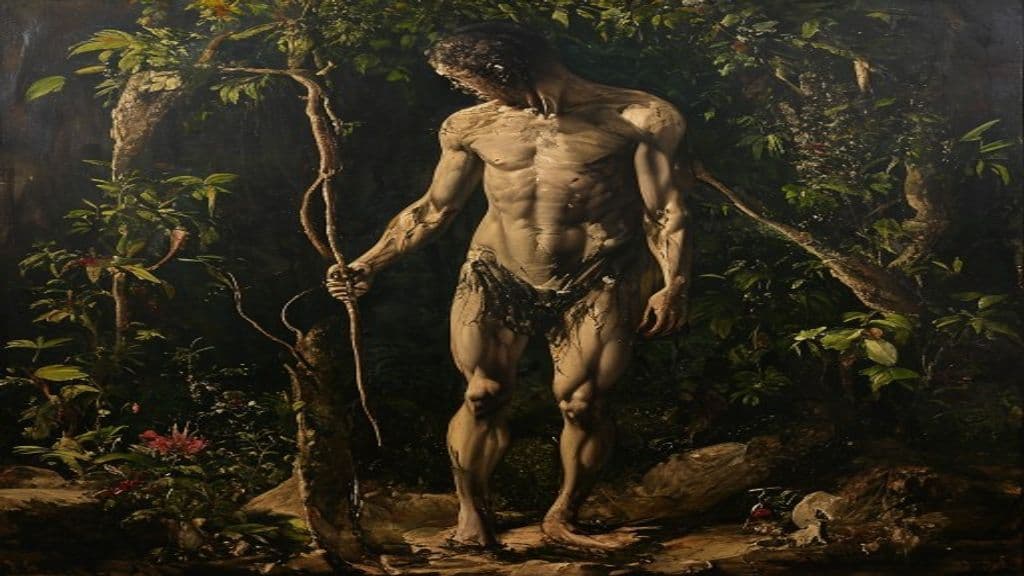
According to the Quranic narrative and the summarized tafsir traditions cited in the sources, God created Adam from earth or clay (ṭīn) and breathed His spirit into him, making him the first human and first prophet. God placed Adam in a paradisical Garden and commanded the angels to prostrate to him as a sign tied to God's will; one created being, Iblīs, refused and became adversarial (Quran 2:30–31; Quran 7:21 as cited). God taught Adam "the Names" (Quran 2:31) and tested him and his wife (Ḥawwāʾ) with a prohibition regarding a certain tree; after they ate, they were sent down to Earth to "live and die," but the sources emphasize that God forgave Adam after his transgression. Later exegetical tradition (e.g., Qiṣaṣ al-Anbiyāʾ as cited) adds motifs such as Adam and Ḥawwāʾ being separated at their fall and later reuniting at Mount Arafat.
The provided sources supply no detailed anthropological or visual description. Islamic scripture as summarized emphasizes Adam's mode of creation—made from earth/clay and animated by God's breath—rather than offering a concrete physical portrait.
Scriptural and exegetical material in the sources attributes to Adam the reception of knowledge from God (notably that God "taught Adam the Names," Quran 2:31) and his role as a paradigmatic moral agent: he functions as progenitor, the figure before whom angels were commanded to prostrate (the episode that occasions Iblīs's refusal), and as one capable of error, repentance, and receiving divine forgiveness. Mystical and philosophical commentators referenced in the sources (e.g., Ibn ʿArabī, Suhrawardī, Tafsir al-Baydawi, as summarized) employ Adam as an archetypal or "Primordial Man" in metaphysical anthropology and at times ascribe to a perfected heavenly Adam capacities such as heightened comprehension of divine names; these are interpretive theological claims cited in later commentary rather than explicit Quranic statements.
Abraham
Abraham (originally Abram) is the foundational patriarchal ancestor in the Hebrew Bible whose life establishes a covenantal relationship between his family/people and God. He functions as an exemplar of faith, the progenitor of promised descendants, and a narrative anchor for claims of land, blessing, and communal identity in later religious traditions.
Abraham (Ibrāhīm) in Islam
Ibrāhīm (Abraham) in Islam is a human prophet and messenger chosen by God, a paradigm of pure monotheism (hanīf), patriarchal ancestor to later peoples and prophets, and traditionally regarded as having helped establish the Kaʿbah with his son Ismāʿīl. He is called Khalīl Allāh ('Friend of God') and is central to rites commemorated in Hajj and Eid al‑Adha.
Allah
Allah is the Arabic-language term for the singular monotheistic God of the Abrahamic tradition as used in Islamic theology and by Arabic-speaking Jews and Christians. Linguistically related to other West Semitic divine names, the term in Islamic usage functions as God's unique proper name (Lafẓ al-Jalālah) and denotes the transcendent creator and sovereign of the universe.
Al‑Yasa (Elisha)
Al‑Yasa (Elisha) is a prophetic figure attested in Abrahamic scriptural traditions. In the Hebrew Bible he is described as an Israelite prophet and 'wonder‑worker'; later traditions in Christianity and Islam also recognize him among the line of prophets.
Archangel
An archangel is a ranked heavenly messenger in Abrahamic and related religious literatures, understood in many traditions as a high‑level angelic agent charged with carrying out divine missions. The term and ranked office are framed by Greek etymology (archángelos, 'chief messenger') and by medieval Christian angelology (notably Pseudo‑Dionysius), while named figures such as Michael, Gabriel, and Raphael appear across Jewish, Christian, and Islamic texts and liturgies.
Asiya bint Muzāḥim (Asiya)
Asiya is the Qur'anic figure presented as the wife of the Pharaoh in the era of Moses who secretly embraced monotheism, adopted and preserved the infant Moses, and is venerated in Islamic tradition as an exemplary righteous woman promised a house in Paradise for her faith and steadfastness.
Azrael
Azrael is the canonical angel of death in Islamic tradition and appears earlier in apocryphal Christian literature; portrayed as a high‑ranking, God‑ordained psychopomp who removes and transports souls, keeps a register of human fates, and acts only under divine command. In some extra‑Quranic and exegetical accounts he is depicted with vast, awe‑inspiring physical attributes and in a few apocryphal Christian texts he is associated with punitive afterlife functions.
Bearers of the Throne (ḥamlat al‑arsh)
The ḥamlat al‑arsh are a class of angels in Islamic textual tradition whose primary role is to carry or support God’s Throne (al‑ʿArsh). Descriptions vary across transmissions, emphasizing their cosmic scale, proximity to the divine Throne, and symbolic features drawn from a range of hadith and exegetical reports.
Bibi Seshanbe
Persian holy angel associated with saving and curing people, particularly the poor and desperate. (Note: - The power_tier should be Greater, as Bibi Seshanbe is described as a "holy angel" which typically suggests deity-level abilities. - The summary mentions she is associated with saving and curing peop)
Bonga/Bong
Mythological figure from Bengali mythology considered the progenitor of the Bengalis, with conflicting accounts in Hindu and Muslim literature. (Note: 1. Power tier: Primordial is likely an overestimation given the conflicting descriptions and lack of clear abilities. 2. Appearance: Should be stated as "No physical description provided" instead of ")
Cherub
In Abrahamic religious literatures a cherub (Hebrew kərūḇ, pl. kərūḇīm; English cherub/cherubim) is a class of exalted celestial being associated with the divine presence, guardianship of sacred space, and service near God. Descriptions range from the composite, winged hybrid creatures of prophetic visions and Near Eastern art to later Western artistic renderings as chubby winged putti; their rank and appearance vary across Jewish, Christian, and Islamic traditions.
Devil
A cross-cultural mythic personification of evil and hostile forces, used in religious, literary, and popular contexts to explain temptation, moral corruption, disease, death, and misfortune. Its exact cosmological status varies by tradition, ranging from an independent principle of evil to a created being that became evil or a symbolic embodiment of human wickedness.
Community Record
- [1]Adam in Islam (Wikipedia). Wikipedia, 'Adam in Islam' article (summarizing Quranic verses 2:30–31, 7:21 and later tafsir/mystical commentary)wiki
- [2]Adam in Islam (Wikidata). Wikidata entry for 'Adam in Islam' (catalog entry noting first man and Prophet in Islam)other
- [3]Archive recording (İnek (Bakara) Suresi 219 Ne Diyor). Archive.org entry included among supplied materials (no substantive content on Adam beyond cataloging)other
- [4]Archive recording (BBC Radio Shropshire: Adam Green). Archive.org audio item included among supplied materials (not used for primary claims about Adam in Islam)other
- [5]Archive recording (Lou Dobbs Tonight). Archive.org audio item included among supplied materials (not used for primary claims about Adam in Islam)other