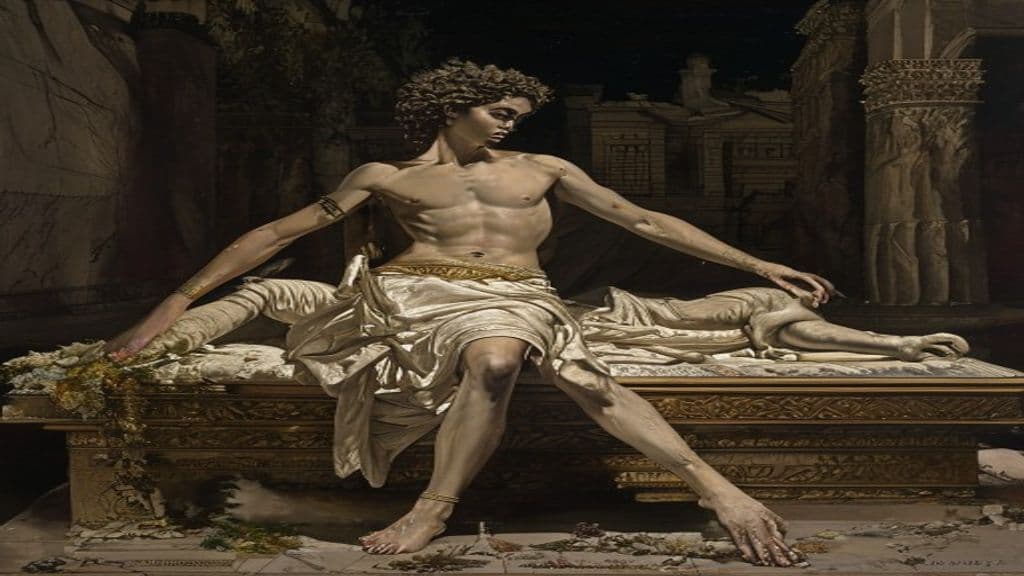
In Greek literary tradition Adonis is a mortal youth of extraordinary beauty who becomes the lover of Aphrodite (and in some accounts also associated with Persephone). He dies after being gored by a wild boar during a hunt; Aphrodite mourns him and his blood mingles with her tears to produce the anemone flower. Scholarly comment in the provided sources locates the Greek Adonis as derived from Near Eastern dying-and-regenerating figures (Sumerian Dumuzid/Tammuz and Levantine ʼAdon), with the Greek name itself deriving from the Canaanite ʼadōn meaning 'lord'. The characterization of Adonis as a 'dying-and-rising god' has been influential in earlier scholarship but is noted in the sources as a debated historiographical classification.
Primary sources emphasize Adonis as the archetype of male beauty in classical antiquity but give no consistent, detailed iconographic description. In cult practice small statuettes or effigies of Adonis were produced and used in the Adonia procession: such a statuette would be laid on a bier and carried to the sea alongside withered rooftop plantings. Beyond these functional cult objects and literary tropes of exceptional beauty, the supplied material records a lack of detailed physical description in the primary texts.
The provided sources do not ascribe supernatural powers to Adonis; rather, his myth functions etiologically and ritually. His death (gored by a boar) is linked to the origin of the anemone flower, and as a cult figure he catalyzes ritual behaviors—rapid rooftop planting of quick-sprouting greens, communal female lamentation, and funerary-style processions to the sea. Adonis is thus described as a mortal whose narrative and seasonal associations structure cult practice rather than as an active supernatural agent with magical abilities.
Weaknesses
- conditionmortality / vulnerable to mortal injury (gored by a wild boar)
- conditionritually bound to seasonal death and the rapid withering of associated vegetation
Wards
None recorded.

Dumuzid (Tammuz)
Dumuzid (Sumerian Dumuzi; Akkadian Duʾūzu/Dûzu; later Tammuz) is an ancient Mesopotamian deity associated with shepherding, plant fertility, and seasonal renewal. He functions as the primary consort of the goddess Inanna/Ishtar, an etiological figure for summer barrenness and autumnal return, and appears in king lists as an antediluvian/early ruler.

Apsara
Celestial dancers and water nymphs of Hindu cosmology — beautiful semi-divine beings who dance at the court of Indra and, by his command, descend to earth to distract sages from excessive asceticism.

Aphrodite
Aphrodite is a major ancient Greek goddess associated with love, lust, beauty, pleasure, passion, procreation, and related social and cosmic forces. She is counted among the principal Olympian deities with major cult-centers (Cythera, Cyprus, Corinth, Athens), celebrated annually at the Aphrodisia, and syncretized with the Roman Venus.
Community Record
- [1]Adonis - Wikipedia. Wikipedia contributors, 'Adonis', Wikipedia, The Free Encyclopediawiki
- [2]Adonis - Wikidata. Wikidata entry Q147534 'Adonis'other
- [3]Quoted scholarship (Walter Burkert) as cited in source excerpts. Burkert, Walter, quoted in the provided material on Adonis (as cited in source excerpts)academic