In the extant summaries preserved in the provided sources, Aindri is presented as a named member of the divine household: the daughter of the asura Puloman and the consort (queen) of Indra, king of the devas. This familial placement — an asura daughter married into the leadership of the devas — appears in the cited encyclopedic summary and situates her within the genealogical and political tensions that frequently structure Hindu narratives of devas and asuras. Sources identify her by variant names (Indrani, Shachi, Paulomi) and treat these as forms of the same goddess-consort rather than as distinct entities. Beyond these relational details, the provided material does not preserve a full cosmogonic or theological origin myth for her (for example, no account of separate cosmogonic birth, creation, or a strict classification within a specific loka is given in the excerpts).
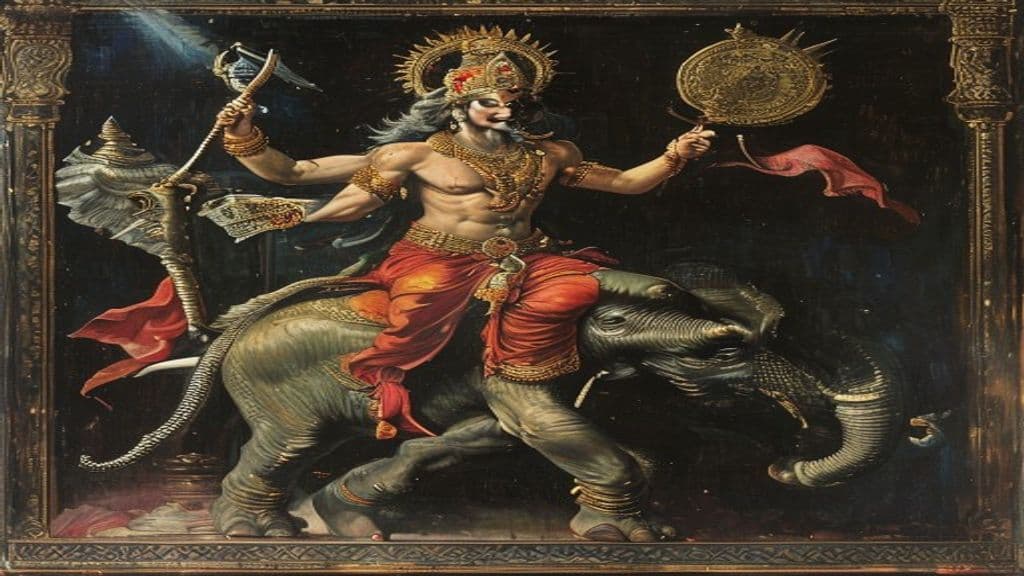
The sources supply only a concise character description rather than a detailed iconography: she is described as 'tantalisingly beautiful, proud and kind.' No consistent, detailed physical portrayal (such as number of arms, standard weapons, or distinctive clothing attributes) is given in the provided material. The single martial fragment references her wielding a club in battle, which indicates at least one textual instance where she is armed; however, that fragment does not elaborate on her broader visual iconography or ritual images.
Available accounts emphasize her social and martial roles. As queen-consort of Indra she occupies a principal status among the devas, invested with the attendant dignity and courtly presence implied by that office. In at least one Vaisnava-periodical fragment she takes an active combat role: the passage states that 'Aindri beat that lord of asuras with her club,' indicating a capacity to fight alongside other divine figures and to wield a weapon effectively against asural foes. Beyond these narrative roles — queen, courtly figure, and episodic warrior — the provided sources do not enumerate additional supernatural powers, magical faculties, or interactions with humans.
Weaknesses
- otherNo weaknesses recorded in the provided sources
Wards
- otherNo warding practices or protective rituals connected to Aindri/Indrani are documented in the provided sources
Community Record
- [1]Indrani (Wikipedia). Wikipedia: Indrani — 'Indrani, also known as Shachi and Paulomi, is the queen of the devas in Hinduism. Described as tantalisingly beautiful, proud and kind, she is the daughter of the asura Puloman and the consort of the king of the devas, Indra.'wiki
- [2]The Sampradaya Sun — Feature Stories (Oct 2023). The Sampradaya Sun — 'Vaisnavi struck him with her discus in the battle, Aindri beat that lord of asuras with her club.'other
- [3]Chhibaiyan (Wikipedia). Wikipedia: Chhibaiyan — 'Chhibaiya is large and populated village near shrine Aindri devi shakteepeeth' (spelling as in source).wiki
- [4]Key Symptoms: Stiffness of back. © Pankaj Oudhia (archive). Archive listing that includes the string 'aindri' among materia medica / remedy titles (no ritual details provided).other
- [5]Key Symptoms: Mental depression without cause. © Pankaj Oudhia (archive). Archive listing that includes 'aindri' among Vedic remedy names or plant listings (link to materia medica, uncertain relation to the goddess).other