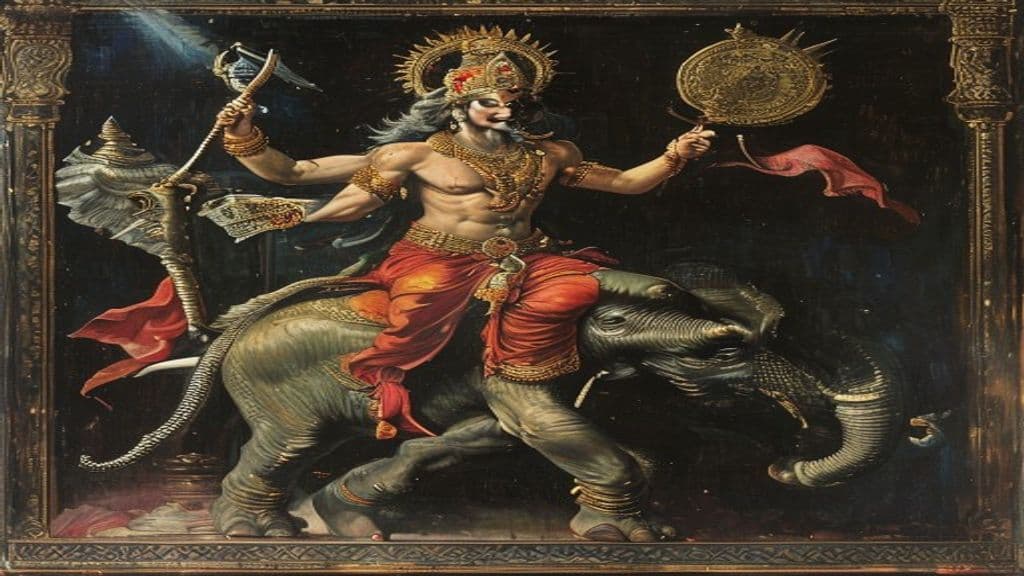
In early Vedic literature—above all the Rigveda—Indra appears as the foremost deity among the devas, a martial sky‑god celebrated for his strength and for deeds that secure human prosperity. The hymns repeatedly praise him as the slayer of the asura Vritra, a cosmic enemy who obstructed waters; by killing Vritra Indra releases the blocked rivers and brings rain and sunshine, restoring abundance and social order. This heroic act and related hymnic material establish Indra’s primary mythic identity in the earliest sources. In later post‑Vedic texts his status evolves: some Purana material (for example the Vishnu Purana as summarized in the provided sources) presents “Indra” less as a single eternal person and more as an office or title borne by the king of gods that is renewed each Manvantara (the Indra of the current Manvantara is named in that tradition as Purandhara in the cited summary). Buddhist and Jain literatures incorporate Indra into their cosmologies as a high heavenly ruler (Pali Indā in Buddhist texts) or as a ceremonial king of superhumans in Svarga‑loka in Jain accounts, but in those traditions he is placed within samsāra and thus subject to rebirth rather than being an absolute, eternal sovereign.
Iconographic and descriptive references in the supplied materials emphasize a small set of stable attributes rather than an exhaustive anthropomorphic portrait: Indra is traditionally shown wielding the vajra (his thunder‑bolt weapon) and riding his vahana, the elephant Airavata. His seat is the capital city of Svarga, Amaravati, and he is associated with the cosmic mountain Mount Meru (Sumeru). The sources summarize these conventional markers—vajra, Airavata, Amaravati/Meru—as the principal visual identifiers attached to Indra in Indic iconography and textual description; the excerpted material does not provide extended physical details such as complexion or dress beyond these attributes.
The supplied texts ascribe to Indra dominion over meteorological and hydrological phenomena—sky, lightning, thunder, storms, rains and river flows—which directly connect him to agricultural prosperity. He is a warrior‑hero figure whose martial role is central: most famously he slays Vritra, the obstructer of waters, thereby freeing rivers and enabling fertility and social well‑being. He functions as king and leader of the devas, ruling from Svarga and exercising authority over other divine beings; in later cosmological schemata the office of Indra is cyclical and attached to whoever holds the kingship of gods in a given Manvantara. The material also records variation across traditions: while Vedic texts place him at the center of divine praise, later Hindu sources sometimes diminish his preeminence, and Buddhist and Jain sources recognize him as a high heavenly being incorporated into their respective cosmologies but subject to samsāric law or placed in ceremonial roles.

Will-o'-the-Wisp
A wandering light seen over marshy ground at night, leading travellers astray into bogs and fens. Possibly a spirit, possibly the soul of the unbaptised dead, possibly the devil himself.
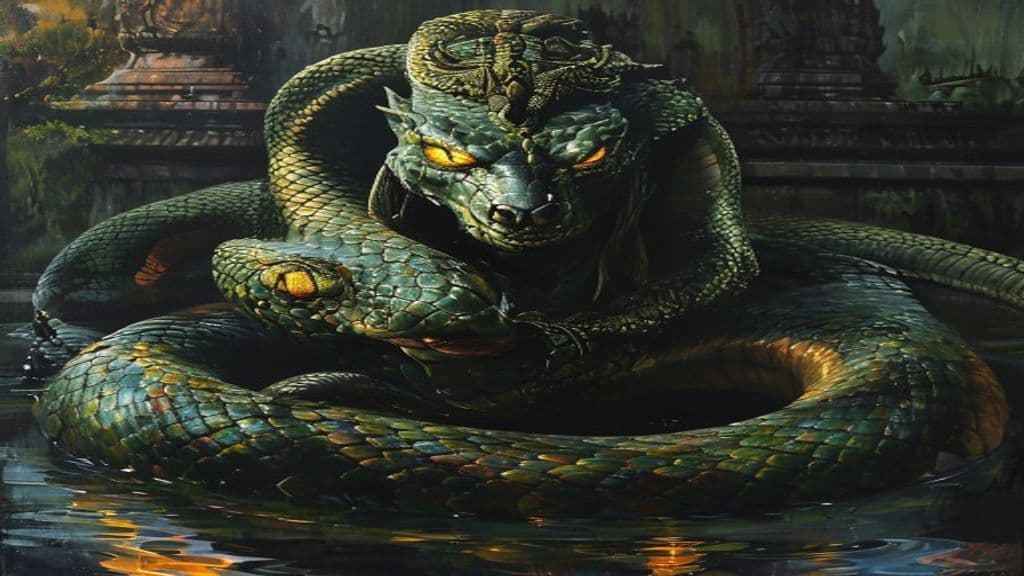
Naga
Divine serpent beings of Hindu, Buddhist, and Jain cosmology — powerful guardians of water, earth, and underground treasures. Revered as deities in South and Southeast Asia.
Abhinandananātha
Abhinandananātha is the fourth Tīrthaṅkara (ford-maker) of the current Jain cosmic age (avasarpini). Traditional accounts place his birth in Ayodhyā to the Ikshvāku (Solar) dynasty, describe his renunciation and attainment of omniscience beneath a priyangu tree, and record his liberation on Mount Śikharjī.
Adi (asura)
Adi is attested in modern reference works as the name of an Asura who 'appears in the Matsya Purāṇa.' Beyond this single-line citation in secondary sources, no descriptive material about the figure is provided in the supplied research notes.
Adi Shakti
Adi Shakti (also Adi Parashakti, Mahadevi, Adya Shakti) is the primordial feminine power in Hindu/Shakta theology, regarded as the ultimate reality (Para Brahman) and the source from which all goddesses and gods manifest. She is both an impersonal cosmic principle (Mulaprakriti) and a focus of devotional invocation in temples, mantras, and pilgrimage sites such as Shakti Peethas.
Adi Vinayaka
Adi Vinayaka (Ādi Vināyaka; also called Nara Mukha Vinayaka) is a named iconographic and devotional form of the Hindu god Ganesha portraying the deity with a human head, described in sources as the form before the episode of decapitation by Shiva. It is rarely worshipped and appears in a small number of South Indian shrines and in devotional/musical repertoires.
Aditi
Aditi is a major Vedic goddess in Hindu tradition who personifies the boundless, infinite cosmic principle and functions as the maternal matrix from which many celestial deities (the Ādityas and other groups) are born. In the Vedic hymns she is invoked as a protective liberator who guards petitioners, provides wealth and safety, and frees devotees from hindrances such as sin and sickness.
Agni
Agni is the Vedic personification of fire in Hindu tradition: a sacred, mediating principle that manifests as terrestrial fire, atmospheric lightning, and celestial sun, and that receives and conveys sacrificial offerings. Prominent in the Rigvedic corpus, Agni functions as sanctifier, witness of rites of passage, and a transformational inner principle in later Upanishadic literature.
Ahalya
Ahalya is a mytho-legendary woman of South Asian (primarily Hindu) narrative tradition, described as created by the god Brahma, married to the sage Gautama, seduced (or tricked) by Indra, cursed by her husband, and ultimately redeemed by Rama. Her tale is a locus for themes of creation, desire, curse/penance, and redemption and she is counted among the ritual-mnemonic panchakanya.
Aindri (Indrani / Shachi / Paulomi)
Aindri (commonly rendered in sources as Indrani, also called Shachi or Paulomi) is a Hindu goddess presented as the queen-consort of Indra. She is depicted in the available material as a courtly queen associated with beauty, pride and kindness who also appears in at least one account as an active martial participant in the devas' battles with asuras.
Ajitanātha
Ajitanātha is the second tirthankara of the current cosmic age in Jainism: an enlightened spiritual teacher who renounced worldly life, attained omniscience (kevalajñāna), and achieved liberation (moksha), and who is credited with establishing a large four-part monastic order in the tradition's hagiography.
Akshayavata
In Hindu mythology, Akshayavata is a sacred banyan tree and/or lake that symbolizes eternal life. It is mentioned in both Hindu and Jain traditions and associated with the Puranas. (Note: - The power tier should be "Greater" or at least "Ancient", as it is associated with the Puranas, which are considered ancient texts. - No specific physical description is provided, but that doesn't m)
Alakshmi
Alakshmi is an inauspicious female supernatural figure in Hindu tradition, presented as the negation or shadow-counterpart of the prosperity-goddess Lakshmi. She personifies poverty, grief, jealousy and social discord and is managed in domestic ritual and festival practice.
Alamelu
Alamelu (also Alamelu Manga / Alarmel Mangai) is a South Indian devotional name for the goddess Padmavati, identified in sources as an avatar of Lakshmi and the consort of Venkateswara; the name is also used widely as a female personal name and in titles of cultural works in Tamil and Telugu contexts.
Community Record
- [1]Indra (Wikipedia). Wikipedia: Indra — summary of Vedic, Hindu, Buddhist and Jain presentations; iconography; etymology; and comparative notes.wiki
- [2]Wikidata: Indra. Wikidata entry for Indra (identifier Q1546248) referenced in source list.other