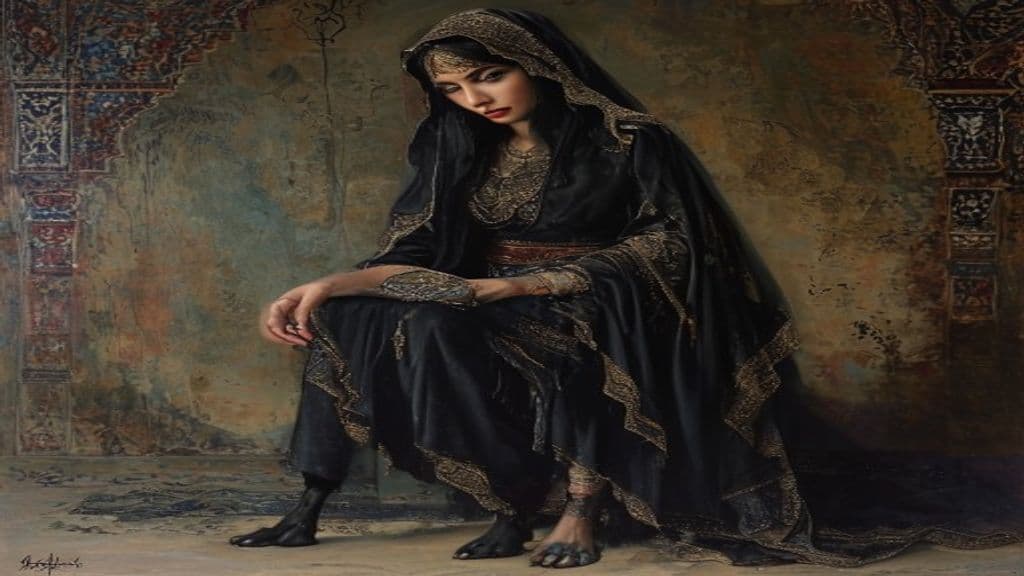
Multiple, contested etymologies and provenance stories circulate in scholarship and vernacular comment. Proposals include derivation from the Hebrew qedēshā (“sacred prostitute”), a link to Carthaginian terminology, an identification with an Eastern goddess (Westermarck's contested suggestion of Qetesh), and an etiological folk-memory of a historical Moroccan woman who seduced Portuguese soldiers; sources treat these proposals as debated and speculative rather than settled.
Common descriptions portray her as a beautiful young woman who also has hoofed legs (reported variants include goat or camel feet) and who wears dark/black garments often concealing provocative clothing beneath. Regional accounts differ in detail: Buffi Sufi traditions emphasize black garments and camel-like feet; local tellings across Tangier, Tétouan, Fez and Beni Ahsen add varying dress and emphasis. She is consistently linked with aquatic settings (seaside, rivers, canals, lakes) in the accounts.
Across sources she is described primarily as a seductive spirit who uses beauty to entice men—posing as a lover or wife in some tales—and who may thereafter cause madness, death, or other harm; the scope and severity of harm vary by region. Some sources state she can manipulate water (for example, moving it or turning it to ice), but this ability is reported as part of the general description and varies among accounts. In Buffi Sufi narratives she can possess people and is said to cause possessed individuals to bray or bark like animals; Buffi material also attributes miscarriage-inducing effects on pregnant women who see her. Local variants report differing temperaments and distinct named Aicha spirits within ritual rosters.
Weaknesses
- substancesteel knives and needles (reported among the Beni Ahsen)
Wards
- otheravoidance of known aquatic haunts (implied preventive practice in local reports)
- substancecarrying or using steel knives or needles (documented regional belief among Beni Ahsen that she fears steel)

Jinn
A class of supernatural beings from pre-Islamic Arabian religion later integrated into Islamic theology; jinn are created, morally accountable entities distinct from humans and angels, often unseen but capable of taking visible forms and interacting with people in varied ways.
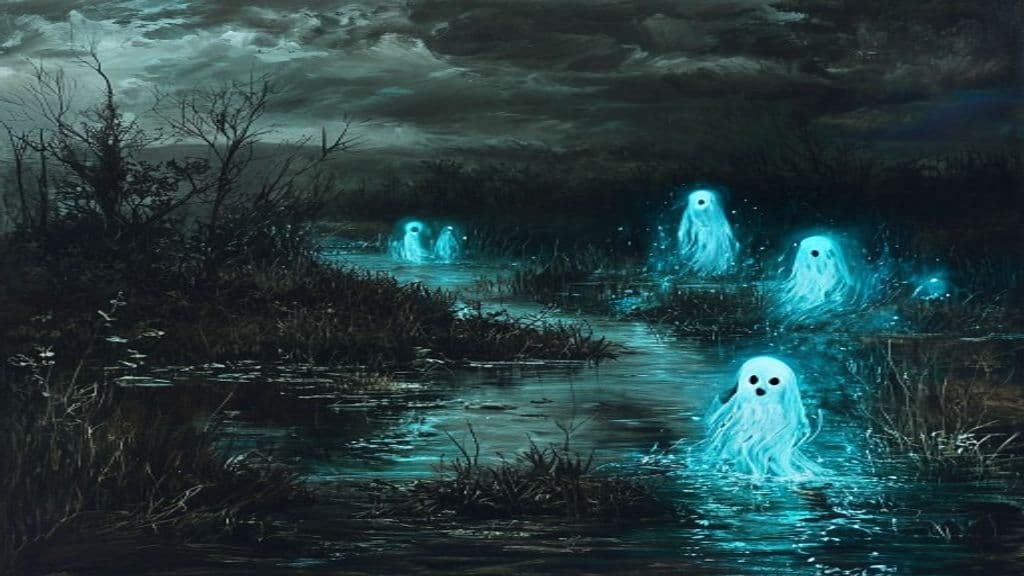
Will-o'-the-Wisp
A wandering light seen over marshy ground at night, leading travellers astray into bogs and fens. Possibly a spirit, possibly the soul of the unbaptised dead, possibly the devil himself.
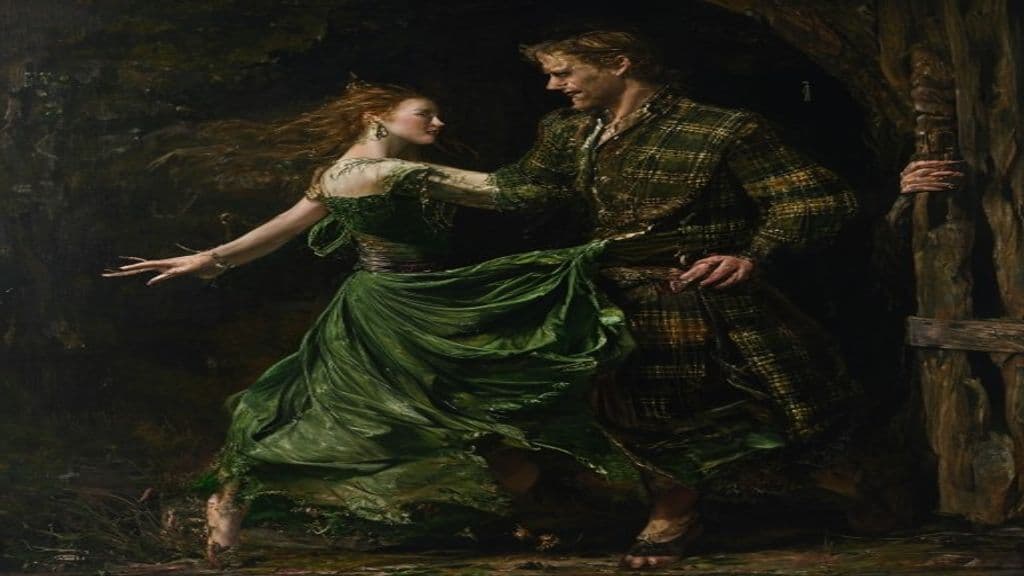
Baobhan Sith
A Scottish Highland vampire fairy — a beautiful woman in a green dress who appears to men alone in the wilderness and drains their blood, her deer hooves hidden beneath her skirts.

Pontianak (Kuntilanak)
A Southeast Asian female vengeful spirit common in Malay‑language traditions, often portrayed as the restless ghost of a woman who died in traumatic circumstances; she commonly appears as a beautiful woman who may reveal a monstrous form and is associated with banana and banyan trees.
Aicha Kandicha (Qandisa)
Aicha Kandicha (also romanized Qandisa/Qandisha) is a female mythological figure in Moroccan folklore described as a jinn-like seductress associated with water. She appears as a beautiful woman with hoofed lower limbs who dwells at rivers, springs, lakes and the sea and is said to use sexual allure to seduce men, sometimes driving them mad or killing them.
Shamharush
Shamharush (also Shamhurish, Shamhurash, Sidi Chamharouch) is a longstanding jinn sovereign figure in Moroccan folk belief, described as one of the seven jinn kings and a supreme judicial ruler of the jinn. Associated with Thursday and Jupiter, he was historically venerated at a shrine near Aroumd in the High Atlas but his cult was later contested by Islamic scholars.
Ahura
Ahura is an Avestan term that designates a class of divinities in the Indo‑Iranian and Zoroastrian tradition, marking the sacred ‘lords’ who are to be reverenced and opposed to the rejected class of daevas. In Zoroastrian scripture the label functions as both a technical category and an honorific applied to high divine figures such as Ahura Mazda, Mithra, and Apam Napat.
Ahura Mazda
Ahura Mazda is the principal deity of Zoroastrian tradition, invoked as the supreme source of goodness and wisdom who instructs Zoroaster and commands helper spirits (yazatas). Historically attested in Achaemenid royal inscriptions, Ahura Mazda occupies a central role in Zoroastrian liturgy (notably the Yasna) and in various Iranian religious formulations.
Ahurani
Ahurani (Avestan ahurani; pl. ahuranis) is a Zoroastrian divinity or class of divinities of the waters in the Avesta. In hymnic contexts (notably Yasna Haptanghaiti and Yasna 68) the ahurani(s) are invoked as companions of the ahura(s), bearers of health, fertility and other gifts, and the ritual recipients of libations (Ab‑Zohr).
Aiapæc (Ai Apaec)
Aiapæc (Colonial Mochica: aiapæc, aiapäk) is a prominent mythological figure identified in Moche (Mochica) iconography. Scholarly reconstructions present Aiapæc as a powerful provider and protector associated with mountains, water, food and military success, and also as a feared punitive recipient of offerings including human heads; the exact rank and identity of the figure within pre‑Hispanic Moche religion is debated in the secondary literature.
Aibell
Aibell (Aoibheall, Aoibheal; anglicised Aeval, Eevill) is a powerful female Otherworld figure in Irish tradition, variously described as a pre‑Christian regional goddess and, after Christianisation, as a Fairy Queen and guardian spirit associated with north Munster. She is linked to a specific entrance to the Otherworld at Craig Liath, acts as a patron/guardian of certain kin‑groups, functions as an oracular/prophetic presence, and is famed for a harp whose music is a death‑omen.
Aidos
Aidos (Ancient Greek: Αἰδώς) is the personification of shame, modesty, and reverent restraint in classical Greek thought. Treated variously as an ethical feeling, a moral force, and occasionally as a goddess with local cults, Aidos embodies the inner reverence that restrains wrongdoing and governs social propriety.
Aigamuxa
Aigamuxa are legendary humanoid man‑eaters from Khoikhoi‑recorded traditions of southern Africa, described in the available sources as desert‑dwelling predators—especially of Kalahari dunes—notable for having their eyes located on their feet and for needing to invert their bodies to see.
Aigosages
Aigosages (Greek Αἰγοσάγες, Latin-alphabet Aegosages) were a Gallic/Galatian tribal group recorded in Hellenistic sources as a recruited mercenary body active c. 218–216 BC. Recruited in Thrace by Attalus I of Pergamon, they were transported across the Hellespont, settled on its shores, conducted raids in the Troad, besieged Ilium, and were annihilated by Prusias I of Bithynia.
Ailill
Ailill (variants Ailell, Oilioll) is an Old Irish male personal name prominent in Irish legendary and early medieval sources. It was borne by numerous kings, druidic figures, and clerics across mytho-historical and historical traditions and is said in the cited material to mean something like "beauty."
Ailill Angubae
Ailill Angubae is a human figure in the Irish tale The Wooing of Étaín, presented as the brother of High King Eochaid Feidlech who falls desperately in love with his brother's wife, Étaín. His unrequited passion leads to a wasting illness and a failed rendezvous when the Tuatha Dé Danann figure Midir casts him into an enchanted sleep.
Community Record
- [1]Aisha Qandicha. Wikipedia, 'Aisha Qandicha' entry (summarized material and selected quotations as provided in research notes)wiki
- [2]Wikidata: Q128091. Wikidata item Q128091 (classification summary for Aisha Qandicha)wiki