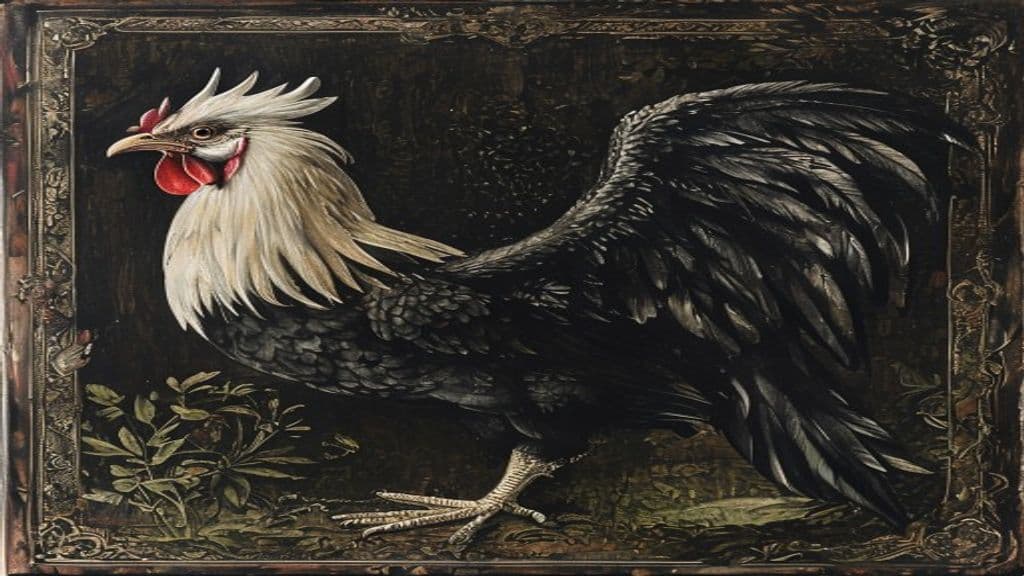
Secondary sources report that an Aitvaras is said to hatch from the egg of a very old rooster. Accounts vary on the required age of the rooster: summaries cite a range of about 9–15 years in one source and 9–12 years in another. No primary ethnographic origin myth or fuller provenance is provided in the available materials.
Sources describe variation by context: indoors the Aitvaras is reported as resembling a white or black rooster or simply a black chicken, while outdoors it is described in some accounts as a dragon-like bird or small dragon about two feet long with a serpentine body and four legs; in some districts it is said to have wings and fly trailing fire. Multiple summaries emphasize a fiery or meteor-like tail, and one source notes that when an Aitvaras dies it 'becomes a spark.'
Summaries state that an Aitvaras will lodge itself in a house and most often refuse to leave. It provides its adopted home with material goods—commonly characterized as stolen gold and grain—and thereby brings both good and bad luck to the household, often getting occupants into trouble. The creature is described as hatching from an old rooster's egg and transforming into a spark at death. Sources do not give detailed mechanisms for how it acquires goods or further supernatural capabilities.
Airmed
Airmed (Airmid) is a healer and keeper of herbal knowledge among the Tuatha Dé Danann in Irish myth. Daughter of Díán Cécht and sister of Miach, she preserves the lore of healing plants, gathers herbs at Miach's grave, and is named among enchanters who sang over the well of Sláine to restore the wounded.
Airyanem Vaejah
Sacred homeland and territory in Zoroastrianism, considered the cradle of Iranian civilization. (Note: * Power tier: Greater (Airyanem Vaejah is a sacred territory, not a cosmic entity) * Appearance and Abilities sections are missing * Weaknesses and Wards sections are missing * Summary should be rewri)
Aita
Aita is an Etruscan chthonic epithet of the older god Śuri (Suri), functioning as an underworld lord in late Etruscan iconography and funerary contexts. Appearing from about the 4th century BC, Aita shows strong influence from the Greek Hades and is depicted rarely in tomb paintings and grave goods.
Aitia (Baltic Finnic)
Primordial figure representing the creative power of the universe, associated with the creation of the world and emergence of life from chaos. (Note: 1. Power tier: Primordial is plausible, but it would be more accurate to indicate "Primordial" as a default power tier without specifying, since there's no further information about its abilities or b)
Aitolos
Aitolos is a name that appears in Greek-language traditions referring to two distinct figures: Aetolus, a mythic genealogical ancestor in classical Greek myth (son of Endymion, descendant of Deucalion), and Kosmas Aitolos (St. Cosmas of Aetolia), a historical/hagiographic Orthodox teacher whose collected writings emphasize pastoral and ascetical themes. The sources do not present Aitolos as a single folkloric supernatural being.
Aitu (Māori)
Malevolent spirits in Māori tradition, often taking the form of plants or animals and associated with trouble-making and mischief. (Note: - Power tier should be Greater, not Lesser (Aitu being lesser gods in some cultures, but also associated with deity-level abilities) - Abilities: Add detail about their role as patrons of specific vil)
Aiwass
Aiwass is the name given by Aleister Crowley to a discarnate intelligence that he reported as audibly dictating Liber AL vel Legis during three days in Cairo in April 1904. Crowley presents Aiwass as an objectively separate revelatory being, variously called the minister of Hoor‑paar‑kraat and later identified by Crowley with his Holy Guardian Angel.
Aiwohikupua
Aiwohikupua is a personal name attested once in the supplied corpus of collected Hawaiian-language narrative material. The available sources provide only a short fragmentary occurrence of the name and no corroborating description, role, or attributes.
Aiy (Aiy-auk)
Aiy (also rendered Aiy-auk) is a name mentioned in relation to Siberian contexts in the queryer's sources, but the provided documents do not contain usable folkloric descriptions or ethnographic data about the entity. This entry records what the supplied materials do and do not establish and points to the research gap.
Aiyanar
Aiyanar (Aiyaṉār, ஐயனார்) is a Tamil rural tutelary deity venerated chiefly in village contexts of Tamil Nadu and among Tamil communities in Sri Lanka. Portrayed as a martial guardian often mounted on a horse or elephant and accompanied by attendant spirits, he functions primarily to protect village boundaries, people, and livestock and has later been syncretized with the Sanskritic Sastha tradition.
Aiyyanar
Aiyyanar (also spelled Aiyanar) is a Tamil rural village deity venerated in South India and Sri Lanka, primarily among rural Tamil communities. He is associated in material culture with large, colorful roadside and temple statues often shown with companions and mounted on horses or elephants, and functions as a local protective/patronal figure within village devotional practice.
Aizen Myō-ō (Rāgarāja)
Aizen Myō-ō corresponds to the deity Rāgarāja, a wrathful/transformation-oriented figure venerated in Esoteric and Vajrayāna Buddhist traditions. The figure is especially revered in Chinese Esoteric Buddhism in Chinese communities and in the Japanese Esoteric schools Shingon and Tendai.
Community Record
- [1]Aitvaras - Wikipedia. Wikipedia: Aitvaraswiki
- [2]Aitvaras | Cryptid Wiki | Fandom. Cryptid Wiki / Fandom entry for Aitvaraswiki
- [3]Aitvaras | Megami Tensei Wiki. Megami Tensei Wiki summary of mythic traitswiki
- [4]Wikidata: Aitvaras. Wikidata entry for Aitvaraswiki