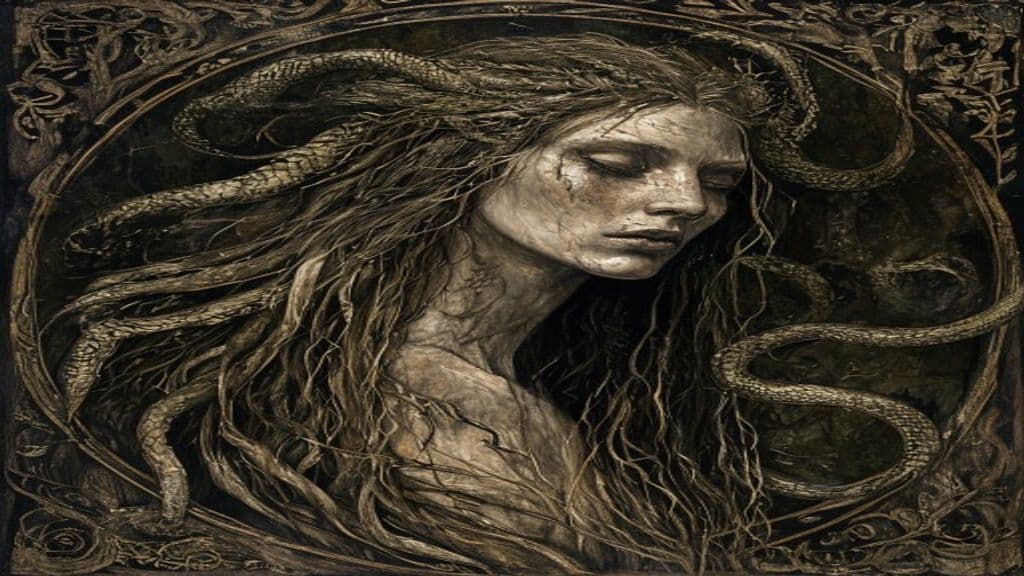
Fragmentary runic-song material and subsequent literary use place Ajatar in the mythic landscape of Finnish tradition rather than a single canonical origin tale. In some runic-song contexts (e.g., Muonio and Enontekiö) forms related to Aattara appear in songs that link her to the origin of snakes (e.g., 'the snake is a twig in Aattara's fence'). Aleksis Kivi's 19th-century literary rendering situates her in the mountains as kin to Hiisi and as one who commands Lempo and gnomes; scholarly sources note that Matthias Castrén later standardized the form 'Ajatar.' The sources do not provide a single cohesive pre-Christian cosmogonic origin story for Ajatar but show her embedded in origin motifs for serpents and in a network of malign powers.
Traditional brief descriptions emphasize a monstrous wild-woman: sources record portrayals of a female spirit with extremely long hair (a plait to her heels) and sagging breasts (to the knees). She is consistently associated with serpents in the source corpus; however, more elaborate reptilian or dragoniform features (green scaled torso, many-snake lower body, fanged mouth) are characteristic of modern artistic and fictional adaptations rather than being firmly attested in the older folkloric fragments cited in the provided materials.
Source material attributes to Ajatar the spreading of disease and pestilence through her associations with Hiisi and Lempo. Etymological commentary and older descriptions characterize her as pursuing or driving people astray (the verb ajaa/ajattaa as a possible root), and Christian Erici Lencqvist described her as 'scary and fast and drives people astray.' Runic-song forms (Ajaster(i)) are attested in northern songs as names linked to Syöjätär and to one who injures people by shooting. Aleksis Kivi's literary portrayal presents her as an instigator who encourages violent deeds. These claims are fragmentary across genres (runic songs, literary usage, and scholarly summaries) in the provided sources.
Weaknesses
- otherNo specific weaknesses attested in provided sources
Wards
- otherNo specific protective rituals, charms, or wards against Ajatar are documented in the supplied sources

Hiisi
A term in Finnic mythologies referring to both sacred localities and associated mythological entities. (Note: - Power tier: Downgrade to Lesser (local spirit) as there's no indication of Primordial-level power. - Summary: Update to clarify that Hiisi refers both to sacred locations and associated entities, bu)
Lempo
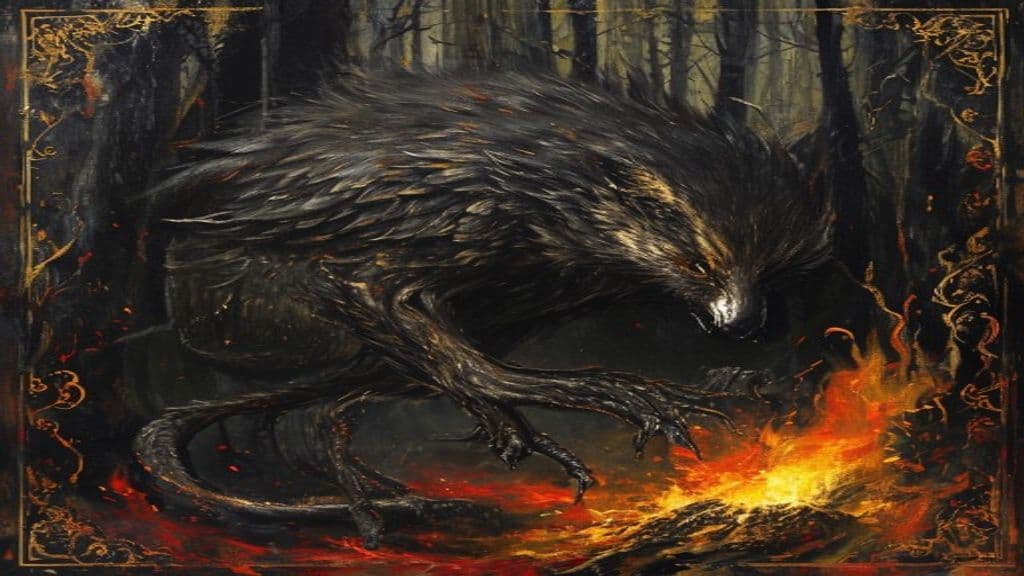
In Finnish folklore, Lempo is a malevolent supernatural being associated with love and fire. (Note: 1. Power tier should be "Greater" is plausible given the described abilities, but it's worth noting that Greater entities typically exert deity-level influence. 2. No information on sensory cues or wa)

Louhi
Louhi is a major supernatural ruler figure in Finnish mythology presented as the Mistress or ruler of Pohjola, an otherworldly northern realm; she is associated with death, disease, and the origin and control of calamities, and appears in traditions as a queenly or witchlike sovereign who can shapeshift into bird-forms.

Loviatar
Loviatar is a figure attested in modern reference works as part of Finnish mythic material associated with death and illness; one database entry describes her as a blind daughter of Tuoni. Source material in the supplied corpus also shows nearby or overlapping traditions (notably Louhi) linked to death, disease, and wolves, but the documents provided do not settle whether Loviatar and Louhi are identical, conflated, or distinct in older tradition.
Tapio
Tapio is attested in the supplied sources as the name of "a god or spirit in Eastern Finnish mythology" and is also widely used as a modern Finnish personal name and in toponymy and cultural references. The provided materials contain no further folkloric detail about Tapio's appearance, duties, or rituals.
Aiwohikupua
Aiwohikupua is a personal name attested once in the supplied corpus of collected Hawaiian-language narrative material. The available sources provide only a short fragmentary occurrence of the name and no corroborating description, role, or attributes.
Aiy (Aiy-auk)
Aiy (also rendered Aiy-auk) is a name mentioned in relation to Siberian contexts in the queryer's sources, but the provided documents do not contain usable folkloric descriptions or ethnographic data about the entity. This entry records what the supplied materials do and do not establish and points to the research gap.
Aiyanar
Aiyanar (Aiyaṉār, ஐயனார்) is a Tamil rural tutelary deity venerated chiefly in village contexts of Tamil Nadu and among Tamil communities in Sri Lanka. Portrayed as a martial guardian often mounted on a horse or elephant and accompanied by attendant spirits, he functions primarily to protect village boundaries, people, and livestock and has later been syncretized with the Sanskritic Sastha tradition.
Aiyyanar
Aiyyanar (also spelled Aiyanar) is a Tamil rural village deity venerated in South India and Sri Lanka, primarily among rural Tamil communities. He is associated in material culture with large, colorful roadside and temple statues often shown with companions and mounted on horses or elephants, and functions as a local protective/patronal figure within village devotional practice.
Aizen Myō-ō (Rāgarāja)
Aizen Myō-ō corresponds to the deity Rāgarāja, a wrathful/transformation-oriented figure venerated in Esoteric and Vajrayāna Buddhist traditions. The figure is especially revered in Chinese Esoteric Buddhism in Chinese communities and in the Japanese Esoteric schools Shingon and Tendai.
Ajak
Ajak is a fictional character created by Jack Kirby who first appeared in The Eternals #2 (1976). Within Marvel Comics continuity Ajak is a member of the near-immortal race called the Eternals, serves as a mediator/communicator with the cosmic Celestials, and has exhibited cosmic and molecular-level abilities across multiple eras and media adaptations (including the MCU film Eternals).
Ajax (Aias)
Ajax (Ancient Greek: Aias) is a human heroic figure of the Trojan-cycle tradition and the tragic protagonist of Sophocles' play Ajax. In the surviving tradition he is a mortal Salaminian warrior celebrated for physical strength and martial reputation whose wounded honor, rage, and resulting suicide are the focus of Sophocles' drama.
Ajax the Great
Ajax the Great (Ancient Greek: Αἴας, Aíās) is a mortal heroic figure of the Trojan War cycle, famed as a towering, steadfast Greek champion and defender of the Achaean ships. Prominent in Homer’s Iliad, he is portrayed as second only to Achilles in martial standing and as a paragon of defensive strength and reliability.
Ajax the Lesser (Aias, the Locrian)
A mortal Greek heroic warrior of the Trojan War (son of Oileus) distinguished from Ajax son of Telamon by the epithet "the Lesser." Celebrated for martial skill, he is chiefly remembered for a sacrilegious act at Athena's sanctuary during the sack of Troy that provoked divine vengeance and led to his violent death at sea; some locales and his native Locrians later maintained a hero-cult.
Aje (Iyami Aje)
Aje appears in the supplied sources only as part of the compound term "Iyami Aje," which the referenced Wikipedia disambiguation entry labels as a Yoruba concept of feminine power. No further details about its nature, practices, appearance, or rituals are present in the provided materials.
Aji Saka
Aji Saka is a legendary Javanese culture-hero and foundational figure credited in tradition with pacifying Java, founding a kingdom at Medang Kamulan, instituting the Saka calendrical era in Java, and composing the hanacaraka mnemonic poem tied to the origin of the Javanese script.
Community Record
- [1]Ajatar (Wikipedia). Ajatar — Wikipedia article summarizing folkloric associations, etymology, appearance, and literary references.wiki
- [2]Wikidata: Ajatar. Wikidata entry for Ajatar (identifier and summary metadata).other
- [3]Archive: Ajatar - art by damianGJ. Modern artistic depiction archived under Ajatar (used in the supplied source set to illustrate modern reception).other
- [4]Archive: Avak Avakyan — Ajatar (mp3). Musical piece titled 'Ajatar' present in the supplied archive links (modern cultural reception).other
- [5]Archive: Painuva päivä; Elämän koreus; Leirivalkeat; Ajatar; Syreenien kukkiessa. Archive listing including material titled 'Ajatar' among other items (part of supplied source set).other
- [6]Godchecker: AJATAR - the Finnish Demoness. Popular reference summarizing Ajatar as a female malign spirit; used among supplied web sources.other
- [7]Mythlok: Ajatar — The Forest Demoness. Online summary describing Ajatar's folkloric associations and modern portrayals (part of supplied materials).other