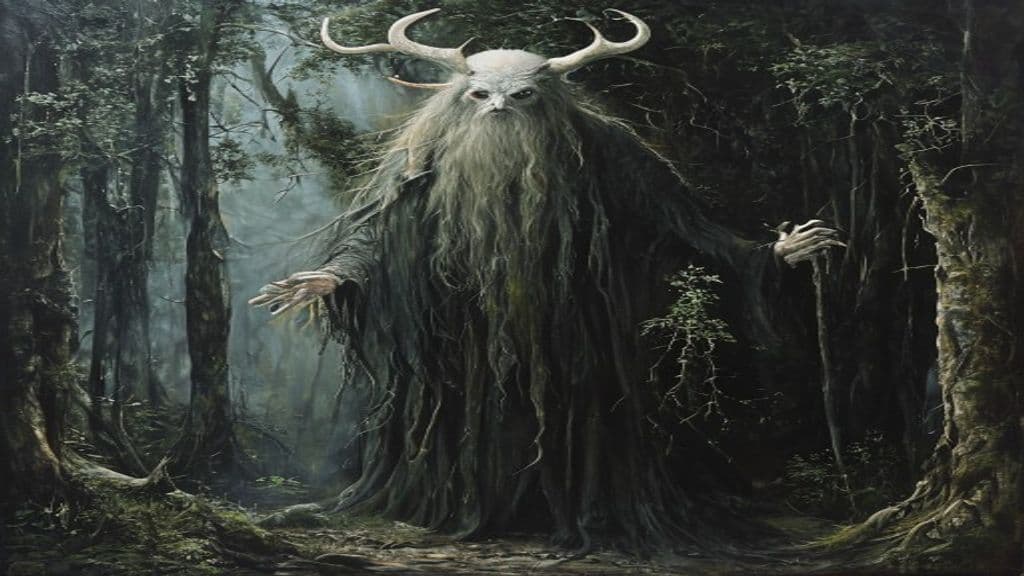
Limited information is available on the specific powers or behaviors of Hiisi, but they are associated with sacred localities and have a connection to mythological concepts within Finnish tradition.
Karsikko (Finnish)
In the Finnic tradition, a karsikko is a ritualistic marking made on a tree to prevent a deceased person's spirit from returning to its former location. (Note: - Power tier should be Minor Spirit instead of Lesser - Appearance description should be added (set of markings on a tree) - Origin story is missing entirely; add source material for it if applicable )
Hibagon
The Hibagon is a regional cryptid reported around Mount Hiba in Hiroshima Prefecture, Japan, described as a large, bipedal, hairy humanoid. Reported since the 1970s, it is presented in sources as a local analogue to North American Bigfoot and the Himalayan Yeti and treated primarily as a cryptozoological/folkloric curiosity rather than a being embedded in traditional religious cosmology.
Hibil (Hibil Ziwa)
Hibil Ziwa is a luminous uthra (lightworld being) in Mandaean religion who serves as a salvific agent. Created by Manda d‑Hayyi, he is sent into the World of Darkness to confront and bind hostile powers, retrieve dangerous elements, and secure the return of souls to the World of Light; he is also reflected as a human archetype cognate with Abel.
Hiderigami (Hanba)
Hiderigami (Japanese) / Hanba (Chinese, 旱魃) is a drought‑associated supernatural being in East Asian tradition. Treated variously as a goddess, spirit/ghost, monster, and later vampire‑like or shape‑changing entity, it is chiefly known for causing severe drought and drying up waters in affected places.
Hidimba
Hiḍimba is a powerful demon king in the Indic epic Mahābhārata who dwells in the forest, preys on humans (including cannibalistic behavior), and is slain in single combat by the Pandava Bhīma. In regional tradition the cultic attention shifts to his sister Hiḍimbī (Hiḍimbā Devī) and their son Ghaṭotkaccha, whose shrines and festival roles are prominent in Himachal Pradesh.
Hidimbi (Hiḍimbī / Haḍimbā)
Hiḍimbī (Hiḍimbā) is a rākṣasī (female rakshasa) figure in the Mahābhārata who encounters Bhīma, changes form to a beautiful maiden, marries him and bears Ghaṭotkaca. In Himalayan (Himachal Pradesh) regional religion the figure is worshipped as the local goddess Haḍimbā, patron of a temple in Manali; scholarship treats the cult as older than or independent of its epic identification.
Hiiden Hirvi
Mythical moose from Finnish tradition that must be hunted by skiing. (Note: - Power tier: Greater (given its classification as a mythical entity that requires special skills to hunt, it's likely more powerful than a Minor Spirit) - Weaknesses: specify what the source material)
Hikairo
Hikairo is attested in the provided sources as a personal and group name within Māori contexts (used for individuals and iwi/hapū identifiers such as Ngāti Hikairo), rather than as a documented supernatural being. References show historical and contemporary usages tied to leadership, ceremonial roles, and local guardianship projects.
Hildeburh
Hildeburh is a human literary character in the Old English heroic-material cycle (the Finnsburg episode as preserved in Beowulf and related fragmentary material). In the narrative she functions as a freothuwebbe or 'peace-weaver'—a marriage-link between royal houses—whose story exemplifies marriage-as-peace-weaving, kin-feud, and funerary response after battle.
Hilkiah
Hilkiah (Hebrew: Ḥilqiyyā(hu), "my portion is Yahweh") is attested in biblical and epigraphic sources as a kohen (priest) and, in the biblical narrative, the High Priest of the Jerusalem Temple during King Josiah's reign. He is chiefly remembered for finding the 'Book of the Law' in the Temple and delivering it to royal officials, an act that precipitated Josiah's religious reforms.
Himegami
Himegami (比売神) is a general term in Shinto for a female kami; it can refer either to an independently identified goddess or to a feminine relational role (for example, the wife, daughter, or other important relation) of a male kami enshrined at the same shrine. The term functions as a classificatory title within Shinto practice rather than denoting a single uniform mythic individual.
Hina
Hina is an onomastic category in Polynesian traditions naming a number of related female divine figures—often sovereign goddesses or queens—who are variously associated with domains such as the moon and, in specific local tales, natural forces like rain or fire. Rather than a single pan‑Polynesian personage, Hina functions as a flexible role filled by distinct local figures (e.g., Sina, Hanaiakamalama).
Community Record
- [1]Wikipediawiki