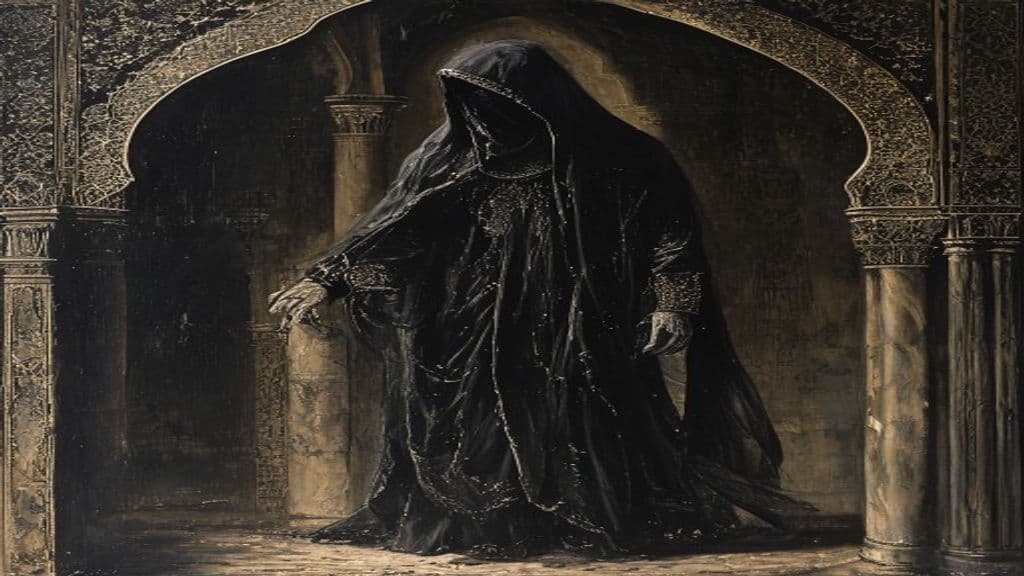
In the tradition cited, the Jann are described as a pre‑Adamite people who inhabited the earth before Adam and function as the ancestor of the jinn. The account records a ruler among them named Jann ibn Jann and notes that "the father of the jinn is also called Abu Al-Jann." Folkloric variants reported in the source state that many consider the Jann to have been punished and turned into the weakest class of jinn, a motif of demotion or transformation used to explain the later status of jinn (Source: Wikipedia: Al-Jann).
The provided source does not supply a reliable physical description for the Jann; no details on form, size, color, or bodily traits are attested in the cited material (Source: Wikipedia: Al-Jann).
The cited material does not record specific powers, habitual behaviors, or modes of interaction with humans for the Jann beyond their genealogical relationship to jinn and the folkloric statement that many consider them to have been punished and turned into the weakest class of jinn. No explicit abilities are described in the available source (Source: Wikipedia: Al-Jann).

Jinn
A class of supernatural beings from pre-Islamic Arabian religion later integrated into Islamic theology; jinn are created, morally accountable entities distinct from humans and angels, often unseen but capable of taking visible forms and interacting with people in varied ways.

Rakshasa (Himalayan variants)
A Himalayan reception of the pan-Indian rakshasa motif: hostile or disruptive non‑human beings known from Sanskrit epic and Puranic literature, here noted where Himalayan sources and discussions intersect with the broader epic tradition. The supplied sources do not document distinct, well‑attested Himalayan folklore variants; the entry therefore presents primarily the epic/legendary profile as transmitted into Himalayan contexts in general references.
Amir Arsalan-e Namdar (The Exalted Prince Arsalan)
A powerful, potentially benevolent figure in Persian mythology with magical abilities. (Note: 1. Power tier needs to be adjusted based on abilities described (as benevolent figure with magical abilities), could be Lesser or Minor Spirit instead of Greater. 2. Summary should mention specific my)
Darab-nama (Persian tradition)
Historical romance novel from 12th-century Persia, with possible references to supernatural entities in Persian folklore. (Note: - Power tier: Primordial (due to its historical significance and cultural impact) - Summary: Needs more specific information on supernatural entity references - Appearance: No information provided in )
Fulad-zereh
A huge horned demon from the Persian story of Amir Arsalan, associated with aerial wanderings and predatory behavior. (Note: 1. Power tier: Lower to "Ancient" or "Greater" as Primordial is typically reserved for entities with cosmic-level powers, which Fulad-zereh's abilities do not suggest. 2. Appearance: Add that it has a)
Akṣayakumāra
Akṣayakumāra appears in the Ramayana as the youngest son of Rāvaṇa and a warrior sent to oppose Hanuman in the Ashoka Vatika episode; described as about sixteen, he fights bravely from a chariot and is killed by Hanuman.
Al (Alı)
No folkloric or ethnographic evidence for a supernatural entity named "Al" or "Alı" is present in the supplied source set. The available materials are modern biographical, political, linguistic, and religious texts that do not describe a Turkish spirit, demon, or other supernatural being by this name.
Al (Georgian Tradition)
In Georgian tradition, Al is a supernatural entity that interferes with human reproduction, acting as a demon of childbirth. (Note: - Power tier should be "Ancient" (Al is a demon of childbirth, but not cosmic-level) - Abilities need to specify that Als can cause spontaneous abortions, stillbirths, and infant mortality, as stated )
Al-Abyad
Al-Abyad (Arabic: al‑Abyad, "the White") appears in modern compilations and anecdotal references as a named jinn or epithet within Arabic/Islamic discourse on jinn. The corpus consists mainly of contemporary lists, forum posts, popular articles, and a polemical anecdote; no coherent classical origin myth or primary ritual tradition for Al-Abyad is attested in the supplied materials.
Al-Haddar
Al-Haddar is documented in the provided sources primarily as (a) an impact crater on Saturn's moon Enceladus named after a character from The Book of One Thousand and One Nights, and (b) as a personal or author name appearing on Arabic devotional manuscript titles. The sources do not present Al-Haddar as a supernatural being within any folkloric cosmology.
Al-Jānn
Al-Jānn (jann) is a pre-Adamite, ancestral category invoked in Arabic-Islamic exegetical, hadithic, mystical, and folkloric materials to designate an earlier class of sentient beings—progenitors of later jinn—said to be created of fire, to have once inhabited and sometimes ruled the earth, and to stand in a liminal ontological position between angels and humans.
Al-Kuz
Al-Kuz is not attested in the supplied corpus as a supernatural being; the name appears as the designation of an impact crater on Saturn's moon Enceladus and as the name of a literary character (one of the barber’s six brothers) in "The Hunchback's Tale" from The Book of One Thousand and One Nights.
Al-Mi'raj
A mythical creature from medieval Arabic literature, described as a one-horned hare or rabbit. (Note: * Power tier: Given the lack of information on abilities and powers, it's too early to assign a power tier. However, considering its classification as a "mythical creature" in medieval Arabic literatu)
Al-Wakwak
Al-Wakwak is a geographic entity in medieval Arabic literature, possibly described as an island or group of islands. (Note: * Power tier should be Primordial (cosmic) given it's mentioned as a geographic entity in medieval Arabic literature. * Origin story section is missing, which would typically include how Al-Wakwak was)
Community Record
- [1]Al-Jānn. Wikipedia contributors. "Al-Jānn." Wikipedia, The Free Encyclopedia. https://en.wikipedia.org/wiki/Al-J%C4%81NNwiki
- [2]Wikidata: Q108308417 (Al-Jannabi). Wikidata entry Q108308417 (family-name form). http://www.wikidata.org/entity/Q108308417wiki