
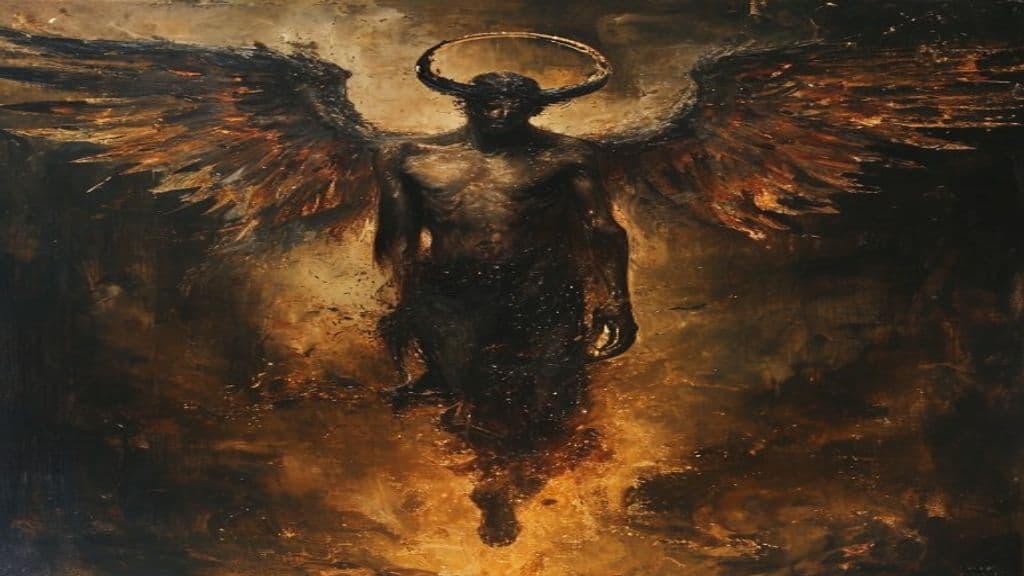
In the cited corpus al-Jānn is presented as an ancestral or prototype class antecedent to the later jinn. The Qur'anic vocabulary used in Surah 15:27 and 55:15 is cited to describe a being created from fire; hadith literature (summarized in secondary sources) and exegetical traditions record narratives in which jann inhabited the earth before Adam. Legends recorded in the surveyed materials include a pre-Adamite polity ruled by a figure called Jann ibn Jann (in Persianate legend) and accounts that angels or angelic forces were sent and drove the jann from the earth, clearing the way for subsequent epochs. Exegetes and transmitters differ on particulars: some sources and traditions equate or identify al-Jānn with figures like Iblīs in certain strands, while others distinguish al-Jānn as the progenitor of jinn and Iblīs (or Iblīs's line) as the source of devils (shayāṭīn).
The supplied materials do not offer a fixed anthropomorphic description. Lexical notes stress the root j-n-n (to hide) and record an association with serpentine imagery (the root can refer to an 'agile snake'); a Qurʾānic episode (Surah 27:10) and related lexical discussion link the term to serpent symbolism in some commentarial strands. Beyond these linguistic and associative notes, the cited sources do not provide consistent corporeal features.
Sources cited describe al-Jānn as created from fire or a subtle/pure flame (Qur'anic references and mystical commentary such as Ibn ʿArabī) and, in hadith summaries, as created from a 'mixture of fire' (Sahih Muslim as summarized). Traditions attribute to the jann the capacity to multiply, to commit violence ('shed blood'), and in some legends to have ruled the earth and to have engaged in warfare against angels (the narrative of Jann ibn Jann's conflict with angelic forces). In Sufi-metaphysical readings (Ibn ʿArabī as quoted), the jann is also theorized as the 'interior' or animal soul of the human being—the source of animal powers, desires, and illusion—so that manifestations of temptation or Satanic illusion are interpreted as arising from this interior principle among the descendants of jann.
Weaknesses
- otherOverthrown by angels / divine/angelic intervention (tradition)
Wards
- ritualInvocation of divine refuge and recitation of Qur'anic revelation (as implied in hadithic context)
Al-Mi'raj
A mythical creature from medieval Arabic literature, described as a one-horned hare or rabbit. (Note: * Power tier: Given the lack of information on abilities and powers, it's too early to assign a power tier. However, considering its classification as a "mythical creature" in medieval Arabic literatu)
Hatif
Hatif (Arabic: هَاتِف, hātif) is an auditory phenomenon in Arabic and Bedouin traditions described as a voice heard without discovering the body that made it. Sources record multiple, sometimes conflicting explanations: an unseen communicator such as a jinn, the voice of the dead near graves, or a psychological hallucination arising from loneliness.
Qutrub
A qutrub (قُطْرُب) in Arabian folklore is described in secondary sources as a type of jinn or demon associated with graveyards and corpse‑eating; it is variously likened to an 'Arabian werewolf' or a ghoul and appears in Arabic literary and manuscript references.
Shiqq
A jinn-like monstrous being from Arabic folklore, described in available sources as a lower-ranked, 'half-formed' creature with a monstrous appearance. Attested in references to pre-Islamic Arabian belief and retained in later Bedouin folklore with conceptual overlap with ghouls and other malformed entities.
Al (Georgian Tradition)
In Georgian tradition, Al is a supernatural entity that interferes with human reproduction, acting as a demon of childbirth. (Note: - Power tier should be "Ancient" (Al is a demon of childbirth, but not cosmic-level) - Abilities need to specify that Als can cause spontaneous abortions, stillbirths, and infant mortality, as stated )
Al-Abyad
Al-Abyad (Arabic: al‑Abyad, "the White") appears in modern compilations and anecdotal references as a named jinn or epithet within Arabic/Islamic discourse on jinn. The corpus consists mainly of contemporary lists, forum posts, popular articles, and a polemical anecdote; no coherent classical origin myth or primary ritual tradition for Al-Abyad is attested in the supplied materials.
Al-Haddar
Al-Haddar is documented in the provided sources primarily as (a) an impact crater on Saturn's moon Enceladus named after a character from The Book of One Thousand and One Nights, and (b) as a personal or author name appearing on Arabic devotional manuscript titles. The sources do not present Al-Haddar as a supernatural being within any folkloric cosmology.
Al-Jann
Al-Jann (Jann) is a primordial, pre‑Adamite class of beings in Islamic/Arab folkloric tradition presented as the ancestor or earlier population from which the jinn derive. They are said to have inhabited the earth before Adam and in at least one account were ruled by a king named Jann ibn Jann; some folkloric variants describe them as punished and turned into the weakest class of jinn.
Al-Kuz
Al-Kuz is not attested in the supplied corpus as a supernatural being; the name appears as the designation of an impact crater on Saturn's moon Enceladus and as the name of a literary character (one of the barber’s six brothers) in "The Hunchback's Tale" from The Book of One Thousand and One Nights.
Al-Wakwak
Al-Wakwak is a geographic entity in medieval Arabic literature, possibly described as an island or group of islands. (Note: * Power tier should be Primordial (cosmic) given it's mentioned as a geographic entity in medieval Arabic literature. * Origin story section is missing, which would typically include how Al-Wakwak was)
Al-ʻUzzā
Al-ʻUzzā was a principal female deity of pre-Islamic Arabian religion, widely venerated by tribes such as the Quraysh. She formed a triad with al-Lāt and Manāt, had a prominent shrine at Nakhlah (near Mecca) with sacred trees and a stone cube, and was invoked for protection, intercession and oracular consultation in late medieval Islamic sources that record pre-Islamic cult practice.
Ala
A female weather-being in South Slavic folk cosmology (Bulgaria, Serbia, North Macedonia) associated with hail, destructive storms, and voracious appetite; she is said to lead hail-producing clouds to destroy crops and is sometimes blamed for eclipses by attempting to devour the Sun or Moon.
Community Record
- [1]Al-Jānn (Wikipedia). Wikipedia, 'Al-Jānn' entry (as cited in research notes)wiki
- [2]Wikidata: Al-Jannabi. Wikidata entry referenced in research notesother
- [3]Archive references and supplementary materials (as provided in research notes). Archive item cited in research notesother
- [4]Archive references and supplementary materials (as provided in research notes). Archive item cited in research notesother
- [5]Archive references and supplementary materials (as provided in research notes). Archive item cited in research notesother