
Alcmene is presented in the classical tradition as daughter of Electryon (grandson of Perseus) and wife of Amphitryon. In the best-known strand she becomes the mother of Heracles after Zeus, disguised as Amphitryon, sleeps with her; different sources preserve variant birth narratives. Homer emphasizes Hera's obstruction so that Eurystheus is born first; Ovid and Pausanias recount that attendants (Galanthis or Historis) tricked the childbirth deity (Lucina/Eileithyia) or witches sent by Hera to release Alcmene and permit Heracles' birth. Other authors preserve further variants (e.g., a painless birth in Plautus).
Classical descriptions (as cited from Hesiod in summary) praise Alcmene as exceptionally tall and beautiful, "the tallest, most beautiful woman with wisdom surpassed by no person born of mortal parents," with a face and dark eyes comparable to Aphrodite's. Later sources sometimes present her as an aging matron in narratives of her later life; no consistent costume or ritual garb is recorded in the provided material.
Classical sources do not attribute supernatural powers to Alcmene herself. Her notable capacities are mortal virtues and narrative roles: fidelity and honor as Amphitryon's wife, endurance through an extraordinarily difficult labor, maternal agency as mother of Heracles, and— in some later traditions—capacity for violent vengeance (for example, an account in which she gouges out Eurystheus' eyes). She is primarily a human figure acted upon by gods (Zeus and Hera) rather than a divine actor.
Weaknesses
- conditionmortal frailty / subject to gods' will
- conditionsusceptibility to divine deception (e.g., Zeus disguised as Amphitryon)
- conditionaging
Wards
- othernone recorded (Alcmene is not a malign being; sources record altars and local veneration rather than protective wards)

Zeus
Zeus (Ancient Greek: Ζεύς) is the supreme deity of the classical Greek pantheon, a sky-and-thunder god who rules as king of the gods on Mount Olympus and functions as a sky‑father who assigns roles among the immortals.
Hera
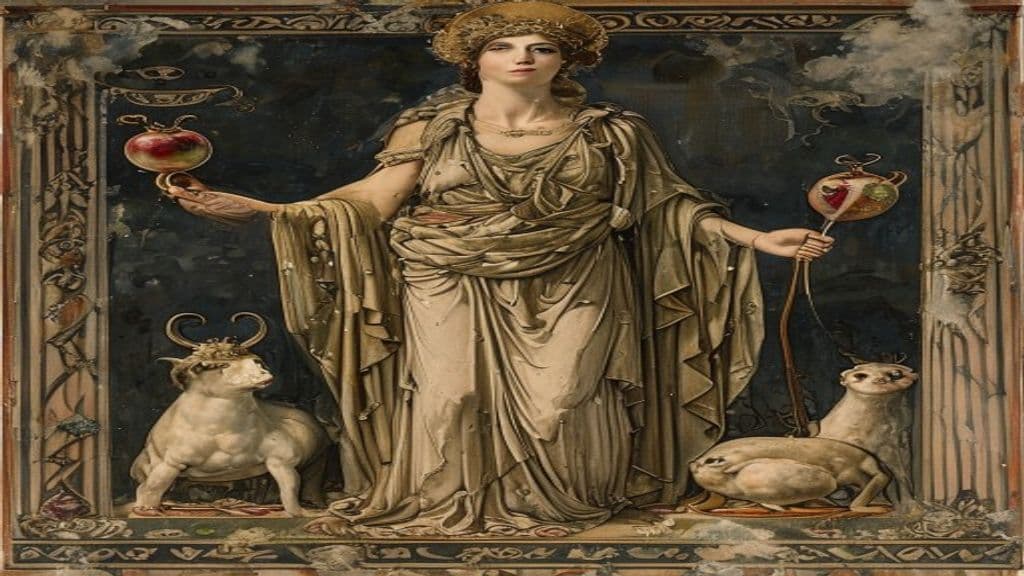
Hera is an ancient Greek goddess, queen of the Olympian gods, and a principal tutelary deity of marriage, women, and family. She functions in myth and cult as protector of lawful marriage and women in childbirth, a civic tutelary figure (notably of Argos), and a sometimes-jealous consort of Zeus with archaic fertility associations in certain local rites.

Amphitryon
Amphitryon is a mortal nobleman of Greek mythic-historical tradition: son of Alcaeus of Tiryns, husband of Alcmene, and the acknowledged stepfather of Heracles. He appears in heroic-age narratives as a warrior, dynastic actor, and the human whose identity is impersonated by Zeus in literary treatments that explore paternity and identity.
Community Record
- [1]Alcmene — Wikipedia. Wikipedia entry 'Alcmene' (summary of classical sources including Homer, Ovid, Pausanias, Hesiod, Apollodorus)wiki
- [2]Wikidata: Alcmene. Wikidata item for Alcmene (cross-reference)other
- [3]Mannycules (archive). Archive.org (modern parody adaptation casting Alcmene; used only for modern reception evidence)other
- [4]Genecules (archive). Archive.org (modern parody adaptation casting Alcmene; used only for modern reception evidence)other
- [5]Pinocchiocules (archive). Archive.org (modern parody adaptation casting Alcmene; used only for modern reception evidence)other
- [6]Pausanias (summary as cited in Wikipedia). Summary of Pausanias' reports concerning an altar to Alcmene at Cynosarges and variants involving Historisliterary
- [7]Ovid, Metamorphoses (summary as cited in Wikipedia). Summary of Ovid's account in which Galanthis announces the birth and is transformed into a weaselliterary
- [8]Homer (summary as cited in Wikipedia). Summary of Homeric account emphasizing Hera's hindrance of Alcmene's delivery so Eurystheus is born firstliterary