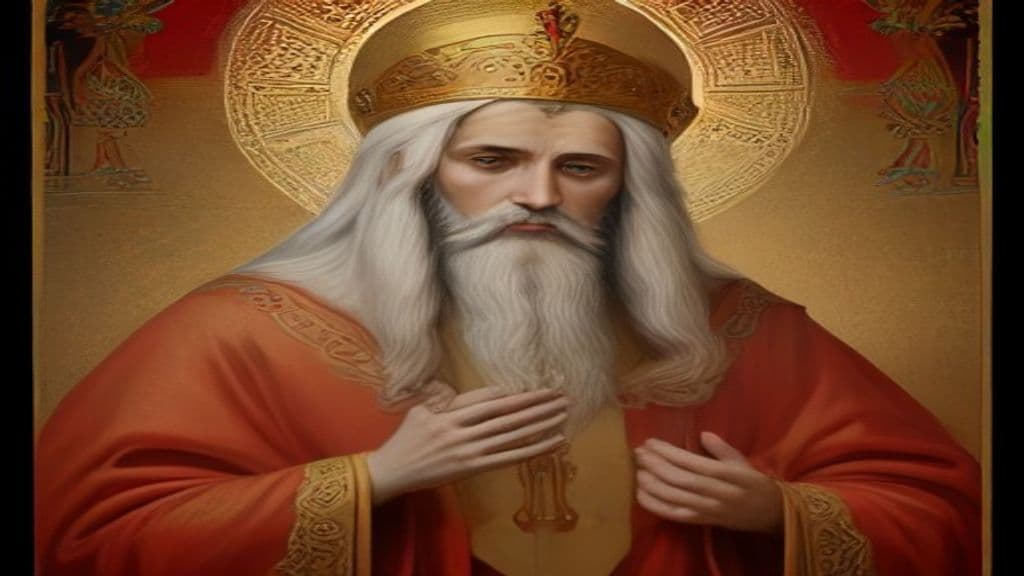
Alexander appears in early Christian sources as a pupil of the Alexandrian Catechetical School under teachers such as Pantaenus and Clement of Alexandria and as a contemporary and friend of Origen. He served as bishop in Cappadocia around 200–212 — recorded as the earliest verifiable bishop of that region in these accounts — and after an earlier imprisonment was later called to Jerusalem to assist the aged Bishop Narcissus, serving as coadjutor and then bishop there. Hagiographical accounts relate that he built a library at Jerusalem, exercised episcopal authority in permitting Origen to speak in churches, endured repeated imprisonments and tortures, and died in custody during the Decian persecution circa 250–251 AD.
Source summaries do not provide a detailed iconographic description; hagiographical wording emphasizes his advanced age and venerable white hair, summarized in the phrase that 'the glory of his white hairs and great sanctity formed a double crown for him in captivity.' No full contemporary physical portrait or standardized iconographic attributes are supplied in the provided materials.
The sources portray Alexander as a learned teacher, ecclesiastical leader, founder/benefactor of a library, and pastor who exercised disciplinary and permissive authority (notably in permitting Origen to speak in churches). Hagiographical narratives credit him with endurance under torture and martyrdom; one traditional motif reports animals in an arena treating him with unusual tameness, presented as a sign of sanctity in the vita. These accounts are presented as hagiographical attestations of holiness rather than descriptions of supernatural powers wielded by Alexander.
Weaknesses
- otherNone recorded in sources (figure is venerated saint, not a hostile entity)
Wards
- otherNo protective wards or anti‑entity rituals recorded in provided sources; commemoration/veneration (feast days) is attested
Anastasia of Sirmium
A Christian martyr venerated in Eastern and Western traditions, traditionally said to have died during the Diocletian persecutions and remembered as a specialist intercessor against poisons and harmful potions (Pharmakolytria). Her cult entered central liturgical usage in Rome and spread to Constantinople, where relic translations and church dedications reinforced her role as healer and deliverer.
Arsenius the Great
Arsenius the Great (c. 350/354–c. 445/450) was a Roman-born imperial tutor who renounced court life to become an anchorite among the Desert Fathers in Egypt. Venerated as a saint in Eastern Orthodox, Coptic, and Roman Catholic traditions, he is remembered for extreme humility, prolonged solitude, silence, copious tears of devotion, and brief monastic writings and sayings preserved in the Apophthegmata Patrum and other collections.
Catherine of Alexandria
A Christian virgin-martyr venerated in Eastern Orthodox, Roman Catholic, Anglican and other Western traditions. Presented in hagiography as a learned princess of Alexandria who debated pagan philosophers, suffered miraculous events during imprisonment and execution, and became the focus of a widespread cult centered on Saint Catherine's Monastery at Sinai and numerous liturgical commemorations and artistic depictions.
Christ Pantocrator
Christ Pantocrator is an iconic Eastern Christian depiction of Jesus emphasizing his sovereignty, judgment, and sustaining rule. It is a visual-theological image used in liturgy and church architecture (domes, apses, iconostasis) rather than a folkloric autonomous being.
Eleazar
Eleazar (Hebrew: אֶלְעָזָר, Eleazar/Elʿazar) is a biblical and historical personal name borne by several individuals in Hebrew tradition; chief among them is Eleazar son of Aaron, who succeeds his father as Israel's high priest and performs custodial and ritual functions in the Exodus, wilderness, and settlement narratives. He is treated as a human priestly office‑holder and is commemorated in some Christian liturgical calendars.
Odigitria (Panagia Odigitria / Hodegetria)
Odigitria is primarily an iconographic epithet and toponym found in Byzantine and modern contexts: a Marian title (Panagia Odigitria / Hodegetria) denoting a specific type of Virgin Mary image regarded as a guide or pointer to Christ, and a place-name applied to churches, monasteries, settlements, and an archaeological Minoan cemetery in southern Crete.
Panagia Agiosoritissa (Maria Advocata)
The Panagia Agiosoritissa, known in Latin as Maria Advocata, is an iconographic type of the Virgin Mary in Byzantine and related Christian devotional art. It depicts the Theotokos alone, shown slightly in three-quarter view with both hands raised in a gesture of prayer or intercession, and functions as an image of Mary the intercessor rather than as an autonomous supernatural being.
Selaphiel
Selaphiel is an archangel venerated in Eastern Orthodox devotional and liturgical imagination as a heavenly intercessor associated with prayer and worship. He is named in Hebrew tradition (Šəʾaltīʾēl, "I have asked God") and appears in iconography as a humble, prayerful figure sometimes holding a thurible.
Alexander Luthor Jr.
A fictional DC Comics character from the multiverse: the son of Earth‑Three Lex Luthor and Lois Lane whose exposure to the Anti‑Monitor's antimatter wave grants him accelerated aging and powers tied to matter/antimatter and reality‑scale engineering. He functions as a survivor, manipulator, and instigator in major crossover storylines (Crisis on Infinite Earths, Infinite Crisis, Blackest Night).
Alexander Peloplaton
Alexander Peloplaton was a 2nd‑century CE Greek rhetorician and Platonist of the Second Sophistic who served as a Greek imperial secretary (ab epistulis) and participated in the era's rhetorical competitions and prestige economy. He is a historical intellectual figure, not a supernatural being.
Alexander the Great (legend)
A pan-cultural legendary hero-king whose historical career was transformed into a body of miraculous and etiological tales (the Alexander Romance). In these traditions he is alternately a divinely sanctioned conqueror, boundary-builder credited with the Gates of Alexander, and a questing culture-hero associated with oracles, votive dedications, and tests of loyalty.
Alexander the Great in Arabic tradition
Legendary figure with divine authority, expanded empire from Greece to northwestern India. (Note: - Power tier: Change Primordial to Ancient (Alexander is a legendary figure with divine authority, but his abilities are not on a cosmic level) - Abilities: Add that Alexander's ability to inspire loy)
Community Record
- [1]Alexander of Jerusalem — Wikipedia. Wikipedia entry 'Alexander of Jerusalem' (summary of hagiographical and historical data, including dates, feast days, and quotations)wiki
- [2]Alexander of Jerusalem — Wikidata. Wikidata item for Alexander of Jerusalem (cataloging identifiers and basic facts)other
- [3]Alexander of Jerusalem — Christian Classics Ethereal Library (author info). CCEL summary page for Alexander of Jerusalem (notes on letters preserved in Eusebius and hagiographical data)other