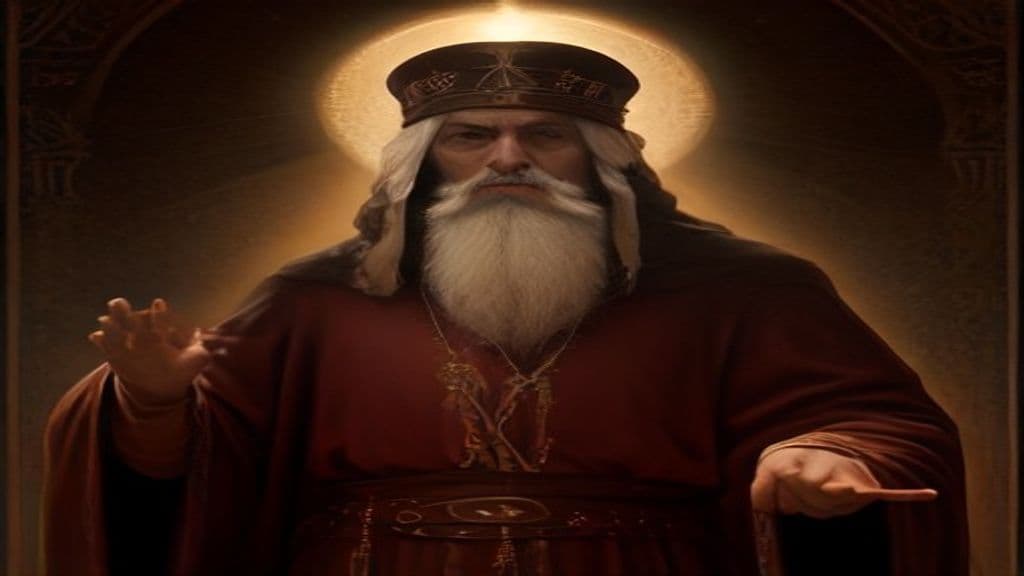
Born into a senatorial Christian family in Rome circa 350–354, Arsenius rose to prominence as tutor to the future emperors Arcadius and Honorius at the imperial court (beginning c. 383). Troubled by worldly honors, he left Constantinople and entered Egyptian monasticism c. 400, presenting himself to Macarius the Great and being tonsured under the direction of John the Dwarf. He lived an anchoritic life in Scetis for some fifty-five years, was forced to leave Scetis around 434 because of Mazices raids, and subsequently relocated to areas such as Tura (near Babylon Fortress/Fustat) and the island of Canopus before dying circa 445–450. His life and sayings were recorded in hagiographical and monastic collections and commemorated liturgically.
Sources emphasize austere, mean clothing and outward humility rather than detailed physical features: he was described as "always the most meanly clad of all" during his fifty-five years of solitude, wore coarse garments and matting, refused luxuries (once eating bread placed on the ground to prove humility), and was noted for copious tears of devotion. Contemporary anecdotes focus on demeanor—silence, stillness, and penitential simplicity—rather than bodily description.
Arsenius is not depicted as a supernatural being; the sources attribute no magical powers. His "abilities" are spiritual and ethical: exemplary ascetic endurance (decades of anchoritic solitude), mastery of silence and contemplative prayer, persistent weeping in devotion, humility under testing, and authority as a teacher through short writings and sayings (e.g., Instructions and Advice; a short commentary on Luke) and inclusion in the Apophthegmata Patrum. He accepted and guided a small number of disciples intermittently (named disciples include Alexander, Zoilus, and Daniel).
Weaknesses
- otherNo supernatural weaknesses recorded; moral struggles noted (former courtly vanities and attachment to worldly life prior to renunciation)
Wards
- otherNone recorded; Arsenius is venerated as a saint and no magical wards or protections against him are described in the sources
Abadiu of Antinoe
Abadiu of Antinoe was a fourth‑century bishop of Antinoe (Antinoopolis, in Roman Egypt) commemorated as a martyr and saint in the Coptic Orthodox Church, with a feast day on 26 December. Sources record that he was killed during a theological dispute with Arian opponents and reference him in collections of Egyptian martyrs.
Abaskhiron the Soldier
A Coptic Orthodox martyr venerated for refusing imperial idolatry during the Diocletian persecution; reputedly healed by the Archangel Michael, preserved in monastery relics, and commemorated on 14 June (7 Paoni).
Abdel Messih El-Makari
Abdel Messih El-Makari (1892–1963) was a Coptic Orthodox monk and priest venerated as a 20th‑century Coptic saint. Associated with the Monastery of Saint Samuel the Confessor and the Monastery of Saint Macarius (Scetes/Wadi El‑Natrun), he is remembered for humility, asceticism, charity, and reported spiritual gifts such as prescience, discerning of spirits, and healing.
Abraham of Scetis
Abraham of Scetis is an early Egyptian desert monk remembered in Coptic Christian tradition as a holy ascetic (a Desert Father). He is venerated as a saint with a feast day on January 4; his cell (Dshabih) later became a local Christian shrine.
Alexander of Jerusalem
A third‑century Christian bishop, teacher, and martyr venerated in Eastern Orthodox, Oriental Orthodox, and Roman Catholic traditions. Trained in Alexandria, served as bishop in Cappadocia circa 200–212, later translated to Jerusalem as coadjutor and then bishop, and died in prison during the Decian persecution (c. 250–251). Remembered for learning, pastoral leadership, a Jerusalem library, and his martyrdom.
Anastasia of Sirmium
A Christian martyr venerated in Eastern and Western traditions, traditionally said to have died during the Diocletian persecutions and remembered as a specialist intercessor against poisons and harmful potions (Pharmakolytria). Her cult entered central liturgical usage in Rome and spread to Constantinople, where relic translations and church dedications reinforced her role as healer and deliverer.
Anba George (Saint George of Assiut)
Anba George is a Coptic Orthodox bishop venerated as a saint and martyr in Coptic hagiographical and liturgical tradition. Associated with Assiut in Upper Egypt and the Monastery of St. George, his life is commemorated in Synaxarium-type records; hagiography recounts his leadership of communal fasting and prayer and his subsequent arrest and martyrdom in the 12th century.
Bashnouna
Bashnouna is a Coptic Christian monk venerated as a saint and martyr in the Coptic Orthodox tradition. According to hagiographical accounts recorded in the Coptic Synaxarion and secondary summaries, he was a monk of the Monastery of Saint Macarius in Scetes, arrested during the Fatimid caliphate of al-'Āḍid, refused to convert to Islam, and was burned alive on 24 Pashons (19 May 1164). His relics are reported buried at the Church of Saint Sergius in Cairo and he is commemorated liturgically on that date.
Bishop Karas (Sorial Ayad Sorial)
Bishop Karas (born Sorial Ayad Sorial, 1955–2002) was a Coptic Orthodox monk, abbot, and the first bishop of the Coptic Orthodox Church in the United States to head its first monastery outside Egypt. He is documented as a historical ecclesiastical figure known for monastic leadership, pastoral care, and ascetic practice.
Catherine of Alexandria
A Christian virgin-martyr venerated in Eastern Orthodox, Roman Catholic, Anglican and other Western traditions. Presented in hagiography as a learned princess of Alexandria who debated pagan philosophers, suffered miraculous events during imprisonment and execution, and became the focus of a widespread cult centered on Saint Catherine's Monastery at Sinai and numerous liturgical commemorations and artistic depictions.
Christ Pantocrator
Christ Pantocrator is an iconic Eastern Christian depiction of Jesus emphasizing his sovereignty, judgment, and sustaining rule. It is a visual-theological image used in liturgy and church architecture (domes, apses, iconostasis) rather than a folkloric autonomous being.
Eleazar
Eleazar (Hebrew: אֶלְעָזָר, Eleazar/Elʿazar) is a biblical and historical personal name borne by several individuals in Hebrew tradition; chief among them is Eleazar son of Aaron, who succeeds his father as Israel's high priest and performs custodial and ritual functions in the Exodus, wilderness, and settlement narratives. He is treated as a human priestly office‑holder and is commemorated in some Christian liturgical calendars.
Community Record
- [1]Arsenius the Great - Wikipedia. Wikipedia: Arsenius the Greatwiki
- [2]Venerable Arsenius the Great - Orthodox Church in America. Orthodox Church in America: Venerable Arsenius the Great (May 8)other
- [3]St. Arsenius the Great - CopticChurch.net. CopticChurch.net: St. Arsenius the Great (13 Pashons)other
- [4]The Romanian Philokalia Volume VII (archive). The Romanian Philokalia, Volume VII (includes material 'From the Life of Saint Arsenius')literary
- [5]Logismoi: 'Flee, Be Silent, Be Still'—St Arsenius the Great. Blog compilation of Arsenius's sayings and life anecdotesother
- [6]Saint Arsenius the Great: Catholic Fire (blog). Catholic devotional summary of Arsenius's lifeother